
Providing water is critical infrastructure for livestock farmers, but finding a system that works isn’t a one-size-fits-all solution.
Steve Sickle, Tom Cunningham and Amadou Thiam discussed several year-round watering systems and calculations required to design a suitable system during a Profitable Pasture webinar hosted by Christine O’Reilly.
WHY IT MATTERS: The closer cattle are to water, the less weight they lose from walking, resulting in higher pasture capacity and increased grazing between watering times.
O’Reilly, an Ontario Ministry of Agriculture, Food and Agribusiness forage and grazing specialist, said a beef stocker needs 67 litres of water daily and will travel up to 250 metres, while a beef cow requires 112 litres and will travel twice that distance. Sheep travel 3,500 metres for 13 litres daily and up to 5,600 metres without affecting production, while dairy cows won’t travel more than 150 metres for the required 130 litres. O’Reilly noted 250 metres is the key distance affecting a pasture’s capacity.
“If any class of cattle had to walk further than that to get to a water source, we saw the carrying capacity of the pasture drop,” she explained. “The location of our water sources is important, but also making sure the water sources can meet the needs of the herd or flock.”
Sickle agreed, saying it’s not obvious how much time cows spend walking to water, but once it’s closer, they aren’t walking off pounds, lessening pasture impact, and not collecting around trough or water supply.
“When they go for a drink now, just one will drink, and the rest are still grazing,” he said.
Distance, herd and tank size affect consumption and pumping requirements and inform pipe diameter to ensure a sufficient flow rate, usually 100 psi to fill the water tank and maintain sufficient storage.
Calculations
Amadou Thiam, an OMAFA senior engineer, built an Excel tool to help farmers calculate and size their watering systems, whether using a pressurized system with a power or solar-powered pump or a low-energy-cost gravity system, to bring water where it’s needed.
For example, if the distance is less than 244 metres, size the tank to provide one-tenth of the need; if it’s farther, make it one-third. Additionally, the duration of stay, four hours or eight hours, is needed to calculate the flow rate; one cow drinks approximately 20 litres per minute. Pencil in elevation loss, required pounds per square inch of pressure and select the appropriate pipe size, avoiding overpressure, to ensure all animals, particularly calves, to access water.
“Rule of thumb is a foot per cow to drink at the same time,” explained Thiam. “Depending on how big that water tank is, you know how many can drink at the same time. Is it only one side or two sides?”
Supply and demands
Sickle, an innovative farmer known for his mobile cow shade, rotationally grazes 25 cows for approximately 10 months a year in Brant County’s north end.
A water line is buried below the fenceline of his permanent pasture, feeding four pastures per spigot, and a steel sleigh-mounted 100-gallon water trough supplies storage pasture-to-pasture.
Sickle uses an old milk tank and pumps water from the pond for cows grazing cover crops and corn stalks. Adding a good cover crop, especially if it includes turnips or corn with snow, reduces water intake.
“I’ve got a motion-sensor, water ball (submersible pump) in the middle of three fields,” he said. The water table is about eight feet below ground due to the culvert from the swamp. “It doesn’t freeze; it drains out the bottom of the trough when the cows walk away.”
Tom Cunningham’s medium-sized rotational and conventional grazing cow-calf operation is smack-dab between Wiarton and Lionshead in the Bruce Peninsula. Early on, he fenced off his natural water sources, creating river crossings in areas with flat escarpment rock to minimize erosion, before adding solar systems and frost-free nose pumps to supply upward of 180 cows per pump.
The system is fed by a 20-foot-deep dug well, with the cows travelling upward of 304 metres to either drink at the crossing or at the nose pump.
“The higher your static water level is, the easier it is to pump,” explained Cunningham, adding even at -30 C, it’s relatively maintenance-free, with water at ground-temperature.
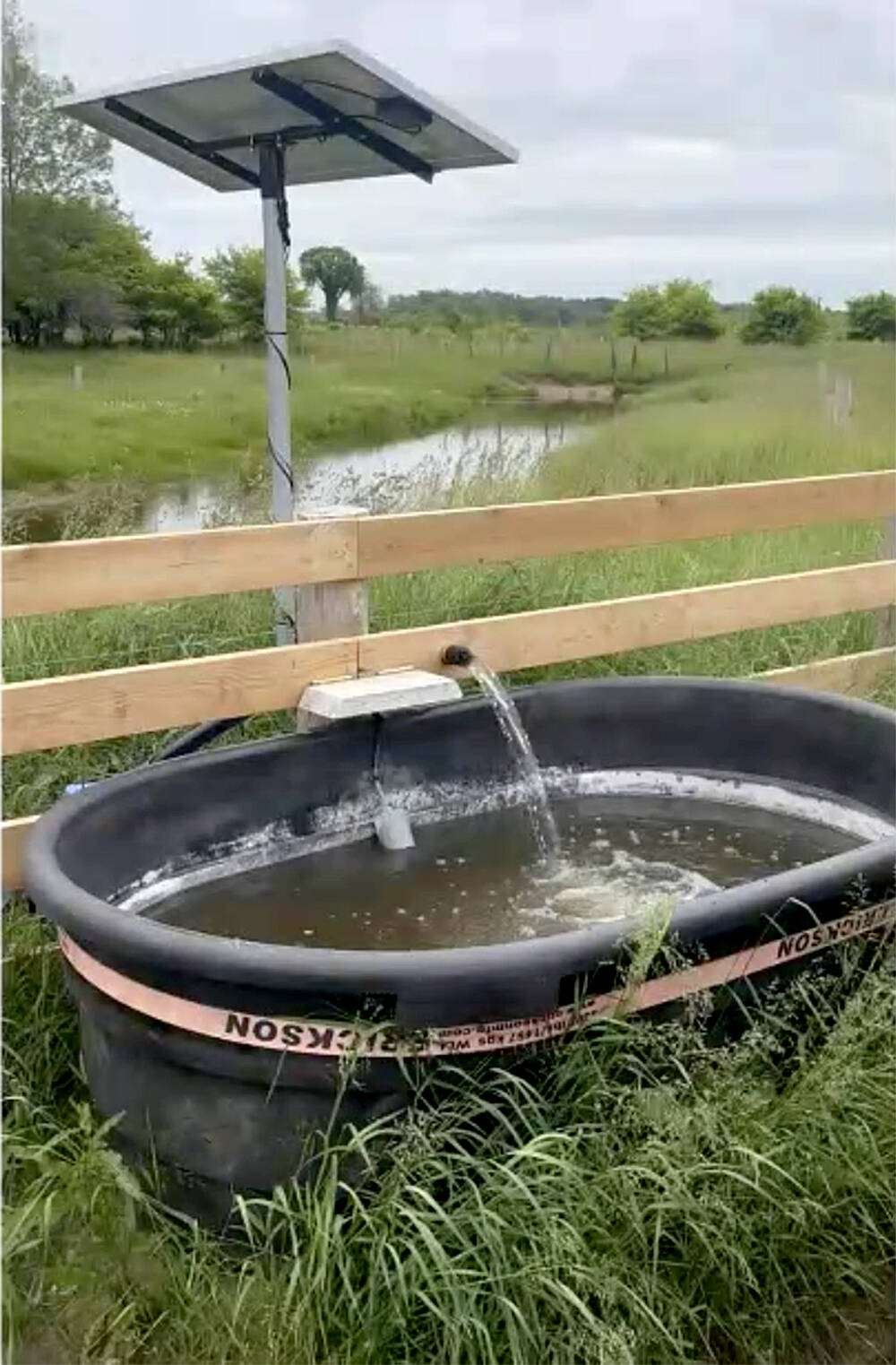
The biggest challenge is training the cows, but once accomplished, they train each other, explained Cunningham, who plugs the drain during training to keep water at the top, and pulls it out during the winter to drain below the frostline.
He estimates his vertical Kellin system costs about $1,400 for the steel hood, pump and other items, adding that if he redid it, he would add multiple pumps to one well to accommodate more cows.
No system is without challenges. Cunningham mentioned nose pumps are not user-friendly for calves under 500 pounds or sheep. Sickle faced solar power issues this winter due to overcast days, noting that in winter, coyotes bite and puncture the hose when the pasture centreline is drained.
Cunningham said the initial cost of remote watering systems may seem high, and while there is some solar system maintenance, the return on investment is quick. He wishes he’d made the investment sooner
“There’s a stigma about the word ‘solar systems,’ and being over-complicated, hard to maintain and expensive to fix, but the technology’s come a long way,” Cunningham stated. “Solar panels are a lot more reliable and cheaper than they used to be, and those bilge pumps that I use are cheap and fairly simple.”
He pointed to a fenced-off pond surrounded by lush green grass and some trees, where he placed two 160-watt solar panels, two 12-volt deep-cycle batteries and a Princess Auto bilge pump floating out in the water to supply 60 pairs. Previously, erosion and desert-like conditions around the pond made it muddy and lifeless; now the water is clear, full of life and thick grass is growing.
“The pond is flourishing,” Cunningham shared. “If anyone’s afraid to fence (cows) out of an area, just do it because the benefits outweigh the cost and the time. It’s just a single strand of wire and a bunch of junk to build it.”
The post Clean water, strong pastures: Producers rethink livestock watering appeared first on Farmtario.


