
Many researchers ask the same question: How do I get my research findings in front of the right audience, in a format they’ll actually use?
The annual ONE-SIM Outreach Award recognizes researchers who have found practical answers for engaging non-academic audiences with their research. The award is a joint initiative of two divisions of the Academy of Management – Organizations and the Natural Environment and Social Issues in Management – in partnership with the Network for Business Sustainability and the Rotterdam School of Management.
In this article, you’ll meet the 2025 award winner and runner-up, and get their advice for making your own outreach more effective. (If you’ve done great outreach work yourself, consider applying for the 2026 award! The deadline is April 30.)
Meet the 2025 award finalists
Award winner: Lee, E. S., Szkudlarek, B., Nguyen, D.C. and Nardon, L. (2020). Unveiling the Canvas Ceiling: A multidisciplinary literature review of refugee employment and workforce integration. International Journal of Management Reviews, 22(2).
- This literature review synthesizes scattered research on refugee employment and workforce integration and introduces the “canvas ceiling” as a systemic, multilevel barrier to refugees’ career advancement. The authors won this award for their wide-reaching outreach strategy, where they tailored their communications materials to reach a range of audiences.
Award runner-up: Karam, C. & Ghanem M. (2021). Multilevel power dynamics shaping employer anti-sexual harassment efforts in Lebanon. Equality, Diversity and Inclusion: An International Journal, 40(4).
- This paper demonstrates how employer efforts to prevent and respond to sexual harassment in Lebanon are shaped by power dynamics at multiple levels, from global pressure and expectations to local attitudes and economic realities. The authors were recognized for leveraging their research to influence policy and for using a range of engagement strategies to reach diverse audiences.
Effective outreach happens at all stages of the research process
Outreach doesn’t have to be something you only do once your research is done. The effectiveness of your outreach can depend on choices you make early in the research process, such as what you study, how you frame the problem, and whom you learn from along the way.
That’s why we’ve split the advice from award finalists into two buckets. The first set focuses on research design choices you can make from the outset, so your work is easier to translate and more likely to resonate with your target audiences later. The second set focuses on outreach tactics you can apply once your research is complete, with findings in hand.
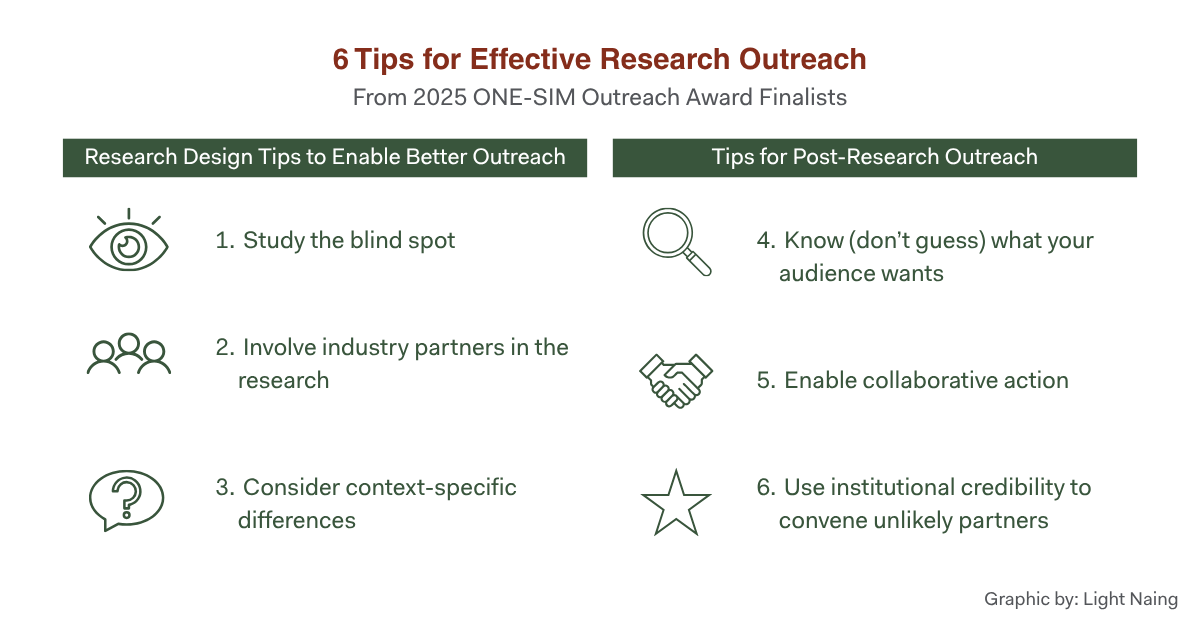
Research Design Tips to Enable Better Outreach
Tip 1: Study the blind spot
A social issue can’t be effectively tackled until it is named and defined. When Eun Su Lee and Betina Szkudlarek noticed that management research wasn’t talking enough about refugees, they decided that it was a critical gap to fill. “[There was] a notable absence of refugee discussion in management, [unlike in] other disciplines like sociology, political science and social work,” said Lee.
Through their research, Lee and Szkudlarek reviewed and synthesized research on refugee employment and workplace integration across multiple disciplines, distilling their findings into a clear concept that could be applied in management: the “canvas ceiling.” By doing so, they provided an agenda for future research and gave practitioners and policymakers a practical way to name (and therefore better address) the systemic barriers refugees face in their quest for employment.
Tip 2: Involve industry partners in the research
If you want your research findings to be picked up by mainstream media, the findings will need to be concrete and actionable. The media wants clear examples of what worked, what didn’t, and why. Szkudlarek believes that one reason their media engagement was so successful was their close collaboration industry during the research process. The scholars worked with the Australian government and large employers, such as IKEA and Woolworths, which gave them insight into workplace realities, and allowed them to give the media specific, relatable examples about the reality of refugees’ working lives.
If you’re trying to communicate findings from a research project that didn’t involve industry collaboration, don’t fret! There are other ways to provide the level of specificity that media often seeks. Consider looking online for case studies that exemplify your findings, or creating fictional examples.
Tip 3: Consider context-specific differences
Solutions to social or environmental issues aren’t ‘one-size-fits-all.’ What works in one place may not work, or may need to be modified, in another. Where possible, consider local context in your research and outreach. You’ll end up with a more nuanced understanding of the issue, and a better chance that your findings will be taken up – and actually work – in practice.
Charlotte Karam and May Ghanem’s work offers a great example. They examined the issue of sexual harassment, specifically within Lebanese workplaces. Global movements, like #MeToo, created shared language and widespread attention around sexual harassment (which is great!). But Karam and Ghanem’s work offered insight on how the ideas from global movements needed to be modified for application in Lebanon.
Global movements are often framed in terms of Western concepts like individual rights, accountability, and formal reporting systems. Lebanese society, however, is shaped by older ideas and institutions. For example, parts of Lebanon’s criminal code were influenced by older French law and still reflect “honour”-based thinking. When Lebanon was developing its 2020 anti-harassment law, stakeholders disagreed on what model to follow. Some leaned towards French law and Sharia-based legal interpretations, others towards international ideas, like the Convention on the Elimination of All Forms of Discrimination against Women (CEDAW) or U.S.-style approaches. In order to understand and inform sexual harassment conversations in Lebanon, the scholars had to understand the local history and thinking that steered these conversations.
Tips for Post-Research Outreach
Tip 4: Know (don’t guess) what your audience wants
As you communicate your findings, it can be tempting to make assumptions about what your audience will find helpful — but these assumptions may send you in the wrong direction. Whenever possible, get really clear on who you’re targeting, what they need, and which format or language will resonate. Let this shape your outputs.
Both of this year’s award nominees used this tactic, though they took different approaches.
As Lee and Szkudlarek shared their findings about refugees in the workforce, they directly asked stakeholders what they would find useful. They spoke with policymakers, employers, and educators to understand their needs and designed resources with a clear end user in mind, including:
-
An employer’s guide written specifically for employers.
-
Videos intended for educators.
-
Explainer videos intended for the general public.
That specificity paid off – for example, organizations began using the videos in their human resources training to advance refugee inclusion.
Karam and Ghanem took a different approach to understanding stakeholder needs. They analyzed a large set of transcripts from a conference they held with academics, policymakers, lawyers, employers, journalists, and grassroots feminist activists. This helped them identify people’s needs, frustrations, and assumptions, which varied significantly between groups.
This, in turn, informed their outreach strategy. Instead of walking into conversations with a generic message, they tailored their findings based on who they were engaging with. For example, moral framing often resonated with community and faith-based groups; crime framing with legal and policy audiences; discrimination framing with employers and HR; and human-rights framing with NGOs and advocates.
Tip 5: Enable collaborative action
To change practice with your research, you may have to go beyond educating people. Sustainability issues are often complex, and solutions require multi-stakeholder collaboration. If you’re able, consider how you might enable that collaboration. Karam and Ghanem took up this challenge, both within their research and the outreach that followed.
To achieve stronger anti-sexual harassment protections, they brought together many stakeholders with important roles to play, including business schools, feminist activists, and policymakers. As they enabled collaboration between these groups, they encountered several major challenges – and learned how to navigate them.
First, some stakeholders didn’t believe that sexual harassment was a serious workplace issue in Lebanon. For example, when an anti–sexual harassment bill was introduced in parliament, some policymakers reportedly dismissed it as unnecessary, suggesting the legislator must be “bored” to draft such a law. The researchers learned how to use different language types and evidence to help different audiences see the importance of the issue.
Second, Karam and Ghanem learned that building trust and buy-in takes time. They were advancing feminist work in a business school, where their work was sometimes dismissed as “not belonging” in business. They were also engaging with feminist activists who were wary of business schools, seeing them as part of a problematic system. Many people had also invested considerable effort in their own anti-harassment work, and were hesitant to let those go of what they had built. For example, before Lebanon’s 2020 consolidated anti-sexual harassment law, at least six separate draft laws had been created.
To build trust and collaborative spirit, the researchers emphasized that the goal was not to replace earlier efforts, but to learn from and build on them. They also emphasized that people didn’t need to agree on everything. “We learned that you can still have multiple conversations, you can still bring people to the table, and not everybody has to agree,” said Ghanem. “What everyone needs, though, is a shared North Star.” So, Karam and Ghanem helped their partners focus on their shared goal of protecting women from sexual harassment.
Tip 6: Use institutional credibility to convene unlikely partners
When your outreach depends on bringing together groups that don’t typically engage with one another, your institutional “home base” can be a major asset. A trusted institution can provide credibility, visibility, and a neutral setting that makes participation feel safer and more legitimate, especially in sensitive or polarized discussions.
In Karam and Ghanem’s case, being based at the American University of Beirut (AUB) helped them convene stakeholders who might not otherwise sit at the same table. As Karam explains, “Because of [AUB], we were able to use that position to bring together different entities that otherwise wouldn’t sit together, like grassroots feminist activists and national gender machineries from the government.”
If your university doesn’t already have legitimacy with your target audience, find a partner with similar convening power—such as a professional association, respected NGO, community foundation, or neutral public institution. The right institutional reputation can lend legitimacy, enable conversations, and help bridge divides.
About the ONE-SIM Outreach Award
The ONE-SIM Outreach Award is sponsored by the Academy of Management’s Organizations and the Natural Environment (ONE) and Social Issues in Management (SIM) Divisions, with support from the Network for Business Sustainability and Rotterdam School of Management. Hear tips from 2024, 2023, and 2022 award finalists.
If you (or someone you know) has prioritized outreach, consider applying for this year’s award! The deadline is April 30. Learn more and apply.
The post 6 Tips for Effective Research Outreach appeared first on Network for Business Sustainability (NBS).


