
There’s a deeply held belief in modern agriculture that more fertilizer equals more yield, and more yield equals more profit. It sounds reasonable on the surface. But when you sharpen your pencil and run the numbers, the math often tells a very different story. For many farmers, a significant chunk of their fertilizer bill is doing nothing more than padding someone else’s bottom line.
I’ve spent the last several years digging into this topic. The more I look at the data, the more convinced I become that our approach to fertility has been fundamentally flawed — not because farmers are doing anything wrong, but because the system they’ve been told to follow doesn’t reflect how soil actually works.
The Problem with Conventional Soil Tests
Let’s start with the tool that drives most fertility recommendations: the standard (conventional) soil test. These tests typically use extractants like hydrochloric acid, ammonium acetate, ammonium fluoride, and EDTA that do not naturally form in soil and are not excreted by plant roots. They dissolve forms of nutrients like calcium phosphate and aluminum phosphate that are not considered plant-available under normal field conditions. In other words, these tests tell you how much of a nutrient can be pulled out of soil with acid in a lab setting. They do not tell you how much your crop can access during the growing season.
That’s a critical distinction. Plant uptake of nutrients should be driven almost entirely by biological activity — mycorrhizal fungi extending from root systems, bacteria solubilizing minerals, and the rhizophagy cycle, in which plants actively cultivate and ingest microbes to meet their nutritional needs. These processes are what make nutrients available to your crop in a healthy soil. A conventional soil test doesn’t measure any of that. If these biological processes are not happening in your field, you have a completely dysfunctional soil that needs an intervention. Think of these dysfunctional soils as “drug addicts” that need their next fertilizer fix to produce a crop.
The proof is in the data. Studies show that only 20 – 40% of fertilizer nitrogen is taken up by the crop in the year it was applied, depending on the timing, rate, form, and method of N application. For phosphorus it’s even worse. A recent global meta-analysis from 274 different studies showed that on average only 12.6% of applied P was taken up by plants in the year it was applied. And within the small fraction of fertilizer that is taken up by the crop, most of it cycles through a microbe before it gets there. The rest becomes tied up in the soil or lost.
The Real Driver: Soil Aggregation and Oxygen
If biology is the engine that drives nutrient uptake, then soil aggregation is the rest of the vehicle. It’s what allows soil to function as a complete system. Aggregation — the crumbly “chocolate cake” structure you see in healthy soil — allows for good gas exchange, water infiltration, and microbial activity. Compacted soil that cannot breathe will have sluggish residue breakdown, poor nutrient cycling, and low nutrient availability regardless of what a soil test says. As I discussed in this 5-part blog series, the conventional model of soil function is obsolete. We cannot use simple formulas based on flawed tests to determine nutrient application rates and expect profitable results.
The photo below tells this story better than I can. These two samples were taken just three feet apart. Where living roots were present, the soil had excellent aggregation — crumbly, porous, full of life. Where roots were absent, the soil was compacted, blocky, and structureless. Same field, same soil type, same day. The only difference was the presence of a living root.
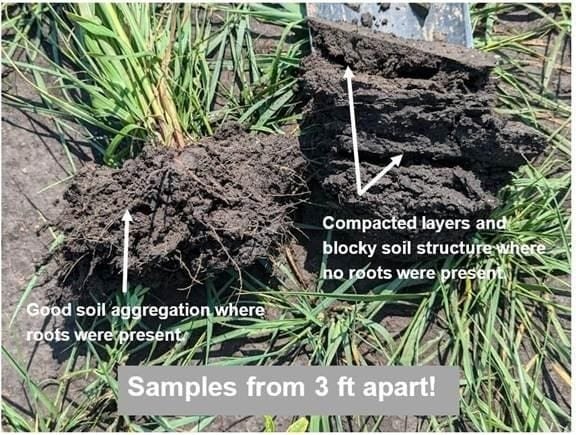
This is why the solution to improving nutrient uptake and profit is not adding more fertilizer. It’s improving soil aggregation and oxygen levels. Fix the habitat and let biology do the work for you. Try to force-feed a crop in compacted, oxygen-starved soil, and you are throwing money at a problem that fertilizer cannot solve.
The Nitrogen Trap
Let’s talk nitrogen, because this is where the fertilizer fallacy hits hardest. The economics of applying N to a crop follow a logarithmic curve. The first pounds of N give you the biggest bang for your buck. As you add more, the return diminishes until eventually one dollar spent on N produces one dollar of additional yield. That’s the “Maximum Return to Nitrogen” rate, or MRTN.
But here’s the thing most people miss: spending one dollar to get one dollar back is zero return, not maximum return. Maximum return comes from the first pound of N you apply. Per unit profitability declines from there.
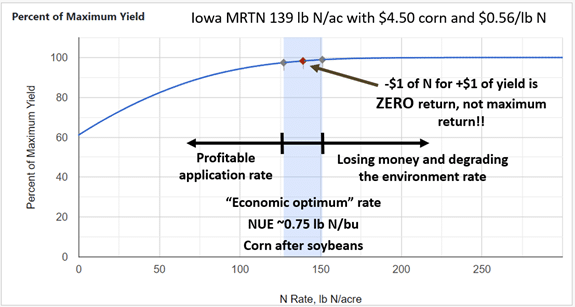
As I covered in Part 3: Chasing Yields, Losing Efficiency and Profits, the Corn Nitrogen Rate Calculator shows an MRTN of about 139 lb N/acre for corn after soybeans in Iowa at $4.50/bu corn and $0.56/lb N. But when you account for harvest, trucking, drying, and storage costs for those marginal bushels, the zero return to N rate is roughly 10 lb/ac less than the MRTN. That extra N you’re applying “just in case” is rarely profitable. And it’s almost certainly degrading your soil biology and water quality in the process.
Until you know what your soil can produce with zero applied N, you cannot know how much you need to apply to optimize profit. That’s why zero-N check strips are so important. Check strips often yield 50 – 80% of full yield with no nitrogen applied. How? There is already a large pool of nitrogen available in your field. Your job is to manage soil so your crop can tap into this pool without degrading it. The question isn’t “How much N should I apply?” It’s “How do I manage my soil so it needs less?”
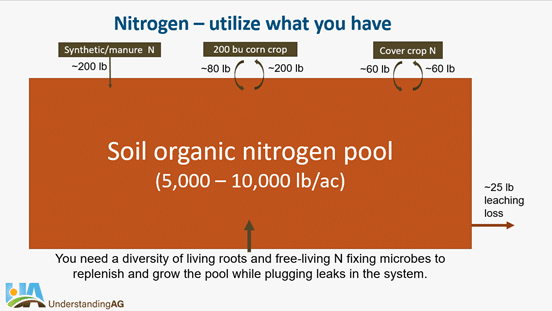
Think about the graphic above. A typical recommendation is to apply roughly 1 to 1.2 pounds of N per bushel of expected yield. A 200-bushel corn crop will take up around 200 lb of N to complete its growth. Some of that is removed during grain harvest, but 60 to 80 lb of N is returned to the field via crop residue. If you applied 200 lb of N, but only 130 was removed from the field, where did the other 70 lb of N go? There are several possibilities. It may have been lost through leaching, volatilization, or denitrification. Where you want it to go is back into the soil organic nitrogen pool where it can be held until next year. The way to accomplish this is with diverse living roots in the off season to capture and hold additional nitrogen and well aggregated soils that allow for N fixation by legumes and free-living soil microbes. When viewed as a system, adding readily available nitrogen fertilizer is like peeing in a swimming pool. It feels good, but it doesn’t add much to the pool, and the public would be happier if we’d quit doing it!
The Removal Rate Racket
Nitrogen gets most of the attention, but phosphorus and potassium deserve a hard look too. Let’s run through a quick example using real numbers.
Let’s say your conventional soil tests come back in the “Medium” or “Optimum” range for phosphorus. A typical recommendation for growing 200 bu/ac corn would suggest applying a “removal rate” of around 75 lb P₂O₅. Using MAP (11-52-0) at price of $850/ton and giving credit for the 11% N it contains at $0.53/lb, the cost for P₂O₅ from MAP works out to about $53/acre for the phosphorus.
Now let’s look at potassium. For the same 200 bu/ac corn your “Optimum” K test soils have a removal rate of about 50 lb of K₂O. For potash (0-0-60) priced at $480/ton, that’s roughly $0.40/lb for K₂O, adding another $20/acre. Total for P & K in this scenario is $73/acre not counting application cost.
In both cases, the conventional test results say there is a “slight probability” of a yield response on medium or optimum testing soils. At $4.50/bu corn, you’d need 11.8 extra bushels to pay for the P and 4.4 bushels to cover the K. That’s over 16 bushels per acre just to break even on P and K fertilizer. A slight probability of a yield response means an even slighter probability of a profitable yield response after accounting for the cost. And those probability numbers come from mostly conventionally managed research plots. The likelihood of an economic return in a healthy soil with good biological function would be even lower.
Iowa State University research confirms this. Their data shows that only soils with test results in the “Very Low” or “Low” category provide a reliable yield response to P or K applications. The probability of getting any yield response to P application on soils in the medium or optimum category is only 20% and it drops to just 5% in the “high” category. Look at it a different way. You spent $73/acre for an 80% chance of getting zero or negative yield response. Those are darn good odds – for someone else. In gambling terms, the house always wins. Yet standard industry practice among agronomists and universities (the same universities that publish this data) is to still recommend “removal rate” application of P and K on fields with adequate fertility. Tell them there is an 80% chance you won’t pay your fertilizer bill and see if they still think it’s a good idea.
Now you may be thinking that if you don’t apply fertilizer at removal rates you will “mine your soil” and be accused of being a bad farmer. I’ll address those concerns in a future article.
The Real Solution
Here’s the bottom line: biology, not fertilizer, is the “right source” of soil fertility. In a functioning soil, plants acquire nutrients through interactions with microbes. Overapplication of soluble fertilizers suppresses these biological pathways, increases nutrient losses, and drives up input costs. It’s a treadmill that keeps speeding up the more you try to outrun it.
The way off the treadmill is to focus on the fundamentals: build soil aggregation by maintaining living roots, reduce physical and chemical disturbance, armor your soil, add diversity, and incorporate livestock if possible. Let biology — not the fertilizer truck — feed your plants. Your job is to feed the biology with carbon.
I’m not saying you should stop fertilizing. But I am saying it’s time to sharpen your pencil, run some on-farm trials with reduced and zero-rate check strips, and ask yourself whether every dollar you’re spending on fertilizer is coming back to you with interest. For a lot of farms, the answer is no. The path to more profit isn’t spending more on inputs with no economic return — it’s investing in a biological system that allows your soil to work with you rather than against you.
If your soil needs an intervention, reach out to an Understanding Ag consultant today.

The post The Fertilizer Fallacy: Pushing Yields Up and Profits Down appeared first on Understanding Ag.


