Ranked: Wages by Country and Growth Since 2010
See visuals like this from many other data creators on our Voronoi app. Download it for free on iOS or Android and discover incredible data-driven charts from a variety of trusted sources.
Key Takeaways
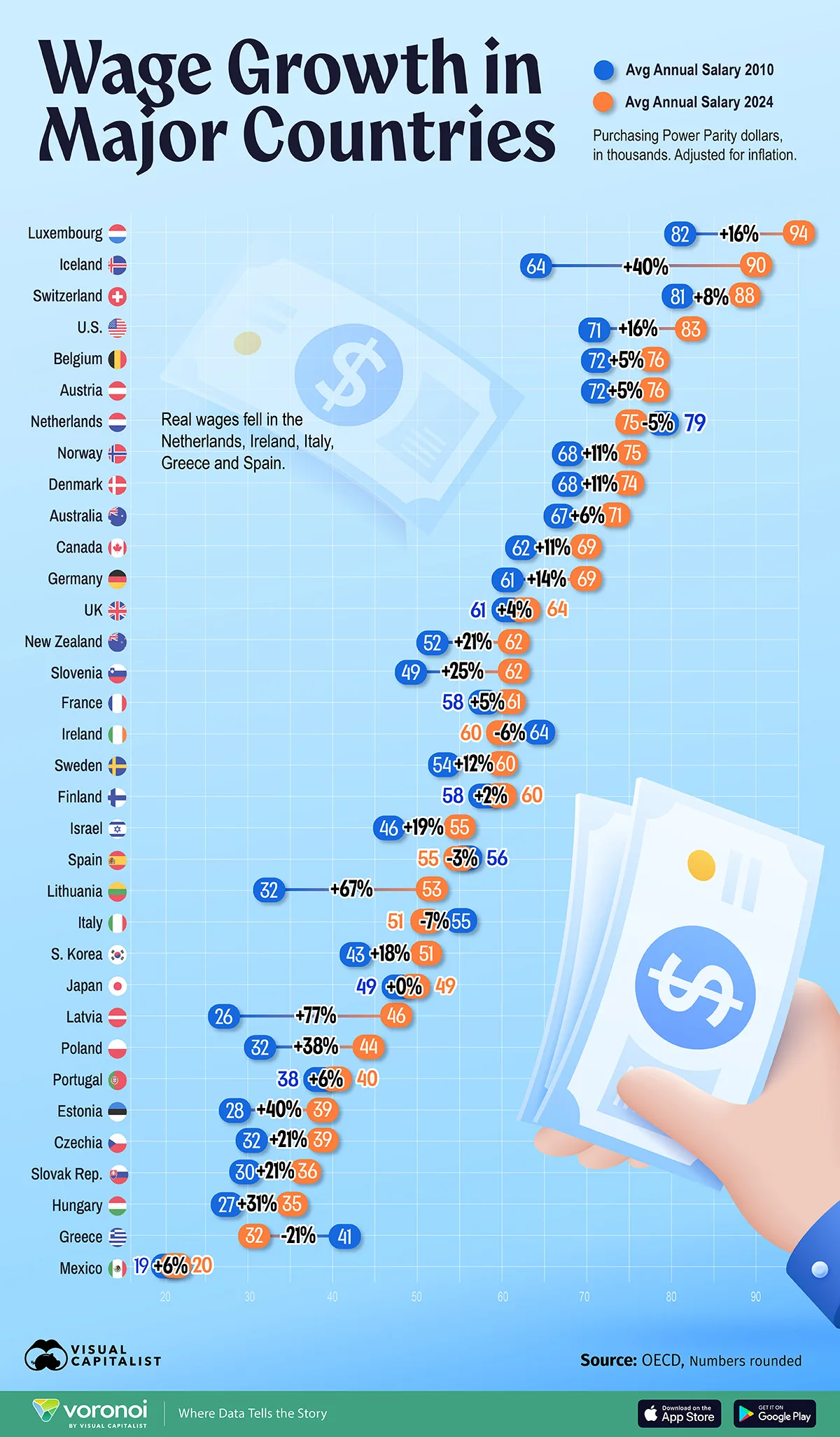
- Real wage growth in the OECD ranges from +77% in Latvia to -21% in Greece since 2010.
- Eastern European countries dominate the fastest growth rates, many posting gains above 30%.
- Several advanced economies—including Italy, Ireland, and the Netherlands—saw real wages decline despite high income levels.
Since 2010, real wage growth has varied widely—even among the world’s highest-income economies.
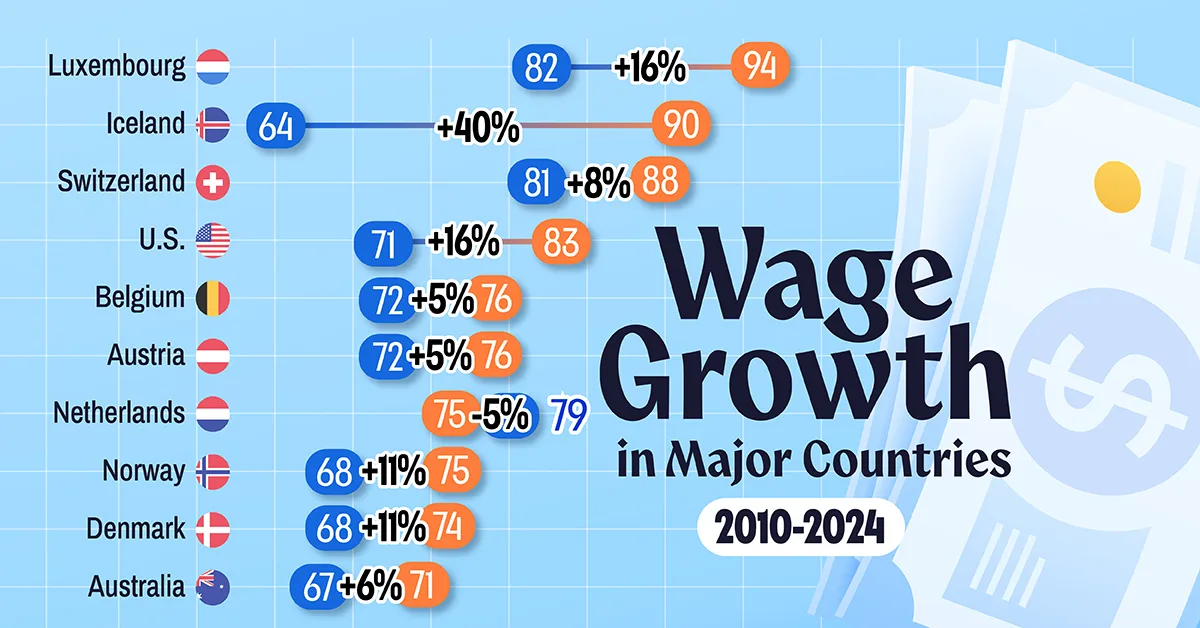
Based on OECD data and adjusted for purchasing power, this graphic compares average annual wages in 2024 alongside their real growth since 2010.
The gap is striking: Latvia’s wages have risen 77%, while Greece’s have fallen 21%, highlighting a wide divergence in how workers have benefited from economic growth.
Top Earners vs. Fastest Growers
Higher-income countries have generally posted slower wage gains since 2010.
Luxembourg leads with average annual wages of $94.4K, up 16% since 2010. Iceland follows at roughly $90K, but stands out for its much stronger 40% increase, well above the OECD average.
The table below compares average annual wages in 2010 and 2024, along with real growth over the period using purchasing power parity adjustments.
| Country | Annual Salaries 2024, PPP inflation-adjusted |
Annual Salaries 2010, PPP inflation-adjusted |
Change 2010-2024 |
|---|---|---|---|
 Luxembourg Luxembourg |
$94.4K | $81.7K | 15.5% |
 Iceland Iceland |
$89.9K | $64.1K | 40.4% |
 Switzerland Switzerland |
$87.5K | $80.8K | 8.2% |
 United States United States |
$82.9K | $71.4K | 16.1% |
 Belgium Belgium |
$76.1K | $72.3K | 5.3% |
 Austria Austria |
$75.8K | $72.1K | 5.1% |
 Netherlands Netherlands |
$75.4K | $79.4K | -5.1% |
 Norway Norway |
$74.9K | $67.5K | 11.0% |
 Denmark Denmark |
$74.0K | $67.5K | 9.7% |
 Australia Australia |
$70.7K | $66.7K | 6.0% |
 Germany Germany |
$69.4K | $61.2K | 13.5% |
 Canada Canada |
$69.4K | $62.4K | 11.2% |
 United Kingdom United Kingdom |
$63.7K | $61.2K | 4.0% |
 New Zealand New Zealand |
$62.4K | $51.7K | 20.7% |
 Slovenia Slovenia |
$61.8K | $49.3K | 25.4% |
 France France |
$60.6K | $57.9K | 4.7% |
 Sweden Sweden |
$60.4K | $53.8K | 12.3% |
 Ireland Ireland |
$60.4K | $64.3K | -6.1% |
 Finland Finland |
$59.6K | $58.4K | 2.1% |
 Israel Israel |
$54.7K | $46.1K | 18.9% |
 Spain Spain |
$54.6K | $56.1K | -2.8% |
 Lithuania Lithuania |
$52.9K | $31.8K | 66.6% |
 Italy Italy |
$51.0K | $54.9K | -7.1% |
 Korea Korea |
$50.9K | $43.0K | 18.4% |
 Japan Japan |
$49.4K | $49.4K | 0.1% |
 Latvia Latvia |
$45.6K | $25.8K | 76.8% |
 Poland Poland |
$44.2K | $32.1K | 37.9% |
 Portugal Portugal |
$40.0K | $37.8K | 5.9% |
 Estonia Estonia |
$39.0K | $27.8K | 40.1% |
 Czechia Czechia |
$38.5K | $31.7K | 21.4% |
 Slovak Rep. Slovak Rep. |
$36.1K | $29.9K | 20.7% |
 Hungary Hungary |
$35.0K | $26.8K | 30.6% |
 Greece Greece |
$32.3K | $40.9K | -21.2% |
 Mexico Mexico |
$20.4K | $19.3K | 5.7% |
 OECD OECD |
$61.1K | $55.1K | 11.0% |
The United States ranks fourth at $82.9K, with wages rising 16% over the period. While this exceeds growth in countries like Germany and Canada, it still trails several faster-growing European economies.
Overall, the pattern is clear: higher-income countries tend to see slower wage growth, while lower-income economies are catching up more quickly.
Eastern Europe Is Catching Up Fast
Eastern Europe stands out as the fastest-growing region for real wages since 2010.
Latvia (+77%) and Lithuania (+67%) lead the OECD, with Poland (+38%) and Hungary (+31%) also posting strong gains.
While absolute wages remain lower than in Western Europe, the pace of growth points to meaningful convergence, supported by rising productivity and a shift toward more value-added industries.
Where Real Wages Declined
Not all countries have shared in this growth.
Greece (-21%) saw the steepest drop in real wages, followed by Italy (-7%), Ireland (-6%), the Netherlands (-5%), and Spain (-3%).
In Southern Europe, these declines reflect the long-lasting effects of the Eurozone debt crisis and uneven recoveries. Ireland presents a different case, where strong GDP growth has not translated into rising real wages for workers.
A Growing Divide in Wage Growth
The data highlights a widening gap between countries where wages are rising quickly and those where they are stagnating or falling.
Much of this divide reflects differences in economic structure, productivity growth, and recovery paths after major shocks.
As a result, where you live continues to play a major role in whether your wages are actually increasing in real terms.
Learn More on the Voronoi App 
To learn more about this topic, check out this graphic on average salaries by state in 2025.
- Source: https://www.visualcapitalist.com/which-countries-saw-the-fastest-real-wage-growth-since-2010/