Mapped: Only One Country Can Feed Itself Fully
See visuals like this from many other data creators on our Voronoi app. Download it for free on iOS or Android and discover incredible data-driven charts from a variety of trusted sources.
Key Takeaways
- Only one country—Guyana—can produce all seven essential food groups domestically.
- Most countries, including the U.S. and China, fall short in at least one category.
- Wealth doesn’t guarantee food independence, with many rich nations relying on imports.
Food security isn’t just about producing enough calories—it’s about covering the full range of nutrients needed for a balanced diet.
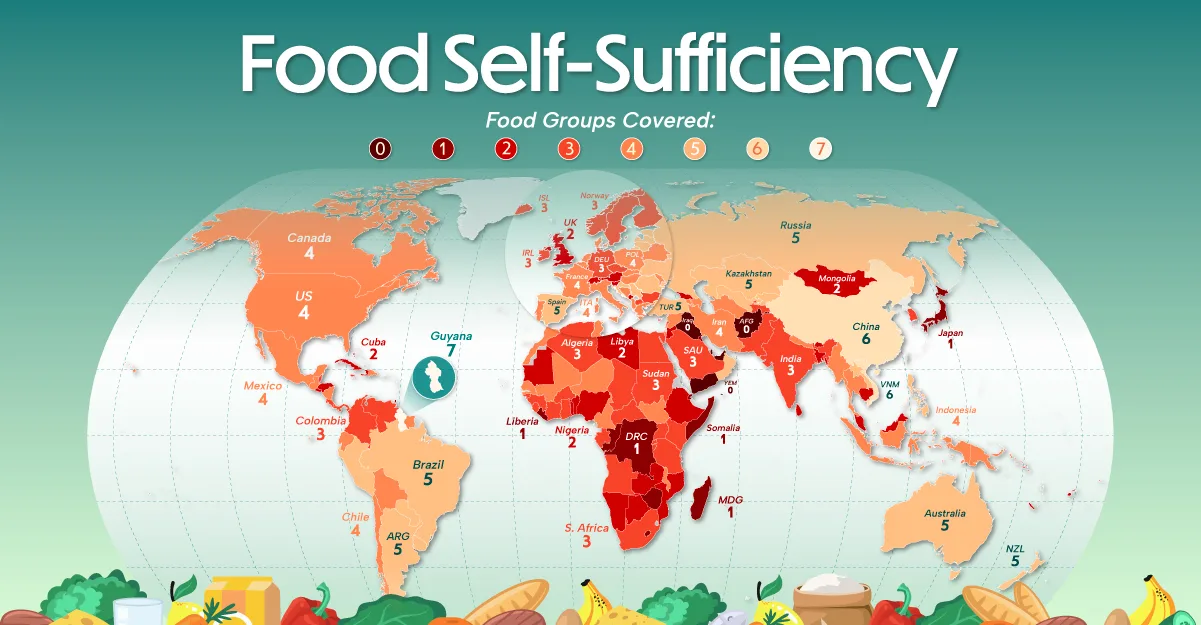
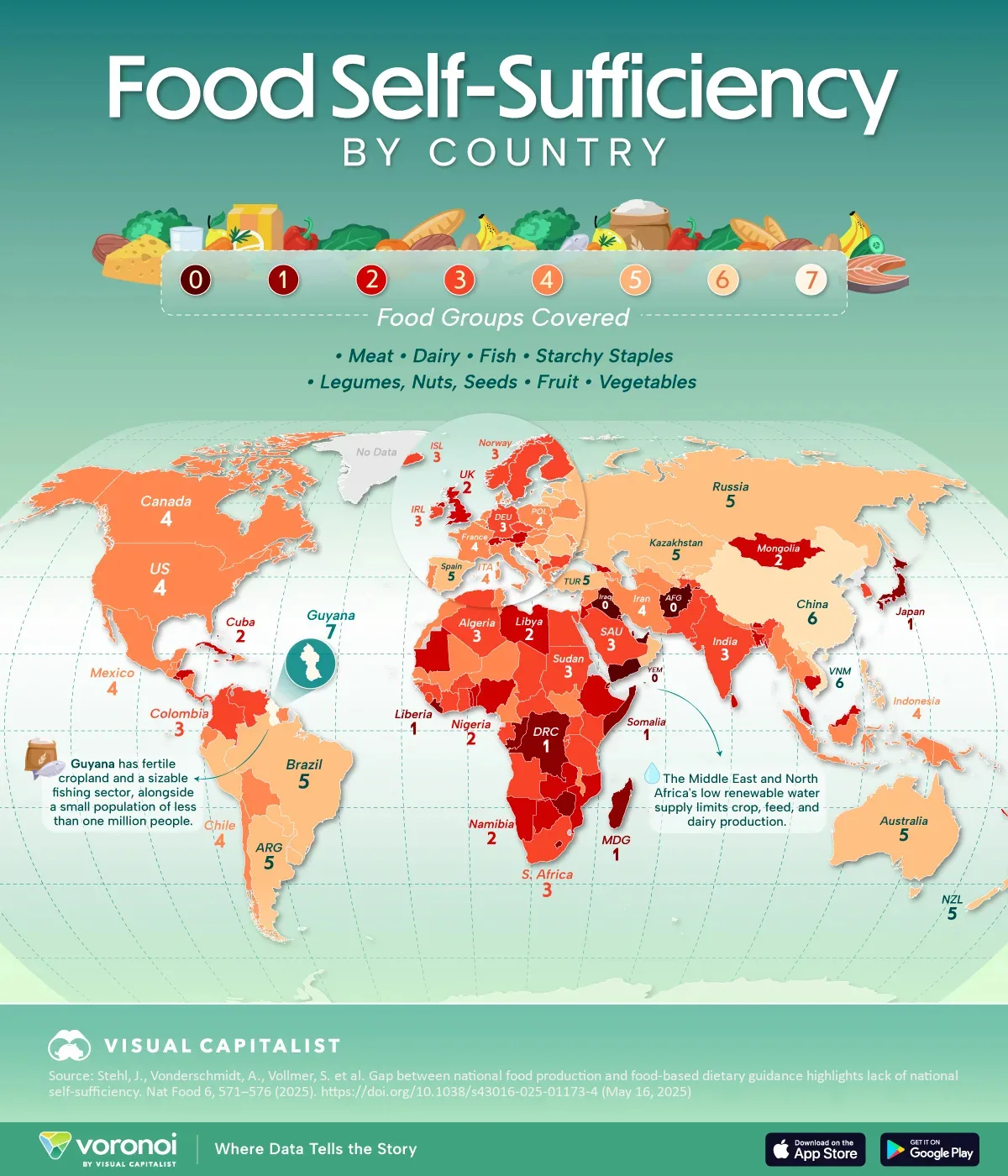
This map shows how many of seven essential food groups each country can supply domestically, based on data from a Nature Food study. The result reveals a striking gap: just one country can meet all its food needs on its own.
The analysis covers key categories including starchy staples, fruits, vegetables, dairy, meat, fish, and legumes—offering a more complete picture of national food independence. Even major agricultural producers like the United States and China still depend on imports for at least one of these groups.
Only One Country Covers All Food Groups
Guyana is the only country that can produce enough of all seven essential food groups to meet domestic demand. It not only covers every category, but exceeds needs in starchy staples and fruit—making it a clear global outlier in food independence.
China and Vietnam come close, each covering six out of seven groups. However, both fall short in dairy production, reflecting structural constraints in key sectors. Even top performers still rely on imports for at least one essential category.
| Country | Self-Sufficient Food Groups (of 7) |
|---|---|
 Guyana Guyana |
7 |
 China China |
6 |
 Vietnam Vietnam |
6 |
 Paraguay Paraguay |
5 |
 New Zealand New Zealand |
5 |
 Uruguay Uruguay |
5 |
 Vanuatu Vanuatu |
5 |
 Argentina Argentina |
5 |
 Brazil Brazil |
5 |
 Lithuania Lithuania |
5 |
 Estonia Estonia |
5 |
 Australia Australia |
5 |
 Latvia Latvia |
5 |
 Spain Spain |
5 |
 Serbia Serbia |
5 |
 Kazakhstan Kazakhstan |
5 |
 Croatia Croatia |
5 |
 Ukraine Ukraine |
5 |
 Peru Peru |
5 |
 Türkiye Türkiye |
5 |
 Romania Romania |
5 |
 Uzbekistan Uzbekistan |
5 |
 Russia Russia |
5 |
 Lao PDR Lao PDR |
5 |
 Kyrgyzstan Kyrgyzstan |
5 |
 Oman Oman |
5 |
 Philippines Philippines |
5 |
 Canada Canada |
4 |
 Denmark Denmark |
4 |
 United States United States |
4 |
 Belarus Belarus |
4 |
 Netherlands Netherlands |
4 |
 Poland Poland |
4 |
 Chile Chile |
4 |
 Belgium Belgium |
4 |
 Moldova Moldova |
4 |
 France France |
4 |
 Hungary Hungary |
4 |
 Papua New Guinea Papua New Guinea |
4 |
 Myanmar Myanmar |
4 |
 Ecuador Ecuador |
4 |
 Dominican Republic Dominican Republic |
4 |
 Senegal Senegal |
4 |
 Greece Greece |
4 |
 Albania Albania |
4 |
 Nicaragua Nicaragua |
4 |
 Portugal Portugal |
4 |
 Niger Niger |
4 |
 Italy Italy |
4 |
 Israel Israel |
4 |
 Cameroon Cameroon |
4 |
 Malawi Malawi |
4 |
 Bolivia Bolivia |
4 |
 Armenia Armenia |
4 |
 Mexico Mexico |
4 |
 Thailand Thailand |
4 |
 Mali Mali |
4 |
 Azerbaijan Azerbaijan |
4 |
 Slovakia Slovakia |
4 |
 Tunisia Tunisia |
4 |
 South Sudan South Sudan |
4 |
 Guatemala Guatemala |
4 |
 Iran Iran |
4 |
 Turkmenistan Turkmenistan |
4 |
 Tonga Tonga |
4 |
 Bosnia and Herzegovina Bosnia and Herzegovina |
4 |
 Indonesia Indonesia |
4 |
 Morocco Morocco |
4 |
 Nepal Nepal |
4 |
 Syrian Arab Republic Syrian Arab Republic |
4 |
 Suriname Suriname |
4 |
 Iceland Iceland |
3 |
 Tuvalu Tuvalu |
3 |
 Ireland Ireland |
3 |
 Norway Norway |
3 |
 Costa Rica Costa Rica |
3 |
 Samoa Samoa |
3 |
 Central African Republic Central African Republic |
3 |
 Belize Belize |
3 |
 Finland Finland |
3 |
 Guinea-Bissau Guinea-Bissau |
3 |
 Burkina Faso Burkina Faso |
3 |
 Germany Germany |
3 |
 Sudan Sudan |
3 |
 Dominica Dominica |
3 |
 Czechia Czechia |
3 |
 North Macedonia North Macedonia |
3 |
 Guinea Guinea |
3 |
 Ghana Ghana |
3 |
 Panama Panama |
3 |
 Tanzania Tanzania |
3 |
 Sweden Sweden |
3 |
 Colombia Colombia |
3 |
 Chad Chad |
3 |
 Uganda Uganda |
3 |
 Rwanda Rwanda |
3 |
 India India |
3 |
 Bulgaria Bulgaria |
3 |
 South Africa South Africa |
3 |
 Côte d’Ivoire Côte d’Ivoire |
3 |
 Cyprus Cyprus |
3 |
 Tajikistan Tajikistan |
3 |
 Solomon Islands Solomon Islands |
3 |
 South Korea South Korea |
3 |
 Jamaica Jamaica |
3 |
 Egypt Egypt |
3 |
 Lebanon Lebanon |
3 |
 Burundi Burundi |
3 |
 Kenya Kenya |
3 |
 Angola Angola |
3 |
 Pakistan Pakistan |
3 |
 Algeria Algeria |
3 |
 Venezuela Venezuela |
3 |
 Gabon Gabon |
3 |
 Sierra Leone Sierra Leone |
3 |
 Saudi Arabia Saudi Arabia |
3 |
 Kiribati Kiribati |
2 |
 Micronesia Micronesia |
2 |
 Seychelles Seychelles |
2 |
 Mongolia Mongolia |
2 |
 Luxembourg Luxembourg |
2 |
 Austria Austria |
2 |
 Comoros Comoros |
2 |
 Namibia Namibia |
2 |
 Mauritania Mauritania |
2 |
 Switzerland Switzerland |
2 |
 Slovenia Slovenia |
2 |
 Sri Lanka Sri Lanka |
2 |
 Benin Benin |
2 |
 United Kingdom United Kingdom |
2 |
 Nauru Nauru |
2 |
 Cambodia Cambodia |
2 |
 Nigeria Nigeria |
2 |
 Georgia Georgia |
2 |
 Montenegro Montenegro |
2 |
 Fiji Fiji |
2 |
 Malaysia Malaysia |
2 |
 St. Vincent and the Grenadines St. Vincent and the Grenadines |
2 |
 Honduras Honduras |
2 |
 Mozambique Mozambique |
2 |
 Cuba Cuba |
2 |
 Bhutan Bhutan |
2 |
 Sao Tome and Principe Sao Tome and Principe |
2 |
 Ethiopia Ethiopia |
2 |
 Zambia Zambia |
2 |
 Bangladesh Bangladesh |
2 |
 Botswana Botswana |
2 |
 Grenada Grenada |
2 |
 Barbados Barbados |
2 |
 St. Lucia St. Lucia |
2 |
 Eswatini Eswatini |
2 |
 El Salvador El Salvador |
2 |
 Libya Libya |
2 |
 Togo Togo |
2 |
 New Caledonia New Caledonia |
2 |
 Haiti Haiti |
2 |
 Jordan Jordan |
2 |
 Maldives Maldives |
1 |
 Zimbabwe Zimbabwe |
1 |
 DR Congo DR Congo |
1 |
 Bahamas, The Bahamas, The |
1 |
 Republic of the Congo Republic of the Congo |
1 |
 Japan Japan |
1 |
 Cabo Verde Cabo Verde |
1 |
 Madagascar Madagascar |
1 |
 Timor-Leste Timor-Leste |
1 |
 Trinidad and Tobago Trinidad and Tobago |
1 |
 Somalia Somalia |
1 |
 Mauritius Mauritius |
1 |
 The Gambia The Gambia |
1 |
 Liberia Liberia |
1 |
 French Polynesia French Polynesia |
1 |
 Kuwait Kuwait |
1 |
 St. Kitts and Nevis St. Kitts and Nevis |
1 |
 Malta Malta |
1 |
 Djibouti Djibouti |
1 |
 Antigua and Barbuda Antigua and Barbuda |
1 |
 Lesotho Lesotho |
1 |
 Bahrain Bahrain |
1 |
 Hong Kong Hong Kong |
1 |
 Afghanistan Afghanistan |
0 |
 Iraq Iraq |
0 |
 Yemen Yemen |
0 |
 United Arab Emirates United Arab Emirates |
0 |
 Qatar Qatar |
0 |
 Macao Macao |
0 |
Wealth Doesn’t Guarantee Food Independence
High-income countries often rank lower than expected. For example, Canada and the United States each cover only four out of seven food groups. Despite strong production in meat, dairy, and grains, both countries depend heavily on imports for fruits and vegetables.
This pattern reflects geography and climate. Northern countries face shorter growing seasons, limiting domestic output of fresh produce. As a result, even advanced agricultural systems cannot fully produce a balanced diet domestically.
Structural Constraints Shape Regional Gaps
The Middle East and North Africa consistently rank among the least self-sufficient regions. Limited water resources play a major role. The region holds roughly 6% of the global population but less than 2% of renewable water supply, restricting agricultural expansion.
Fish production is another major constraint globally. According to the Food and Agriculture Organization (FAO), Asia accounts for 91% of aquaculture output. This concentration leaves many countries dependent on seafood imports, even when they can produce meat or crops domestically.
Learn More on the Voronoi App 
If you enjoyed today’s post, check out this graphic about how 30% of food produced worldwide goes to waste.