AI Use by Students Across Major Economies
Key Takeaways
- Brazil (11.6%) and India (11.5%) lead global student AI adoption.
- India’s young population supports stronger uptake than many developed peers.
- Adoption gaps persist, with the UK (4.6%) and Japan (5.6%) trailing significantly.
Student AI use is becoming increasingly common in classrooms worldwide, reshaping how students complete assignments, conduct research, and manage workloads. New data from Adobe Digital Insights (September 2025) highlights how student AI use for schoolwork varies significantly across major economies.
This visualization, created in partnership with Adobe, highlights global trends in student AI use and marks the third post in our series on AI use in India. While usage rates remain relatively close among top countries, a clear gap is emerging between early adopters and slower-moving markets. This points to broader differences in digital readiness and education systems.
Leaders in Student AI Use: Brazil and India Set the Pace
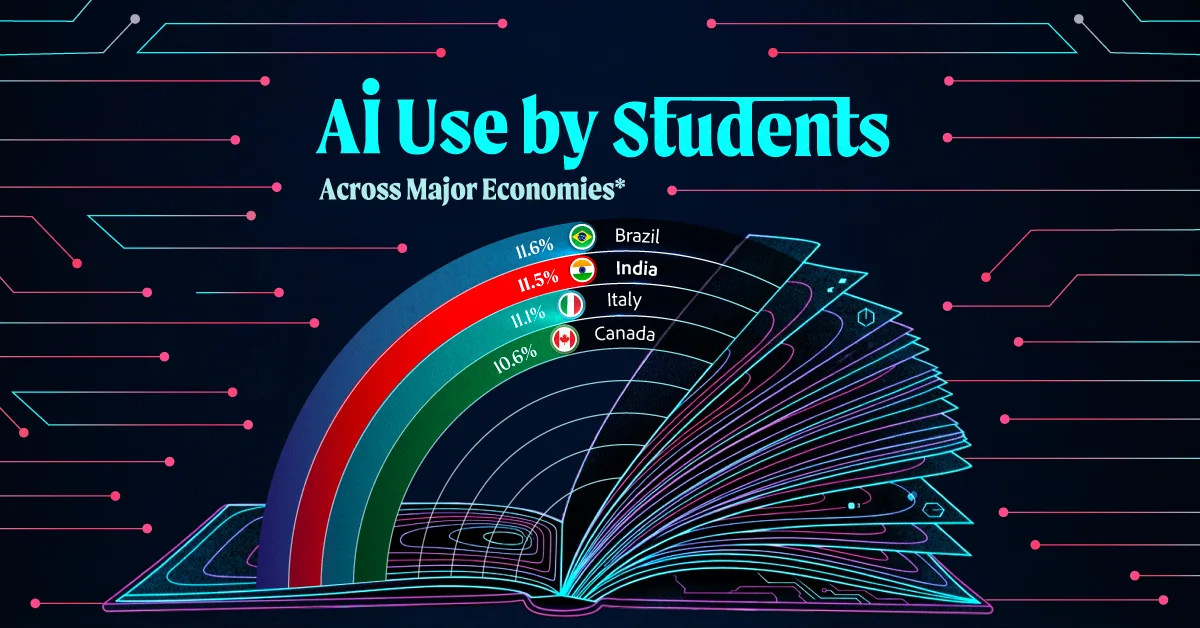
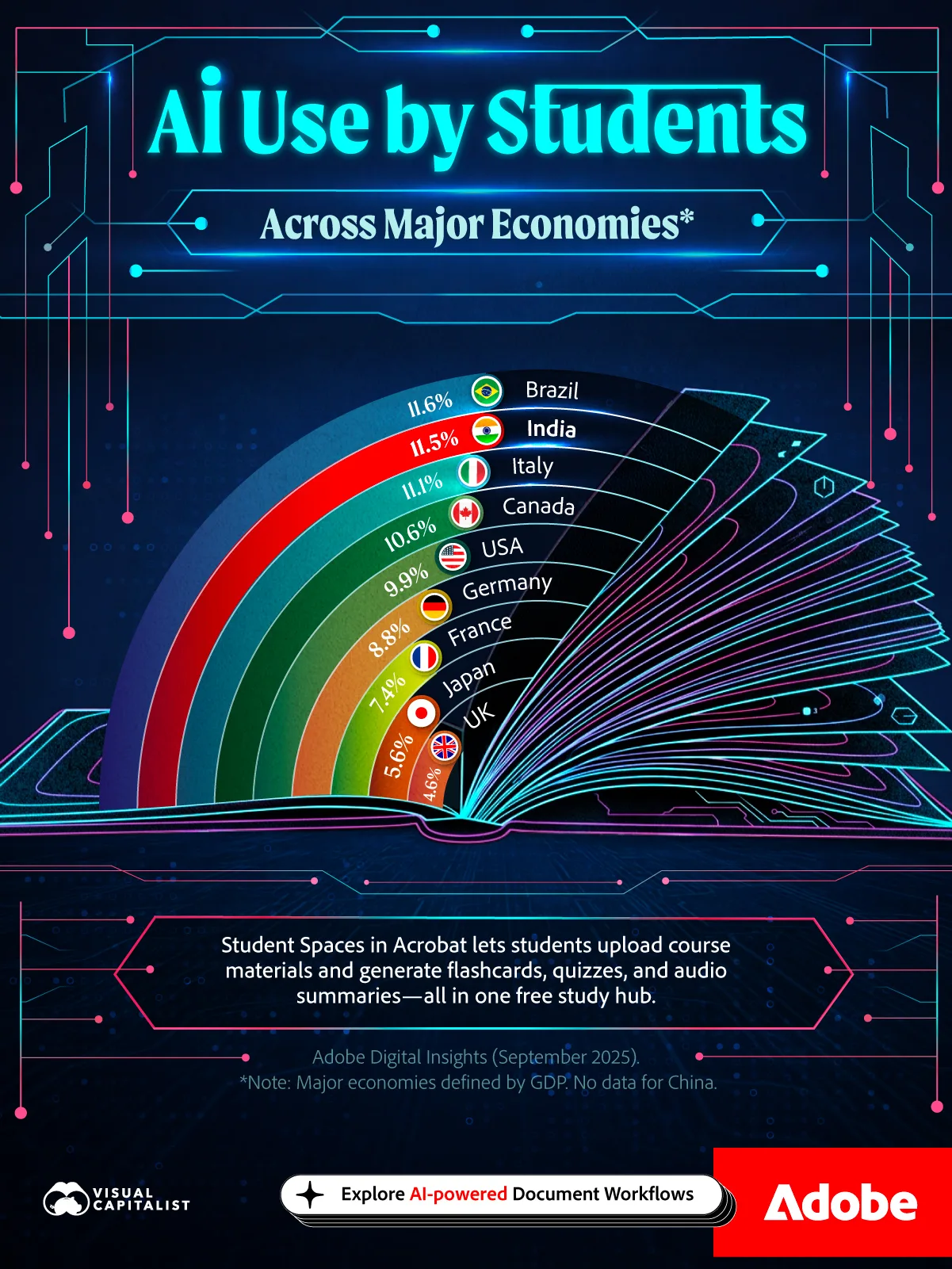
Brazil leads globally, with 11.6% of students using AI for schoolwork, closely followed by India at 11.5% and Italy at 11.1%. Canada (10.6%) and the United States (9.9%) also rank among the top adopters, showing that AI is gaining traction across both emerging and developed economies.
| Country | Student AI Use |
|---|---|
 Brazil Brazil |
11.6% |
 India India |
11.5% |
 Italy Italy |
11.1% |
 Canada Canada |
10.6% |
 United States United States |
9.9% |
 Germany Germany |
8.8% |
 France France |
7.4% |
 Japan Japan |
5.6% |
 United Kingdom United Kingdom |
4.6% |
India is particularly notable in student AI use given its demographic advantage. With a median age of just 30, it has one of the youngest populations among major economies, helping drive faster adoption of AI study tools. School and university students across India are already using AI assistants for homework and revision, turning this youth-driven familiarity with technology into a tangible academic edge.
Lower Adoption Markets: Developed Markets Fall Behind
At the lower end of the spectrum, student AI use is notably weaker in advanced economies such as the United Kingdom (4.6%) and Japan (5.6%). These countries fall well behind the global leaders, highlighting a clear adoption gap.
Even mid-tier adopters like France (7.4%) and Germany (8.8%) lag behind top performers. This disparity may reflect stricter academic policies, slower institutional adoption, or cultural hesitancy toward AI in education. These factors could impact long-term digital competitiveness.
From AI Adoption to AI Study Tools
As student AI use grows globally, tools that bridge casual usage and focused learning will define which students stay ahead. They need purpose-built AI tools for students that turn course materials into real learning outcomes. For students in high-adoption markets like India and Brazil, the next step is turning that AI familiarity into real academic advantage.
Free AI study tools like Adobe Acrobat Student Spaces let students upload class notes and instantly generate flashcards, quizzes, study guides, and even audio summaries, turning scattered materials into a structured study hub. As AI adoption grows globally, tools that bridge casual usage and focused learning will define which students stay ahead.

Explore AI-powered Document Workflows.
-
 AI4 weeks ago
India on Top: AI Adoption by Country
India’s tech-savvy workforce is leading the world in AI adoption, fueling the next wave of economic growth.
-
 AI1 month ago
How AI Could Add $600B to India’s Economy by 2035
India’s AI boom is poised to reshape its economy, with AI expected to boost productivity by between $550B and $607B by 2035.