Ranked: The World’s Biggest Memory Chip Makers
See visuals like this from many other data creators on our Voronoi app. Download it for free on iOS or Android and discover incredible data-driven charts from a variety of trusted sources.
Key Takeaways
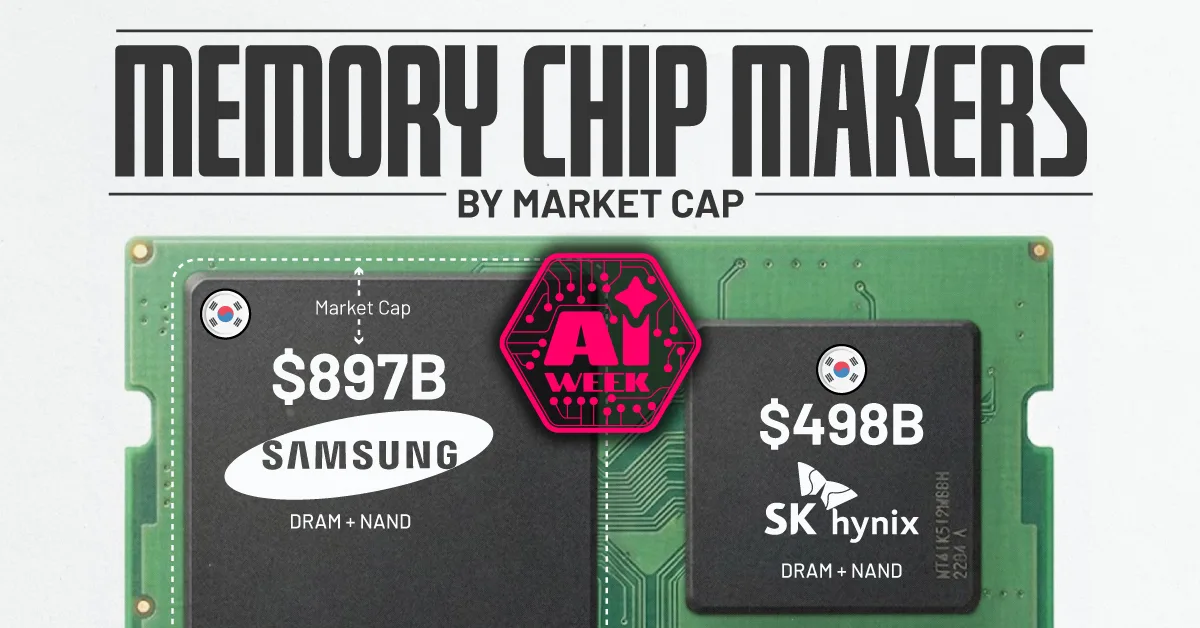
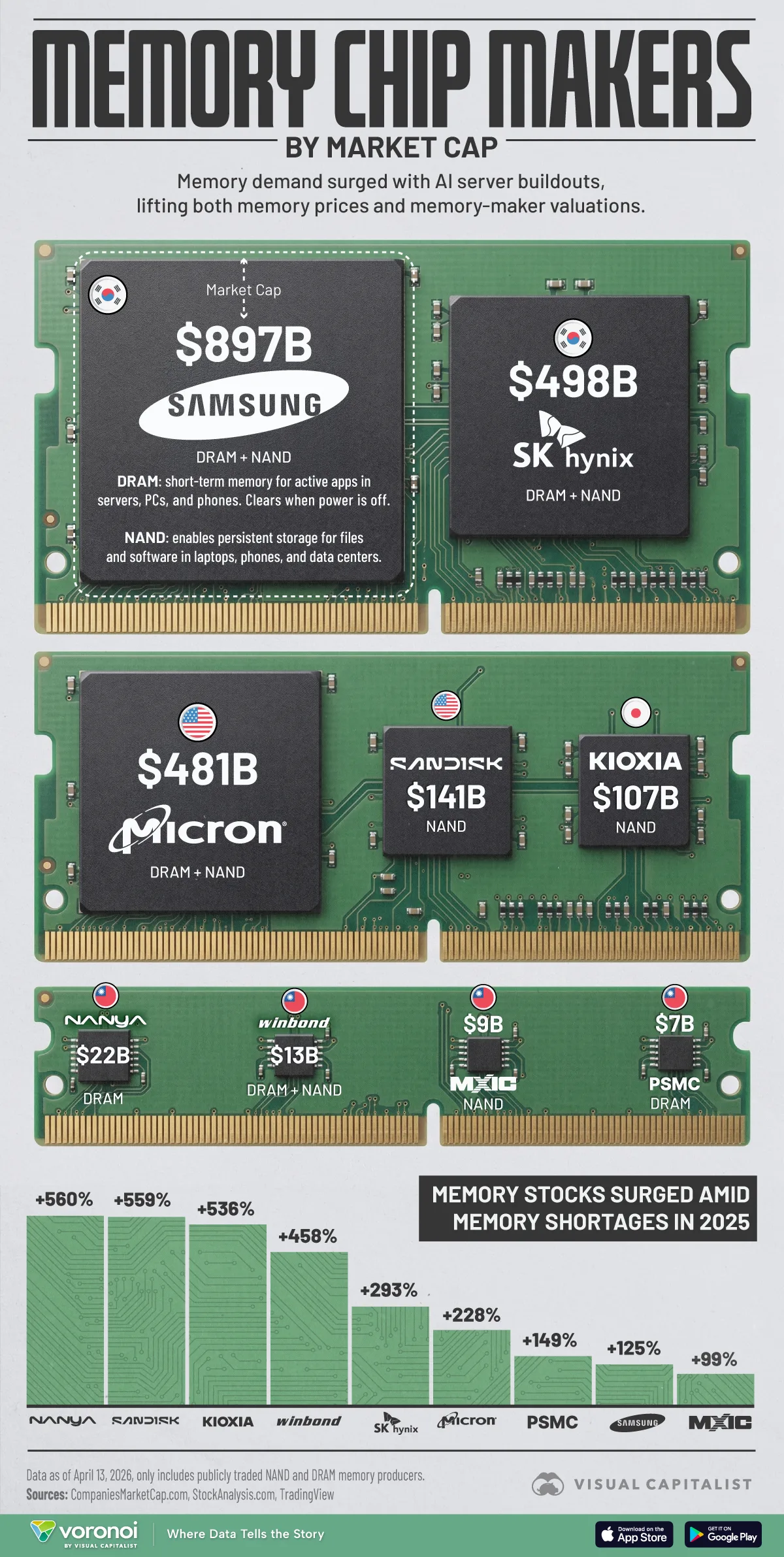
- Memory maker valuations have risen sharply as AI server demand tightened supply, with Samsung at $897B, SK Hynix at $498B, and Micron at $481B in market cap.
- Below the top three, valuations drop off quickly, with Sandisk at $141B and Kioxia at $107B, showing how concentrated the memory chip market remains.
- As AI infrastructure expands, memory chips are becoming one of the most strategically important parts of the semiconductor stack.
Memory chip makers’ market capitalizations have surged as AI infrastructure spending reshapes the semiconductor industry.
This visualization is part of Visual Capitalist’s AI Week, sponsored by Terzo. It ranks the world’s publicly traded DRAM and NAND producers using data from CompaniesMarketCap and StockAnalysis.
Samsung Is the World’s Biggest Memory Maker
The data of memory chip maker valuations shows an industry that has rebounded sharply as AI server buildouts drive memory demand higher.
The data below shows the world’s leading publicly traded memory chip makers by market cap:
| Company | Market Capitalization (Billions, USD) | Country | Memory Type |
|---|---|---|---|
| Samsung | 897.3 |  South Korea South Korea |
Both (DRAM + NAND) |
| SK Hynix | 498.4 | South Korea |
Both (DRAM + NAND) |
| Micron | 481.0 |  United States United States |
Both (DRAM + NAND) |
| Sandisk | 140.6 | United States |
NAND |
| Kioxia | 106.8 |  Japan Japan |
NAND |
| Nanya | 22.1 |  Taiwan Taiwan |
DRAM |
| Winbond | 13.4 | Taiwan |
Both (DRAM + NAND) |
| Macronix | 8.6 | Taiwan |
NAND |
| Powerchip Semiconductor Manufacturing | 7.3 | Taiwan |
DRAM |
Samsung ranks first by a wide margin, with a market capitalization of $897 billion. SK Hynix ($498B) and Micron ($481B) follow close behind, forming a clear top tier among memory producers.
Further down the ranking, Sandisk ($141B) and Kioxia ($107B) stand out as sizable second-tier players. Four Taiwanese companies round out the list, Nanya ($22B), Winbond ($13B), Macronix ($9B), and Powerchip Semiconductor Manufacturing ($7B).
Why Memory Stocks Have Climbed
Memory prices jumped in 2025 as suppliers kept output disciplined while AI server demand tightened supply. That combination helped lift both pricing power and investor expectations for memory producers.
Several names on the list posted especially dramatic gains. Nanya rose 560%, Sandisk climbed 559%, and Kioxia advanced 536%, while Winbond, SK Hynix, and Micron also saw major stock gains.
2026 has seen share prices continue to rise for memory makers. Samsung is already up 80% as of April 17, while SK Hynix is up 73% and Micron is up 59%.
What DRAM and NAND Memory Actually Do
DRAM is short-term working memory that holds the data apps need right now, but clears when power is off. NAND is long-term storage memory that keeps files and software even when a device is shut down.
Both are essential to modern computing, but AI data centers are making high-performance memory even more strategically important.
As a result, memory chip makers are increasingly tied not just to consumer electronics cycles, but also to the buildout of AI data centers.
Learn More on the Voronoi App 
If you enjoyed today’s post, check out Comparing Major American Chipmakers in One Chart on Voronoi.