
Liver abscesses affect the quality and profitability of cattle by millions of dollars in North America.
A Canadian beef quality audit done 10 years ago estimated an annual cost of liver abscesses to be $61 million. But that does not include the “unseen” costs like reduced growth efficiency, increased feed costs and added carcass trim. If modelled toward more recent U.S. research (Taylor et al. 2025), the number can be closer to $250 million.
WHY IT MATTERS: With millions of dollars up for grabs in quality of cattle affected by liver abscesses, more proactive research and screening are critical in finding solutions other than antibiotics that may get banned by government eventually.
“The important thing was that most of the losses that were associated with that number were before slaughter. So these are your increased energy maintenance. A pen that has 20 per cent animals with liver abscesses will have four per cent increased maintenance energy cattle with A-plus liver,” said Rob Gruninger of Agriculture and Agri-Food Canada at the Alberta Beef Producers’ annual beef research showcase at the University of Lethbridge.
A-plus livers are defined by being severely abscessed with multiple small abscesses, as opposed to A-minus livers with one or two small abscesses and a lower carcass weight by approximately 29 pounds.
Varied by individual, the resulting loss is $11 to $275 per animal.
The difficulty with liver abscesses is you cannot diagnose them until the cattle are processed, as they often do not show clinical signs unless they have been severely impaired. Ultrasounds have proven ineffective capturing the entire liver. The hope is that a blood-based test looking at gene expression will soon be developed.

Numbers thrown around in feedlots estimate 10 to 30 per cent of cattle have liver abscesses in North America, with Canada being on the higher end of the spectrum.
Steers are found to have more abscesses than heifers. The more days an animal is on feed, the higher the incidence of liver abscesses. The more digestible the diet, the more likely there will be gastrointestinal issues.
Dairy cattle have higher rates than beef cattle, popping up more in summer months than winter. Diets of wheat and barley tend to produce higher rates than corn/sorghum, according to Gruninger’s study data, along with silage over hay.
“The currently accepted theory of how liver abscess is developed is that it’s related to acidosis, and so the consumption of highly fermentable diets results in the rapid production of volatile fatty acids. The rumen is only able to absorb those acids at a certain rate. So if you’re producing more acid than the animal is able to use for growth, then the pH of the rumen is going to decrease,” said Gruninger.
“If it decreases to enough of an extent for a long enough period of time, you can get damage to the rumen layer, which can allow for bacteria in the gut to get into the rumen layer and into the bloodstream (ruminitis). Once bacteria get into the bloodstream, they go through the liver, through the portal vein, where they have a potential to colonize and form an infection.”
Other hypothesis have emerged, where hind gut acidosis and epithelial damage (cecum/colon) may also allow bacteria to cross into the bloodstream to reach the liver.
“When there is acidosis in the rumen, you also get depressed rumen pH in the lower gut,” said Gruninger.
The core bacteria found most commonly in abscessed livers is fusobacterium and bacteroids. Given that both are found in healthy and abscessed livers (at higher levels), it is the triggering factors that have to be considered, be it type of diet, stress of the animal and days on feed.
Given beef cattle are being pushed to greater finishing weights in recent years, with more days on feed, thoughts are that any numbers taken today would dwarf the economic impact from the studies conducted 10 years ago.
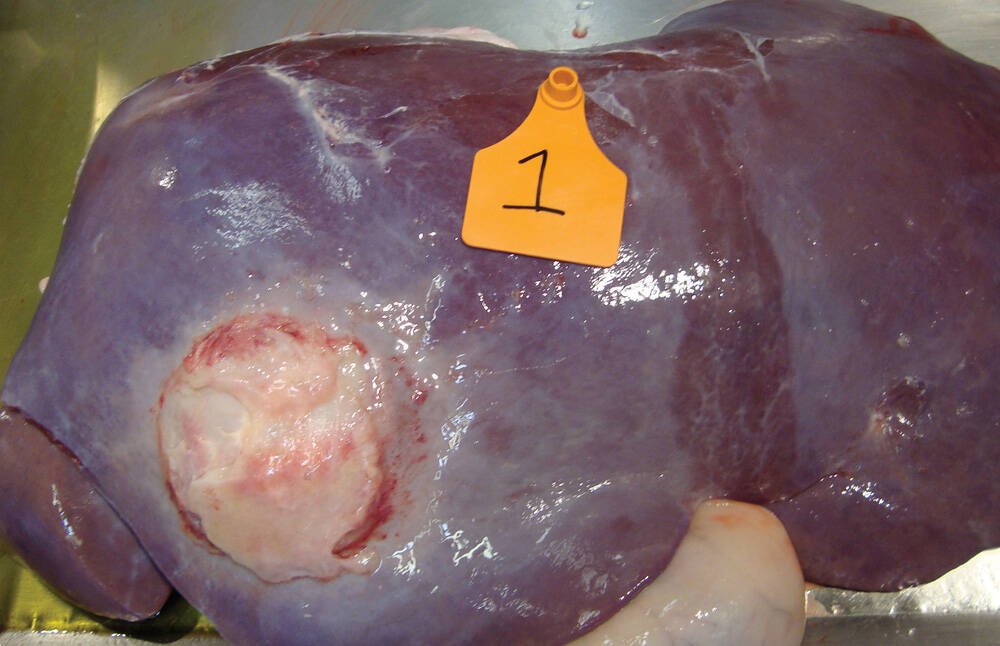
Producers in the audience during question period hypothesized the incidence of liver abscesses is probably five times larger than the numbers from 10 years ago given for economic impact.
Early identification would help
“If there was a way to identify it earlier, better (feed) management decisions would be great. The closest thing I’ve seen in data related to that is the beef-on-dairy. Those animals are on feed for an extra 100 days relative to an Angus cow, and you see significantly higher rates of abscesses,” said Gruninger.
Tylosin is the primary feed additive antibiotic used to battle liver abscesses in cattle by 30-35 per cent (Waiter et al. 2018) without affecting gain.
But there is increasing pressure federally to reduce antimicrobial use in livestock. Gruninger stressed alternatives should be sought in case Tylosin is eventually banned. Current approaches like more fibre/forage, yeast products, direct-fed microbials, essential oils and a dated fusobacterium‑specific vaccine have shown inconsistent or inconclusive results.
Reducing chronic pen overcrowding, avoiding disruptions during diet transitions, choice of grains in feed and managing days on feed were all suggestions made by Gruninger in unison with Tylosin until a better alternative vaccine can be found.
“The goal of the research is can we find some other (effective) ways,” said Gruninger.
“I think the most feasible would be, could we figure out how to make a vaccine that works well enough that is cost effective and makes sense to use? Maybe targeting more than just fusobacteria.”
The post As cattle finishing weights rise, liver abscesses increase appeared first on Farmtario.


