Ranked: Where the World’s Migrants Live Today
See visuals like this from many other data creators on our Voronoi app. Download it for free on iOS or Android and discover incredible data-driven charts from a variety of trusted sources.
Key Takeaways
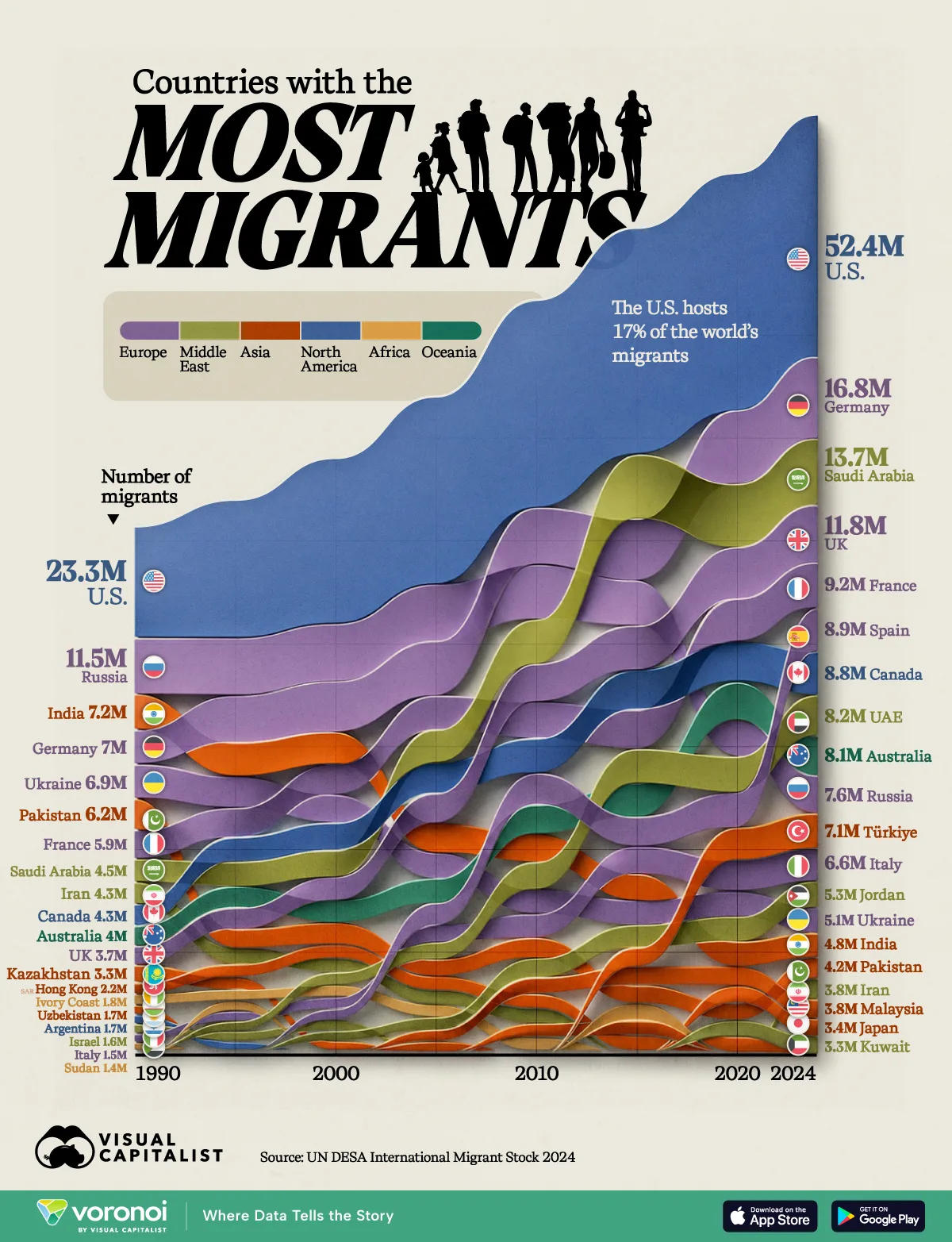
- The U.S. hosts 52.4M migrants in 2024—more than any other country by a wide margin.
- European countries like Spain, Italy, and the UK have seen migrant populations roughly triple since 1990.
- Gulf nations including Saudi Arabia and the UAE have emerged as major migration hubs driven by labor demand.
Global migration has surged over the past three decades, reshaping where people live and work worldwide. Today, more than 280 million people live outside their country of birth, with a growing share concentrated in a handful of destinations.
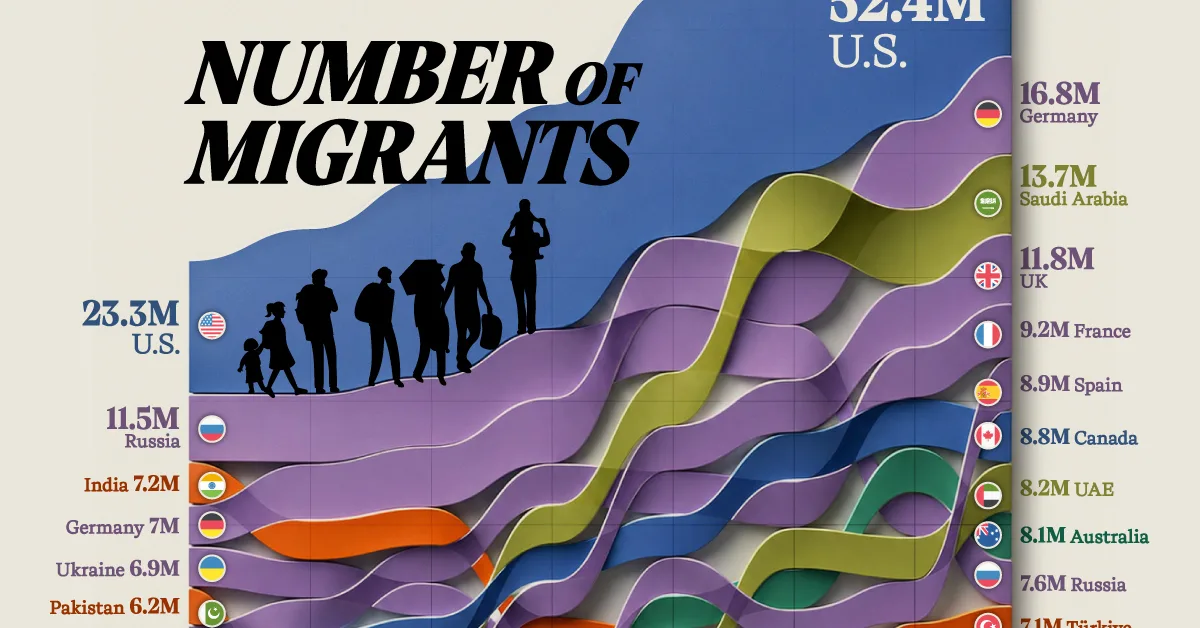
This graphic compares the countries with the largest migrant populations in 1990 and 2024, based on data from the UN DESA International Migrant Stock 2024. It highlights not only the continued dominance of the United States, but also the rapid rise of Europe and the Middle East as key migration hubs.
The U.S. Remains the Top Destination
With 52.4 million migrants in 2024, the United States hosts nearly one in six migrants worldwide—more than the next three countries combined.
This reflects decades of immigration driven by economic opportunity, education, and family reunification.
| # | Country | Migrants (1990) | Country | Migrants (2024) |
|---|---|---|---|---|
| 1 |  United States United States |
23,266,147 | United States |
52,375,047 |
| 2 |  Russia Russia |
11,524,948 |  Germany Germany |
16,750,084 |
| 3 |  India India |
7,212,791 |  Saudi Arabia Saudi Arabia |
13,683,841 |
| 4 | Germany |
6,960,112 |  United Kingdom United Kingdom |
11,845,479 |
| 5 |  Ukraine Ukraine |
6,892,920 |  France France |
9,186,757 |
| 6 |  Pakistan Pakistan |
6,208,204 |  Spain Spain |
8,870,527 |
| 7 | France |
5,890,023 |  Canada Canada |
8,805,839 |
| 8 | Saudi Arabia |
4,484,868 |  United Arab Emirates United Arab Emirates |
8,157,000 |
| 9 |  Iran Iran |
4,291,601 |  Australia Australia |
8,111,404 |
| 10 | Canada |
4,251,056 | Russia |
7,605,774 |
| 11 | Australia |
3,991,501 |  Türkiye Türkiye |
7,083,501 |
| 12 | United Kingdom |
3,664,896 |  Italy Italy |
6,553,671 |
| 13 |  Kazakhstan Kazakhstan |
3,289,058 |  Jordan Jordan |
5,280,168 |
| 14 |  Hong Kong SAR Hong Kong SAR |
2,218,473 | Ukraine |
5,064,173 |
| 15 |  Ivory Coast Ivory Coast |
1,822,374 | India |
4,796,255 |
| 16 |  Uzbekistan Uzbekistan |
1,653,000 | Pakistan |
4,175,958 |
| 17 |  Argentina Argentina |
1,647,935 | Iran |
3,840,654 |
| 18 |  Israel Israel |
1,622,505 |  Malaysia Malaysia |
3,806,514 |
| 19 | Italy |
1,529,367 |  Japan Japan |
3,409,529 |
| 20 |  Sudan Sudan |
1,402,896 |  Kuwait Kuwait |
3,323,191 |
Europe’s Rapid Growth Since 1990
Europe has seen some of the fastest growth in migrant populations since 1990. Spain’s migrant population, for example, has increased nearly fivefold, while Italy and the UK have roughly tripled.
The European Union’s open-border framework has also facilitated migration within the region. At the same time, external migration has increased due to labor demand and geopolitical factors.
Middle East Driven by Labor Demand
In contrast to Western economies, migration to countries like Saudi Arabia and the United Arab Emirates is largely driven by foreign labor demand. These nations have seen rapid growth in migrant populations, particularly in construction, domestic work, and service industries.
Unlike the U.S. and Europe, migration to Gulf countries is largely temporary. In places like Saudi Arabia and the UAE, migrants often make up the majority of the workforce but have limited pathways to permanent residency.
Learn More on the Voronoi App 
If you enjoyed today’s post, check out U.S. Immigration By Status, 2001 to 2024 on Voronoi, the new app from Visual Capitalist.