Ranked: Countries With the Highest Water Use Per Person
See visuals like this from many other data creators on our Voronoi app. Download it for free on iOS or Android and discover incredible data-driven charts from a variety of trusted sources.
Key Takeaways
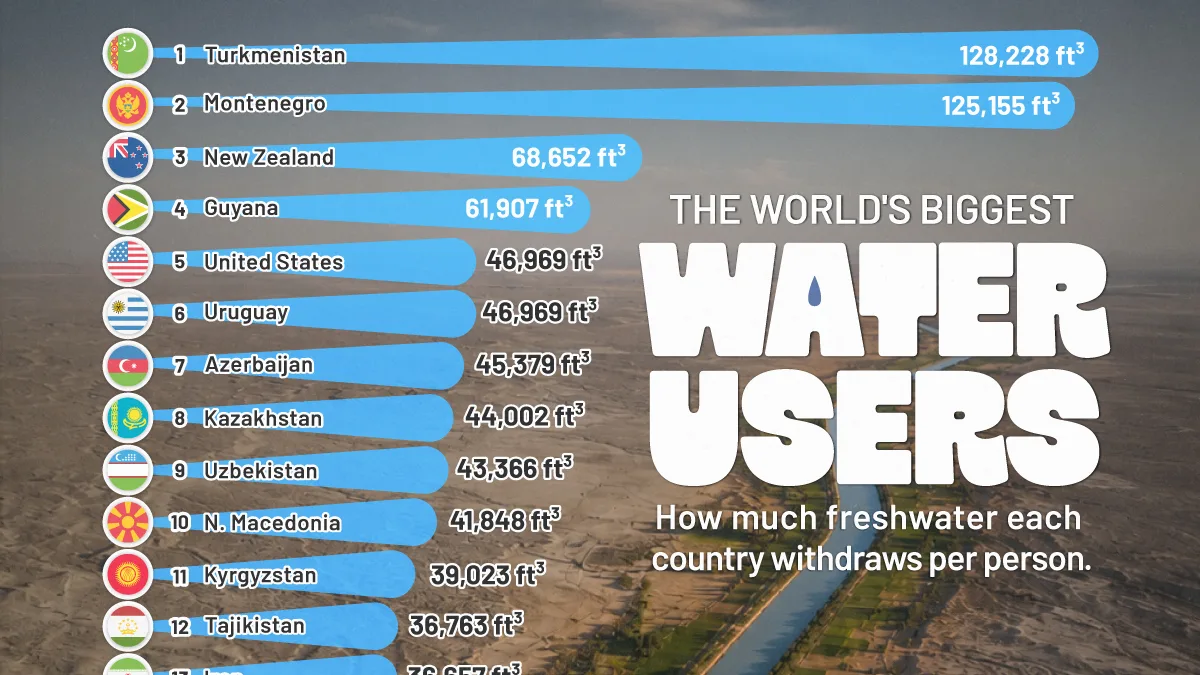
- Turkmenistan and Montenegro withdraw more freshwater per person than any other countries in the world.
- Agriculture accounts for roughly 70% of global freshwater withdrawals.
- The U.S. ranks fifth globally, driven partly by industrial activity and power generation.
Most of the world’s freshwater isn’t used in homes. It’s used to grow crops, cool power plants, and support industry.
This graphic ranks countries by annual freshwater withdrawals per person using data from FAO AQUASTAT and the UN, along with population figures from the World Bank. The figures include water used for agriculture, industry, and municipal systems.
Some of the results are surprising. Turkmenistan ranks first by a wide margin due to massive irrigation systems tied to cotton farming, while Montenegro ranks second because of intensive water use relative to its population size. The U.S. also places in the global top five.
Turkmenistan Leads by a Wide Margin
Turkmenistan ranks first, with 128,228 cubic feet of water withdrawn per person. The country’s massive irrigation network was built to support cotton farming in one of the driest regions of Central Asia.
Soviet-era canals diverted water from the Amu Darya River into arid farmland. These same diversions contributed to the dramatic shrinking of the Aral Sea.
Agriculture Drives Global Water Use
Agriculture accounts for around 70% of global freshwater withdrawals worldwide.
That helps explain why many high-ranking countries are located in dry or semi-arid regions with large irrigation demands. Azerbaijan, Kazakhstan, Uzbekistan, Kyrgyzstan, Tajikistan, and Iran all appear in the top 15.
| Rank | Country | Cubic feet per capita |
|---|---|---|
| 1 |  Turkmenistan Turkmenistan |
128,228 |
| 2 |  Montenegro Montenegro |
125,155 |
| 3 |  New Zealand New Zealand |
68,652 |
| 4 |  Guyana Guyana |
61,907 |
| 5 |  U.S. U.S. |
46,969 |
| 6 |  Uruguay Uruguay |
46,969 |
| 7 |  Azerbaijan Azerbaijan |
45,379 |
| 8 |  Kazakhstan Kazakhstan |
44,002 |
| 9 |  Uzbekistan Uzbekistan |
43,366 |
| 10 |  North Macedonia North Macedonia |
41,848 |
| 11 |  Kyrgyzstan Kyrgyzstan |
39,023 |
| 12 |  Tajikistan Tajikistan |
36,763 |
| 13 |  Iran Iran |
36,657 |
| 14 |  Armenia Armenia |
36,515 |
| 15 |  Suriname Suriname |
35,138 |
| 16 |  Lao PDR Lao PDR |
34,326 |
| 17 |  Greece Greece |
34,008 |
| 18 |  Iraq Iraq |
34,008 |
| 19 |  Canada Canada |
32,772 |
| 20 |  Estonia Estonia |
31,677 |
| 21 |  Eswatini Eswatini |
31,006 |
| 22 |  Timor-Leste Timor-Leste |
30,159 |
| 23 |  Bulgaria Bulgaria |
29,700 |
| 24 |  Argentina Argentina |
29,311 |
| 25 |  Vietnam Vietnam |
28,993 |
In these countries, water demand is often shaped by crop production and river diversion systems. Per-capita figures can rise sharply when large irrigation networks are spread across relatively small populations.
Industrial Use Also Matters
Not every country on the list is dominated by irrigation.
The United States ranks fifth, while Canada and Estonia also appear in the top 20. In these countries, high water withdrawals can reflect industrial activity and power-plant cooling.
This type of water use differs from household consumption. Much of the water withdrawn for cooling may later return to rivers or lakes, but it still places pressure on local water systems.
Small Populations Can Push Ratios Higher
Per-capita rankings can rise quickly in smaller countries when large irrigation or industrial systems are divided across relatively few people.
For example, Montenegro, with a population of 627,702, ranks second at 125,155 cubic feet per person. New Zealand ranks third with 68,652 cubic feet per person, followed by Guyana at 61,907.
Learn More on the Voronoi App 
If you enjoyed today’s post, check out Which Countries Use the Most Electricity? on Voronoi.Use This Visualization