Ranked: Where Inflation is Highest in Europe in 2026
See visuals like this from many other data creators on our Voronoi app. Download it for free on iOS or Android and discover incredible data-driven charts from a variety of trusted sources.
Key Takeaways
- Romania has Europe’s highest inflation rate at 9.0%, followed by Kosovo and Bulgaria.
- Only four countries are at or below the common 2% inflation target: Switzerland, Denmark, Czechia, and Sweden.
- Many of Europe’s largest economies, including Germany, France, and the UK, remain above target.
Inflation has eased from its recent peaks, but price growth remains stubbornly high across much of Europe.
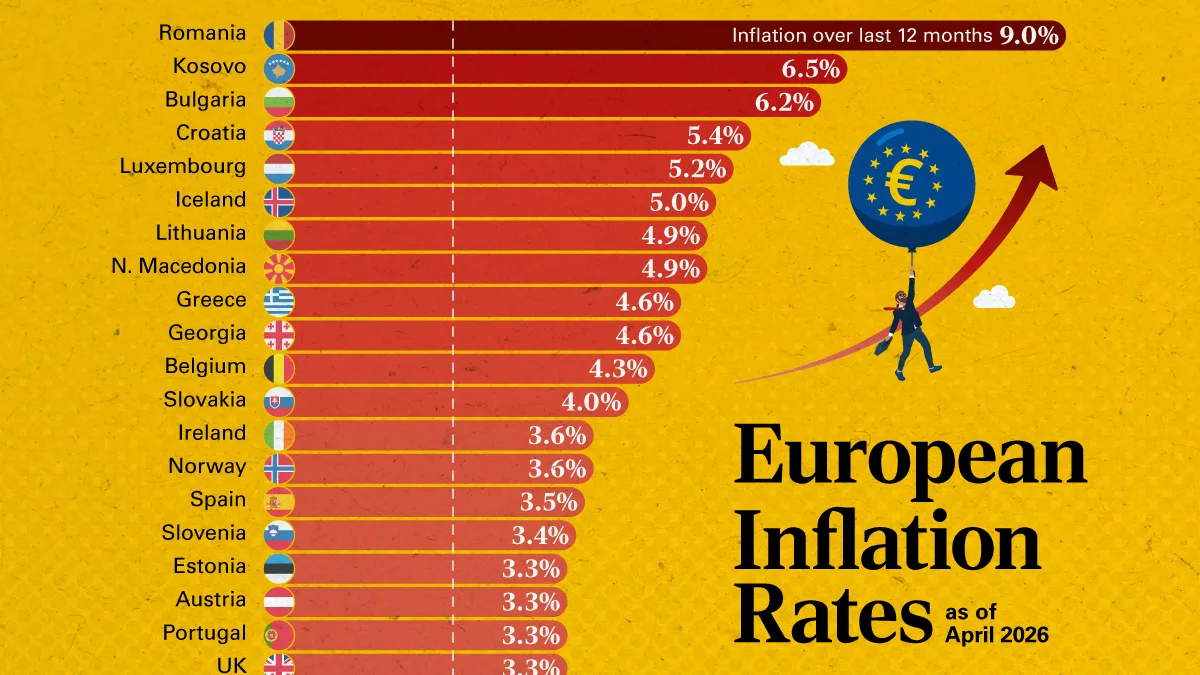
This graphic ranks 36 European countries by annual inflation rate, using the latest available 2026 data from Eurostat and the UK Parliament.
Annual inflation measures how much consumer prices have risen over the previous 12 months, such as from April 2025 to April 2026.
Where Inflation is Highest in Early 2026 in Europe
Romania has the highest inflation rate in Europe at 9.0%, followed by Kosovo at 6.5% and Bulgaria at 6.2%. Several of the highest-inflation countries are in Southeastern Europe, highlighting how price pressures remain especially elevated in parts of the region.
This data table ranks European countries by their annual inflation rates as of early 2026.
| Rank | Country | Inflation Rate (%) for Last 12 Months |
|---|---|---|
| 1 |  Romania Romania |
9.0 |
| 2 |  Kosovo Kosovo |
6.5 |
| 3 |  Bulgaria Bulgaria |
6.2 |
| 4 |  Croatia Croatia |
5.4 |
| 5 |  Luxembourg Luxembourg |
5.2 |
| 6 |  Iceland Iceland |
5.0 |
| 7 |  Lithuania Lithuania |
4.9 |
| 8 |  North Macedonia North Macedonia |
4.9 |
| 9 |  Greece Greece |
4.6 |
| 10 |  Georgia Georgia |
4.6 |
| 11 |  Belgium Belgium |
4.3 |
| 12 |  Slovakia Slovakia |
4.0 |
| 13 |  Ireland Ireland |
3.6 |
| 14 |  Norway Norway |
3.6 |
| 15 |  Spain Spain |
3.5 |
| 16 |  Slovenia Slovenia |
3.4 |
| 17 |  Estonia Estonia |
3.3 |
| 18 |  Austria Austria |
3.3 |
| 19 |  Portugal Portugal |
3.3 |
| 20 |  United Kingdom United Kingdom |
3.3 |
| 21 |  Poland Poland |
3.2 |
| 22 |  Serbia Serbia |
3.1 |
| 23 |  Cyprus Cyprus |
3.0 |
| 24 |  Latvia Latvia |
3.0 |
| 25 |  Germany Germany |
2.9 |
| 26 |  Italy Italy |
2.9 |
| 27 |  Montenegro Montenegro |
2.9 |
| 28 |  France France |
2.5 |
| 29 |  Netherlands Netherlands |
2.5 |
| 30 |  Malta Malta |
2.4 |
| 31 |  Finland Finland |
2.3 |
| 32 |  Hungary Hungary |
2.1 |
| 33 |  Czechia Czechia |
1.5 |
| 34 |  Sweden Sweden |
1.5 |
| 35 |  Denmark Denmark |
1.0 |
| 36 |  Switzerland Switzerland |
0.6 |
Romania, the largest economy in Southeastern Europe, faces a crisis on three fronts: high inflation, a multi-month economic recession, and a protracted political crisis that imperils governmental efforts to rein in the country’s fiscal deficit, the largest in Europe.
Inflation in recent months has climbed not only because of food and fuel prices, but also due to rising rents.
Inflation is equally politically sensitive in neighboring Bulgaria, given the country’s recent adoption of the euro in January 2026. Many in the country had feared that joining the eurozone would contribute to rising prices for everyday goods.
The Success Stories of Europe
The European Central Bank, Bank of England, and Swiss National Bank all maintain a 2% inflation target. Only four European countries fall within this target range as of March 2026: Czechia and Sweden (1.5%), Denmark (1%), and Switzerland (0.6%).
Interestingly, none of these countries use the euro as their national currency, although both the Czech Republic and Sweden are theoretically expected to join the eurozone upon satisfying certain criteria. Denmark has negotiated an opt-out.
Switzerland’s inflation rate is not only the lowest in Europe, but also among the lowest worldwide. The small Alpine country has successfully navigated international turbulence without seeing large-scale price increases.
It has also managed to avoid deflation (negative inflation), another key part of the Swiss National Bank’s mandate.
Inflation in Europe’s Major Economies
The major European economies today each grapple with inflation rates above the targets set by the ECB and other central banks.
France (2.5%), Germany (2.9%), and the United Kingdom (3.3%) are all facing substantial cost-of-living increases, driven partly by rising energy prices linked to geopolitical conflicts such as the wars in Iran and Ukraine.
Persistent inflation has also kept cost-of-living pressures high, making price stability a central political issue across many of Europe’s largest economies.
Learn More on the Voronoi App 
Wondering where rising prices can be seen most clearly? Check out Where Inflation Has Hit the Hardest (2000–2025) on Voronoi.Use This Visualization