We are constantly bombarded by messages that tell us we need more stuff to be happy. The average American household contains around 300,000 items. The average home size has roughly tripled since the 1950s, and we still rent self-storage units by the millions to hold the overflow.
If you are rethinking your relationship to consumer culture – whether by choice or necessity – we’ve rounded up a list of books to make breaking up with consumerism and easier to understand which of our purchases are really necessary.
(Amazon links are provided for convenience. Your local library and independent bookstore are excellent first stops.)
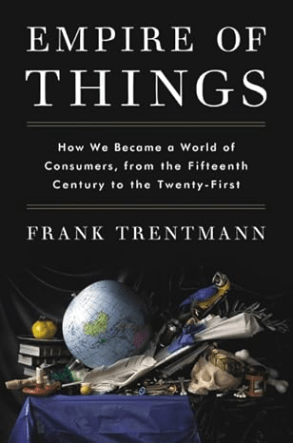
Empire of Things
by Frank Trentmann
Trentmann’s sweeping 2016 history follows material culture from late Ming China and Renaissance Italy through to today’s global supply chains. He shows that consumerism is not a recent American export but a centuries-long international phenomenon, one that has reshaped households, cities, and the planet.
Empire of Things is dense but never preachy, and it gives readers the long view needed to understand what we are actually pushing back against.
No Logo – 10th Anniversary Edition
by Naomi Klein
No Logo was a movement manifesto when it appeared in 1999, and its dissection of branding, sweatshop labor, and corporate cultural takeover reads as prescient now that nearly every screen on earth is an ad surface. To take the next step, pair this read with Klein’s more recent argument about capitalism and ecological collapse, How To Change Everything.
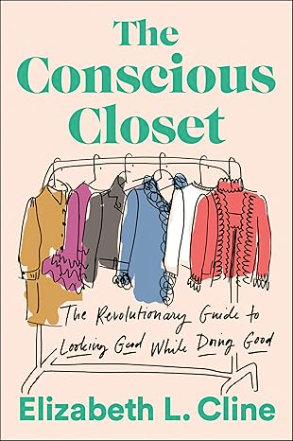
The Conscious Closet
by Elizabeth L. Cline
Cline first exposed the human and environmental costs of fast fashion in Overdressed (2012). The Conscious Closet is the practical follow-up: how to clean out, repair, swap, and rebuild a wardrobe without funding the industry that produces an estimated 92 million tons of textile waste each year. It is the most actionable book on this list for anyone with a closet.
The Myths of Happiness
by Sonja Lyubomirsky
Psychology professor Sonja Lyubomirsky brings the receipts. In The Myths of Happiness, she walks through decades of research showing that material milestones — the raise, the upgrade, the bigger house — produce short bursts of satisfaction that fade quickly. What actually sustains wellbeing is rarely for sale. A clarifying read for anyone tempted to outshop their way to contentment.
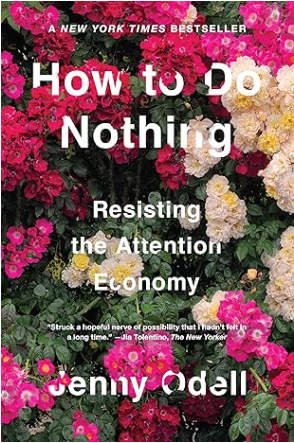
How to Do Nothing: Resisting the Attention Economy
by Jenny Odell
Waste is coming for our minds, too. Odell argues that our scarcest resource is attention — and that the platforms we use have turned it into the raw material of a trillion-dollar industry. How to Do Nothing is not a digital-detox manual; it is a case for reclaiming attention as a political act, with consequences for everything from bird-watching to civic life. More relevant in 2026 than when it was published in 2019.
Less Is More: How Degrowth Will Save the World
by Jason Hickel
Economic anthropologist Jason Hickel makes the case that endless GDP growth is incompatible with a livable planet, and that “green growth” is mostly a marketing exercise. Less Is More (2020) traces 500 years of capitalism and lays out what a degrowth economy could actually look like — one organized around human and ecological flourishing rather than perpetual expansion. The book has helped move degrowth from the margins of academia into the mainstream of the climate debate.
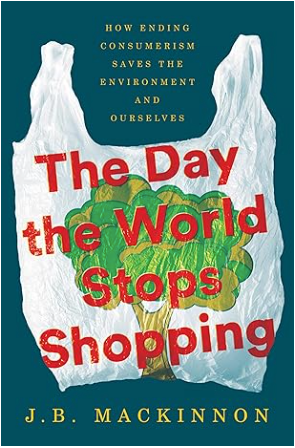
The Day the World Stops Shopping
by J.B. MacKinnon
Journalist J.B. MacKinnon designed The Day the World Stops Shopping (2021) as a thought experiment — what would happen if global consumption dropped by 25%? — and then watched the pandemic run a version of the experiment in real time. He travels from Namibian hunter-gatherer communities to American big-box retail, talking to economists, ecologists, and CEOs. The result is one of the most readable accounts of why we shop, why we cannot easily stop, and what we would gain if we did.
Consumed: The Need for Collective Change
by Aja Barber
Writer and consultant Aja Barber connects fashion, colonialism, and climate in Consumed (2021), a debut that has become a touchstone for the ethical fashion conversation. Where Cline writes as a practitioner, Barber writes as a systems critic, tracing the textile trade’s roots in slavery and racial inequality and asking readers to confront why we fill emotional gaps with purchases. Pointed, generous, and built to be read in two sittings.
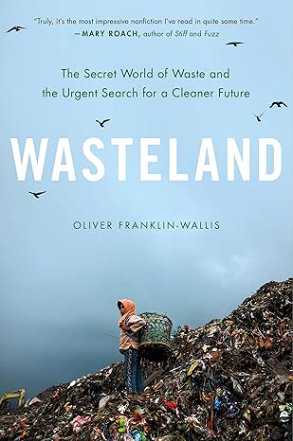
Wasteland: The Secret World of Waste and the Urgent Search for a Cleaner Future
by Oliver Franklin-Wallis
If consumerism is the input, waste is the output we work hardest not to see. Award-winning journalist Oliver Franklin-Wallis follows that output across continents in Wasteland (2023) — from New Delhi’s landfills and Ghana’s secondhand clothing markets to nuclear storage sites and the corporate origins of curbside recycling. Named a Best Book of 2023 by The New Yorker, The Guardian, and Kirkus, it is essential reading for anyone who has ever wondered where “away” actually goes.
Fixation: How to Have Stuff Without Breaking the Planet
by Sandra Goldmark
Sandra Goldmark runs a pop-up repair shop in New York and serves as director of sustainability at Barnard College. Fixation (2020) is her plainspoken case for getting things fixed instead of replaced, and for building a circular economy where good design, reuse, and repair are the default. Her five-rule formula — borrowed in spirit from Michael Pollan — is the most quotable advice on this list: “Have good stuff. Not too much. Mostly reclaimed. Care for it. Pass it on.”
What You Can Do
Reading is a start, not a finish. A few next steps:
- Start at the library. Most of these titles are available through WorldCat or your local branch. Borrowing keeps a book in circulation and out of a landfill.
- Audit one category of stuff before adding to it. Pick clothes, kitchenware, or electronics. Inventory what you already own before the next purchase. Most of us own more than we remember.
- Find a repair option in your community. Take the time to locate repair, reuse, and donation outlets near you before tossing anything broken.
- Support right-to-repair policy. Several U.S. states have passed right-to-repair laws since 2023; the rest are weighing them. Individual purchasing choices matter more when manufacturers are required to make repair possible.
- Read one of these books and talk about it. Anti-consumption is harder alone. Book clubs, mutual-aid groups, and faith communities have all become surprising hubs for this work.
Editor’s Note: Originally authored by Gemma Alexander on June 18, 2020, this article was updated in May 2026.
The post 10 Books to Counter Consumerism appeared first on Earth911.