On August 26, 2009, an Australian biologist’s audio detector picked up a single bat working its way through the rainforest canopy on Christmas Island. The recording captured the last echolocation call of the Christmas Island pipistrelle. After that night, no detector ever heard another.
This is the strange feature of extinction in the 21st century: a lot of it happens on the record. We have audio of a bat’s last call. We have photographs of the last individual. We know the names of endangered individuals — Lonesome George, Sudan, Toughie — and in many cases, we knew years in advance that we were going to lose them.
Since 2000, the International Union for Conservation of Nature (IUCN) has formally moved dozens of species into its Extinct or Extinct in the Wild categories, and hundreds more sit one rung above, in Critically Endangered (Possibly Extinct). The species described below are not the longest list. They are the clearest cases of losses that played out as they were documented, with causes nobody had to guess at.
The question is whether humans will learn from past losses to prevent future ones.
The pipistrelle that nobody caught in time
The Christmas Island pipistrelle was a microbat the size of a thumb. Its population had been collapsing for two decades when, in 2006, scientists estimated only a few dozen remained. The Australian government authorized a captive-breeding rescue in mid-2009. By the time crews reached the island, only one bat could be found. Four weeks of trapping failed to catch it. The IUCN declared the species extinct in 2017.
The cause was not climate change or habitat loss in the usual sense. It was a cascade of invasive species, including yellow crazy ants, feral cats, and an introduced wolf snake, combined with a slow government response. The pipistrelle is the kind of extinction that makes the policy lesson uncomfortably clear, showing that the science was correct and that a rescue plan existed, but that the action came roughly two years too late.
Lonesome George and the end of a lineage
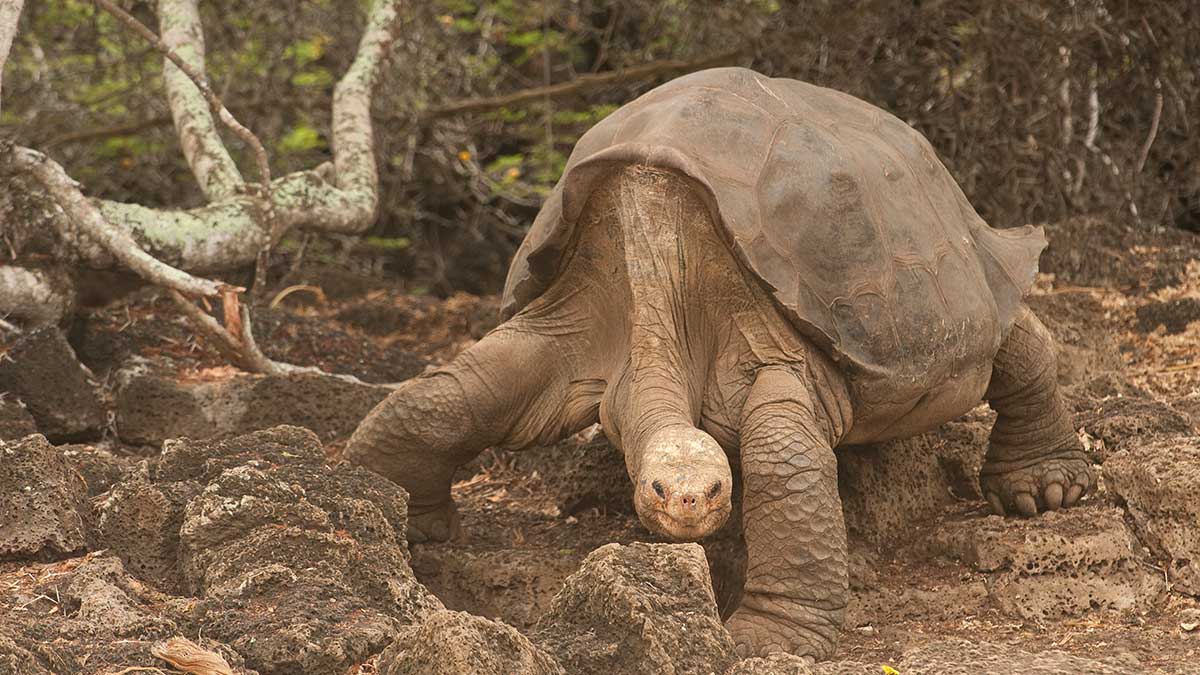
On June 24, 2012, Lonesome George died on Santa Cruz Island in the Galápagos. He was the last known Pinta Island tortoise (Chelonoidis abingdonii), a subspecies hunted to functional extinction by 19th-century whalers who used them as food, then finished off by goats introduced on the island. Decades of mating attempts with related subspecies failed to produce viable offspring.
George’s death loss was foreseeable for forty years before it happened. Conservationists found him in 1971 and immediately understood what he was: a subspecies of one. Yet, every year of his life was a year the question “what would it take to save this lineage?” had a clear answer (nothing, in the end) and a public audience. He is one of the most-watched extinctions in history.
The western black rhinoceros: poached out
The western black rhinoceros was declared extinct by the IUCN in 2011, following a 2006 survey of its last range in Cameroon that found none. Its disappearance was not driven by habitat conversion or climate buy by horn prices that, at peak, exceeded $50,000 per kilogram on illegal markets. Sophisticated poaching operations that anti-poaching units could not match ran the western black rhino to oblivion.
The northern white rhinoceros is now traveling the same road in slow motion. Sudan, the last male, was euthanized on March 19, 2018, and only two females remain, both past breeding age. An IVF and stem-cell program, BioRescue, is attempting to revive the subspecies using stored gametes, the half of a species’ DNA contributed by the male and female parent. Whether that succeeds or not, the wild northern white rhino is gone.
The baiji: a dolphin lost in plain sight
The baiji, or Yangtze river dolphin, was an evolutionary outlier. Its lineage diverged from other cetaceans roughly 20 million years ago. After a six-week 2006 expedition failed to find a single individual along the entire Yangtze, scientists declared it functionally extinct. It was the first cetacean species lost to human activity.
The baiji was killed by an combination of human factors. It was frequently gillnet bycatch, caught up when fishermen netted other species. Its range was constrained by dam construction. Ship strikes and pollution from the industrial corridor running through the most densely populated river basin on Earth killed many.
No single act caused the extinction. That is part of why nothing stopped it. The Yangtze finless porpoise, the only remaining freshwater cetacean in China, now faces the same pressures.
The Bramble Cay melomys: the first mammal climate extinction
The Bramble Cay melomys was a small rodent that lived on a single five-acre coral cay at the northern tip of the Great Barrier Reef. As sea levels rose and storm surges intensified, the cay’s vegetated area collapsed, taking the melomys’ food supply and burrows with it. The species was last seen in 2009, declared extinct by the IUCN in 2015, and by the Australian government in February 2019, the first mammal extinction explicitly attributed to anthropogenic climate change.
The melomys had nowhere else to go. That is the feature low-elevation island endemics share, and it is a feature thousands of species share with them.
The po’ouli: an extinction due to an absent partner
The po’ouli was a Hawaiian bird discovered in 1973, the first new honeycreeper species described in 50 years. By 2003, only three individuals could be located. In September 2004, biologists captured the last known male and brought him to the Maui Bird Conservation Center, hoping to find him a mate. None could be found before he died on November 26, 2004.
Hawaii has lost more bird species than any other U.S. state, primarily to avian malaria carried by introduced mosquitoes. As global warming pushes mosquitoes to higher elevations, the remaining honeycreepers are running out of altitude they can flee to.
Tissue samples from the last po’ouli are stored at the San Diego Zoo’s Frozen Zoo. Whether they can be restored through cloning is a 22nd-century question.
Beyond species, lost knowledge and connections
It is tempting to count extinctions as a tally as more species are discovered: species in, species out. That undercounts what is gone, even as science finds new species, many of which are also at risk. Each of these losses is also the loss of:
- Evolutionary time. The baiji represented 20 million years of independent evolution. That information is not retrievable.
- Ecosystem function. The melomys was a seed disperser; the pipistrelle ate insects that no other Christmas Island species had eaten; the rhino moved nutrients across savanna landscapes.
- Cultural meaning. Lonesome George became a global symbol; the po’ouli had a Hawaiian name before it had a scientific one. Extinction erases human relationships with nature, not just specimens.
- Possibility space. We do not know what the baiji’s hearing system, the rhino’s microbial gut community, or the melomys’s heat tolerance might have taught medicine, materials science, or conservation.
Extinctions share patterns
Six of the seven species above had clearly identified causes years before they disappeared. The interventions that might have saved them, such as captive breeding, habitat protection, anti-poaching enforcement, gillnet bans, and mosquito suppression, were known. In each case, the intervention either started too late, was funded at a fraction of what would have been required, or ran into political and economic interests that outweighed the species’ remaining time.
This is the harder lesson of the post-2000 extinctions. We are not, on the whole, losing species we did not know about. We are losing species we documented, named, photographed, and in some cases captured on audio in their final hours. The bottleneck is not knowledge.
The vaquita, a porpoise native to Mexico’s Upper Gulf of California, is a live test of what we have learned. The 2025 monitoring effort confirmed 7 to 10 surviving individuals, including new calves — slightly above 2024’s record-low count of eight vaquita.
The decline is due to their becoming bycatch in illegal totoaba gillnets. Whether the vaquita follows the baiji is, at this point, a question about fishing practices enforcement and political will, not science.
What you can do
Individual action alone does not stop extinction. But the drivers behind the species above are not unreachable. The most useful interventions are policy- and supply-chain-level, and they require the kind of sustained constituency that individual choices feed:
- Support habitat protection at scale. Donate to or volunteer with organizations that buy, defend, or restore habitat: The Nature Conservancy, Rainforest Trust, American Bird Conservancy, and regional land trusts. Habitat preservation is the highest-leverage intervention against extinction.
- Push for stronger enforcement of wildlife trade law. Contact your congressional and state representatives in support of full funding for the U.S. Fish and Wildlife Service’s Office of Law Enforcement and the Convention on International Trade in Endangered Species (CITES). The western black rhino was lost to an openly operating market across borders.
- Cut your climate footprint where it actually moves the needle. For most U.S. households, that is home heating fuel, vehicle miles, and air travel, in roughly that order.
- Buy seafood from sources that audit gear, not just species. Bycatch, which resulted in the loss of the baiji and threatens to be the vaquita’s killer, is a gear problem. The Monterey Bay Aquarium’s Seafood Watch rates fisheries on bycatch as well as stock health.
- Vote on conservation budgets at every level. Most of the species rescues that worked in the past 25 years — the California condor, the black-footed ferret, the island fox — were funded through the Endangered Species Act and matching state programs. The species rescues that failed were generally underfunded earlier in the curve.
Editor’s Note: The next installment of Environmental Losses looks at the ecosystems that have collapsed or substantially restructured since 2000 — coral reefs, kelp forests, and freshwater systems — and what their loss takes with it.
The post The Extinctions We Watched Happen appeared first on Earth911.