
Developing an optimized production host in biomanufacturing takes time and money, two things most startups lack. Saku Biosciences is on a mission to dramatically speed up and improve this process via high-throughput screening of cells in environments that better mimic real-world fermentation.
The potential of biomanufacturing to produce everything from dairy proteins to biopesticides is clear, says cofounder Mark van Zee, PhD. But many firms still struggle to make the economics work at scale, in part because commercial timelines pressure them to move forward using “suboptimal cells, locking in scale-up cost and complexity early.”
Right now, he says, high-throughput screening in well plates or microfluidic systems (using miniaturized droplets on chips) can speed up the discovery and optimization process. The problem is that the winners emerging from these techniques may be optimized for well plates but not for fermentation tanks, which is ultimately what matters.
This creates both false positives (where candidates look good in screening but fail later) and false negatives (where strains that might have worked well in production are never selected in the first place). Put another way, says van Zee: “You get what you screen for: strains that work well in a well plate or microfluidic system, not a bioreactor system.”
Los Angeles-based Saku Biosciences—which has just secured its first VC check from Big Idea Ventures—has an alternative approach whereby cells are encapsulated inside tiny porous “PicoShells” or hollow hydrogel particles that allow nutrients and oxygen in and waste out, while keeping each colony physically separated.
The encapsulated colonies can then be tested in benchtop bioreactors or flasks rather than well plates or droplets on chips, improving the odds of finding strains that will perform in real-world conditions, says van Zee, PhD, who is now moving from academic validation into early customer contracts.
How it works
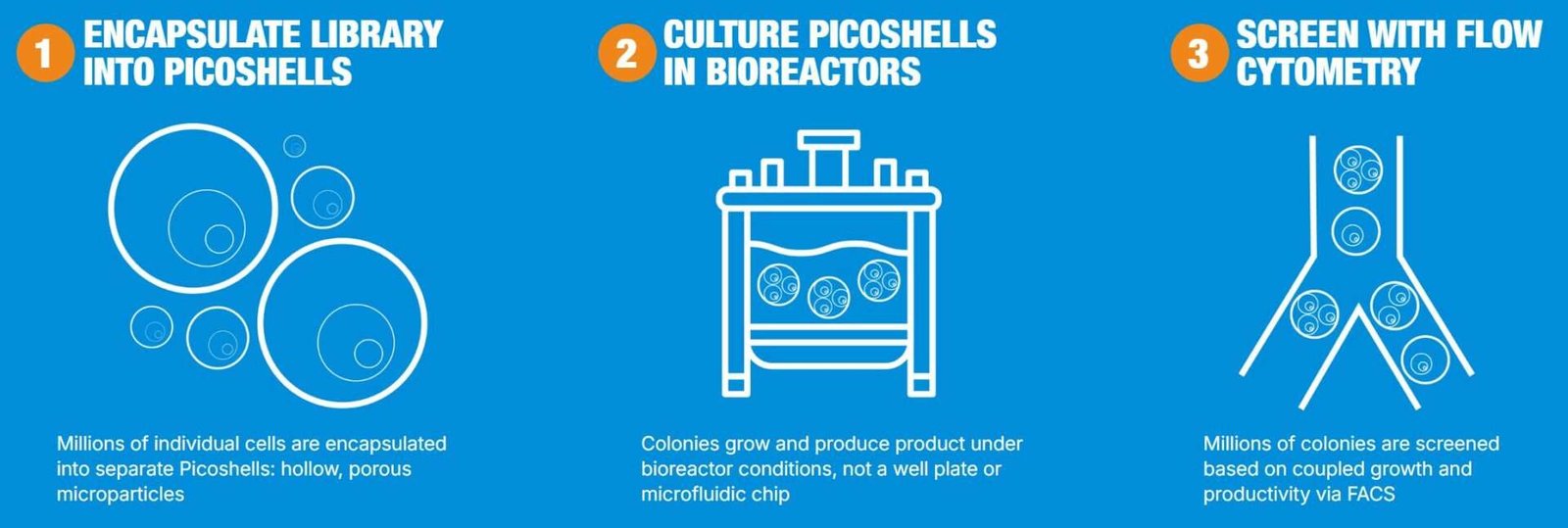
👉 Saku puts millions of separate strain variants into millions of separate PicoShells “like hollow whiffle balls” using a chip-based process “that essentially makes the PicoShells form around them.”
👉 The PicoShells (made from polyethylene glycol) are put into a benchtop bioreactor, where the strains grow and produce product.
👉 Saku then runs them through a flow cytometer equipped for FACS (fluorescence-activated cell sorting), which uses laser-based readouts to identify and physically sort the best-performing colonies.
👉 The best performers are then isolated and can be re-cultured for another round of optimization, says van Zee. “We iterate and go through that process again to find better and better variants with better manufacturing economics.”
Meanwhile, new image-based cytometers from firms such as BD Biosciences are expanding the range of traits Saku can screen for beyond growth and production to “things like protein aggregation, cell clumping, and other morphological or spatial features that weren’t possible before,” he says.
Faster and smarter screening
Notably, the PicoShells tech is not being pitched purely as a faster screening tool, but a smarter one.
The goal, says van Zee, is to help firms scale production more rapidly by identifying better-performing strains: cells that can deliver higher titers, consume a wider array of cheaper feedstocks, and carry characteristics that simplify downstream processing, a major cost driver in biomanufacturing.
“One cool thing about PicoShells is that we can look at multiple parameters at once. We’re just trying to increase the odds that you’re going to hit the economics that you need to make products that are economically viable.”
Validating the tech
The tech, which emerged from van Zee’s work at UCLA in the lab of bioengineering professor Dino Di Carlo, is used by Saku under license, with pending IP seeking to protect the use of PicoShells for growing and isolating cell colonies under conditions relevant to manufacturing, rather than single cells in a well plate or droplet, says van Zee.
“That’s going to be important for manufacturing applications, because a lot of times when people try to make screening tools, they use them for R&D applications, which is more single cell analysis.”
Founded by van Zee, John Alden, and Michael Mellody, PhD in 2024, Saku has been working with Lawrence Berkeley National Laboratory, Sandia National Laboratories, and the Advanced Biofuels and Bioproducts Process Development Unit at Berkeley Lab to generate validation datasets.
It’s early days, but case studies on lipid-producing yeast strains highlight how rapidly the approach can compress R&D timelines, says van Zee. Titers in one Rhodotorula toruloides variant increased from 38.6g/L to 50.4g/L and in one Yarrowia lipolytica variant from 7.4g/L to 10.8g/L in a 4-6 week process including bioassay development, screening, and validation.
As a point of comparison, assay-development work alone on microfluidic systems may take three to four months, he claims.
The business model
Saku has a two-pronged business model. The near-term model is a service/partnership model whereby customers either send strains to Saku, or Saku brings its compact setup onsite if customers do not want their core IP to leave their facilities.
The system can be reduced to roughly two benches of equipment, making onsite work more feasible than large automated platforms. Revenue would come through milestone-based agreements rather than large upfront platform fees or back-end royalties.
The longer-term, more “VC-backable” model is to develop off-the-shelf starter strains with better baseline economics—such as strains adapted to cheaper alternative feedstocks—and bundle those with software to help with genetic edits, media optimization, process optimization, and scale-up. In this model, Saku would own IP around the strain and relevant edits, while customers would own the IP around the molecule or product they make.
Beyond the giant biofoundry model
Notably, claims van Zee, Saku’s lower-capex setup avoids some of the pitfalls of earlier platform-biotech models, where companies such as Zymergen and Ginkgo built expensive automated foundries and sought to generate returns through high service fees, royalties, equity stakes, or proprietary products to make the economics work.
To date, Saku has had interest from pharma, ag, and industrial biotech, but says he sees particular interest from food and ag, particularly in protein production, although the tech is “cell-agnostic,” he says.
“Essentially we can look at any cell type from yeast and bacteria to CHO cells (widely used mammalian production cells) to plant cells, although filamentous fungi give us some problems, as they do a lot of other people.”
Saku started its pre-seed round about a month ago, says van Zee, who says he started to get multiple expressions of potential customer interest while he was still at university, including from a large pharmaceutical company interested in using it for antibody discovery.
“I had to say whoa! Let’s take a step back and figure out where we want to play in the stack.”
Further reading:
Could ‘chickpea-sized’ biosensors make biomanufacturing more cost competitive?
Vivici sees 30% boost in titers, yield, via cell productivity tech from Enduro Genetics
Fermeate raises $2m to deliver “step change” in precision fermentation economics with optogenetics
Funding dip for alt protein fermentation signals shift from promise to proof
The post Saku Biosciences bets on tiny “PicoShells” to solve a big biomanufacturing problem appeared first on AgFunderNews.


