





8 Predictions for the Future of Fraud
Fraud is entering a new era. Businesses across North America expect fraud trends like biometric fraud, deepfake scams, and synthetic identities to become more common in 2026 as criminals adopt faster and more sophisticated tools.
This visualization, created in partnership with Inigo for the Fraud in Data campaign’s sixth post, uses data from the Sumsub Fraud Report 2025 to explore the fraud trends businesses believe will shape the future of digital risk.
Biometric Fraud Could Become the Biggest Threat
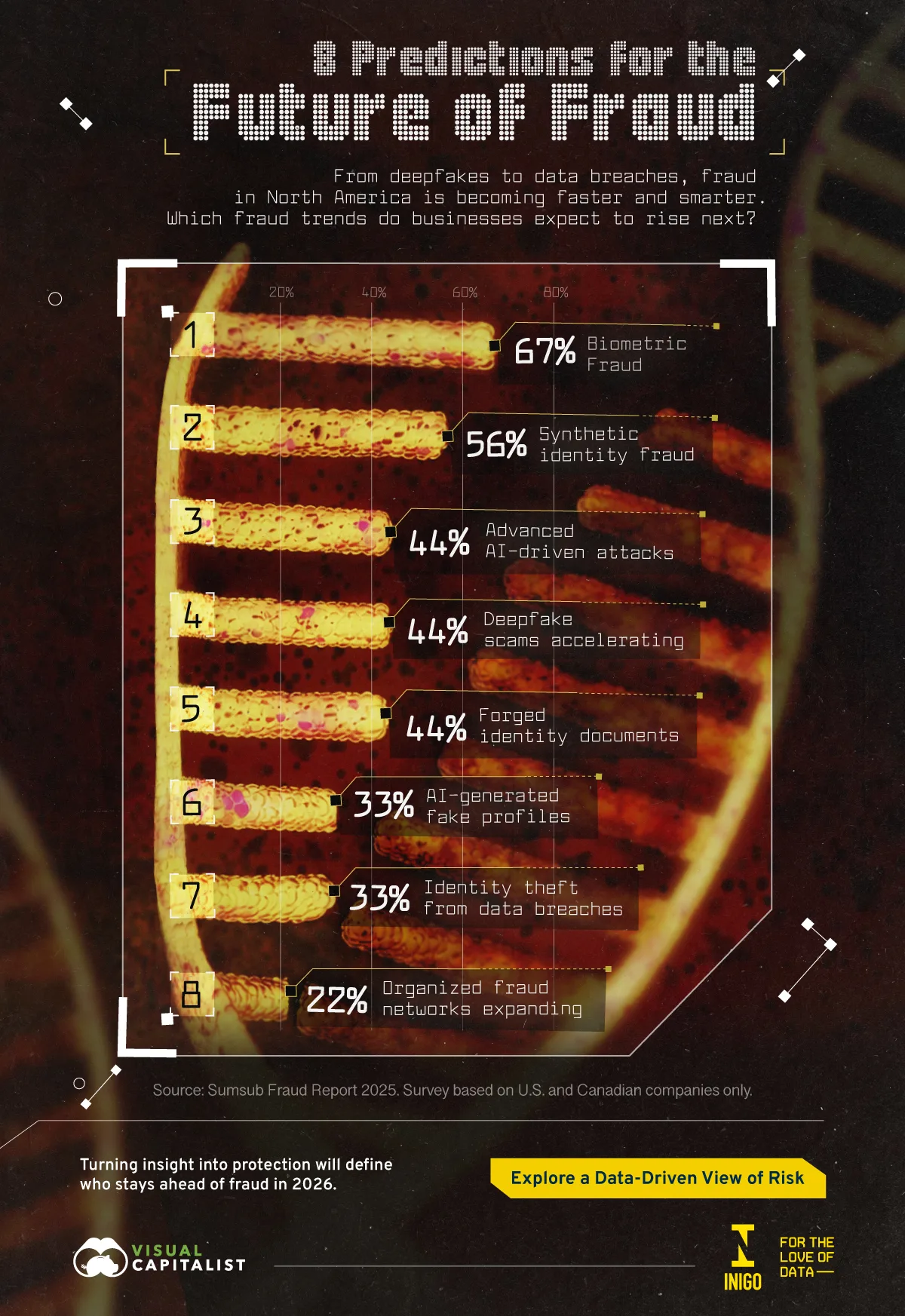
Surveyed businesses expect biometric fraud to rise the most, with 67% predicting an increase. As companies rely more on facial recognition, voice authentication, and remote onboarding, fraudsters are finding new ways to exploit those systems.
| Fraud Trend | Share Expecting an Increase (%) |
|---|---|
| Biometric fraud | 67 |
| Synthetic identity fraud | 56 |
| Advanced AI-driven attacks | 44 |
| Deepfake scams accelerating | 44 |
| Forged identity documents | 44 |
| AI-generated fake profiles | 33 |
| Identity theft from data breaches | 33 |
| Organized fraud networks expanding | 22 |
Deepfake technology is already making identity verification harder. In the future, AI-generated videos, cloned voices, and stolen biometric data could make fraud attempts more convincing and more scalable than ever before.
Businesses also expect synthetic identity fraud to grow, with 56% anticipating a rise. Criminals are increasingly combining real and fake information to create identities that can bypass traditional fraud checks.
AI and Deepfakes Are Changing Fraud Trends
Businesses expect fraud attacks to become more automated in 2026. Around 44% predict increases in advanced AI-driven attacks, deepfake scams, and forged identity documents.
Another 33% expect AI-generated fake profiles to rise as fraudsters use generative AI tools to impersonate real users online. These scams could become faster to produce and harder to detect across financial services, ecommerce, and digital platforms.
As fraud tactics evolve, businesses may need to shift from reactive fraud prevention toward real-time risk monitoring powered by machine learning and behavioral analysis.
Data Breaches Will Continue to Fuel Identity Fraud
Data breaches are expected to remain a major source of fraud risk. About 33% of businesses anticipate more identity theft linked to stolen personal data.
Organized fraud networks are also expanding, according to 22% of respondents. As cybercriminal groups become more coordinated, fraud operations could become increasingly global and industrialized.
The Future of Fraud Trends
Companies that invest in adaptive verification systems, stronger cybersecurity, and understand the data around fraud prevention may be better positioned to respond to the next generation of threats.

In 2026, turning insight into action will define who stays ahead of fraud. Explore a data-driven view of risk at Inigo’s insights hub.
-

 Cryptocurrency3 days ago
The Biggest Crypto Hacks Since 2025, Ranked by Money Lost
Bybit’s massive $1.5 billion breach leads a wave of crypto hacks that have cost the industry billions since 2025.
-
 Cryptocurrency5 days ago
Most Crypto Hacks Don’t Start With Stolen Wallets—They Start in the Code
Five of the top ten crypto hacking methods exploit code vulnerabilities. See how attackers manipulate tokens, prices, and crypto platforms.
-
 Crime1 week ago
The Largest Employee Fraud Cases in 2025–2026
Employee embezzlement schemes stole tens of millions before being detected. See the biggest fraud cases from May 2025 to April 2026.
-
 Crime1 week ago
The New Face of Fraud: Five Scams Costing Companies Millions
From deepfakes to phishing, these social engineering scams are becoming more convincing—and more expensive.
-
 Crime2 weeks ago
Mapped: Fraud Vulnerability by Country in 2025
Which countries face the highest fraud risk in 2025? Explore global fraud vulnerability rankings to see how economies compare.
-
 Geopolitics2 months ago
Ranked: Top 10 Countries With the Most U.S. Troops in 2025
The global footprint of U.S. troops remains extensive with deployments concentrated across a small group of strategic host countries.
-
 Geopolitics2 months ago
Countries Losing Trust in the U.S.
Global perceptions of trust in the United States are shifting, reflecting a broader reassessment of alliances in a more uncertain world.
-
 Real Estate3 months ago
Mapped: The U.S. Cities at Risk of Sinking
Across the U.S., the ground beneath many major cities is gradually subsiding. 25 out of America’s 28 largest cities are slowly sinking.
-
 Real Estate3 months ago
Charted: The Escalating Destruction of U.S. Wildfires
Wildfires in the United States are becoming more destructive, with many of the most severe seasons occurring in the past decade.
-

 Real Estate3 months ago
Mapped: The U.S. States Building the Most Homes in the Fire Line
As housing spreads into the fire line, exposure is rising sharply, compounding loss potential and challenging long-term insurability.
-
 Real Estate3 months ago
The Rising Costs of U.S. Construction Inputs
Rising labor and material costs mean every insured dollar now rebuilds less, widening the recovery gap after disasters across the United States.
-
 Real Estate3 months ago
How Do Interest Rates Impact the Real Estate Market?
Lower interest rates have often supported stronger real estate returns and improved valuations. Will that trend return in 2026?
-

 Real Estate3 months ago
6 Trends Reshaping U.S. Property Insurance
From climate volatility to economic and technological shifts, a wide range of forces are reshaping property risk in the U.S.
-

 Environment7 months ago
Ranked: The 10 Most Powerful U.S. Hurricanes (1900-2025)
Hurricanes are a defining force in the U.S. climate, capable of leaving behind profound environmental, social, and economic devastation.
-
 Environment8 months ago
Mapped: Which U.S. Cities Saw Record-Breaking Temperatures in 2024?
Global temperatures are climbing—but how is this trend playing out across the United States, and which regions are being hit the hardest?
-

 Environment9 months ago
Ranked: The Most Expensive U.S. Wildfire Events, So Far
Wildfire events are growing increasingly frequent and destructive around the world as human-driven climate impacts continue to escalate.
-

 Environment9 months ago
Mapped: The United States of Drought
Drought grips much of the U.S., affecting over 60 million people today.
-

 Healthcare10 months ago
The $58B Weight Loss Drug Market in One Chart
Weight loss drugs have surged in popularity in recent years, transforming the pharmaceutical landscape. Which brands are dominating this space?
-
 Healthcare10 months ago
Ranked: Which Areas Receive the Most Pharma R&D?
The pharmaceutical industry has made enormous strides in treating—and even curing—a wide range of diseases and conditions. Which areas are seeing the most R&D in 2025?
-

 Healthcare10 months ago
The $5.6T Pharmaceutical Industry in One Chart
Pharma giants don’t just make medicine—they shape the future of healthcare. Who are the world’s major players?
-

 Crime11 months ago
6 Fraud Trends Reshaping Risk in 2025
The fraud and financial crime landscapes are evolving rapidly. What are the key threats shaping risk in 2025?
-

 Cryptocurrency11 months ago
Ranked: The 10 Biggest Digital Heists
Some of the largest digital heists didn’t rely on brute-force hacking, they exploited the weakest link in security: human trust.
-

 Crime11 months ago
The Most Costly Financial Crimes in 2024
As cybersecurity threats escalate, which financial crimes are causing the most harm? The FBI has the data.
-
 Crime11 months ago
Mapped: U.S. Financial Crime Activity by State
Suspicious activity has been rising in the U.S., but is it spread evenly throughout all 50 states? Certainly not.
-
 Crime11 months ago
Ranked: America’s Most Common Financial Crimes
As technology and AI become more widespread, fraud and other suspicious activity are rising across America. Which types are the most common?
-
 Economy11 months ago
Tracking the $3.1 Trillion Financial Crime Pandemic
From money laundering to fraud, financial crime acts as a drain on the economy, totaling an incredible $3.1 trillion.
-
 Politics12 months ago
Which Types of Government Rule the World?
Over half the global population is ruled by non-centrist types of government, including autocracies and left or right wing parties.
-
 Politics12 months ago
Breaking Down the $524 Billion Investment Needed to Rebuild Ukraine
Ukraine will require an estimated $524B over the next decade to recover from the Russia-Ukraine war. Which sectors have been most impacted?
-
 Politics1 year ago
Are Tariffs Causing U.S. Inflation Fears?
Amid tariff increases, consumers’ expectations for U.S. inflation in the next five years have reached their highest level since March 1991.
-

 Politics1 year ago
Ranked: Executive Orders by President in the First 100 Days
In his first 100 days, President Trump has issued far more executive orders than any other president in history.