
Just how enriching are the enrichments pork producers use for their pigs on Canadian farms?
That was a topic of conversation at a recent Prairie Swine Centre (PSC) producer meeting.
Why It Matters
Happy pigs are more productive, and enrichment could save producers as much as $10 an animal, according to research from the Western College of Veterinary Medicine.
Hanging chains are common to make the barn environment more interesting, but there may be better options. Miranda Smit from the PSC’s Knowledge Transfer team presented research suggesting potential toys and renewable materials like cardboard and rope were more effective in reducing medication use among the swine herd and pig removal rates.
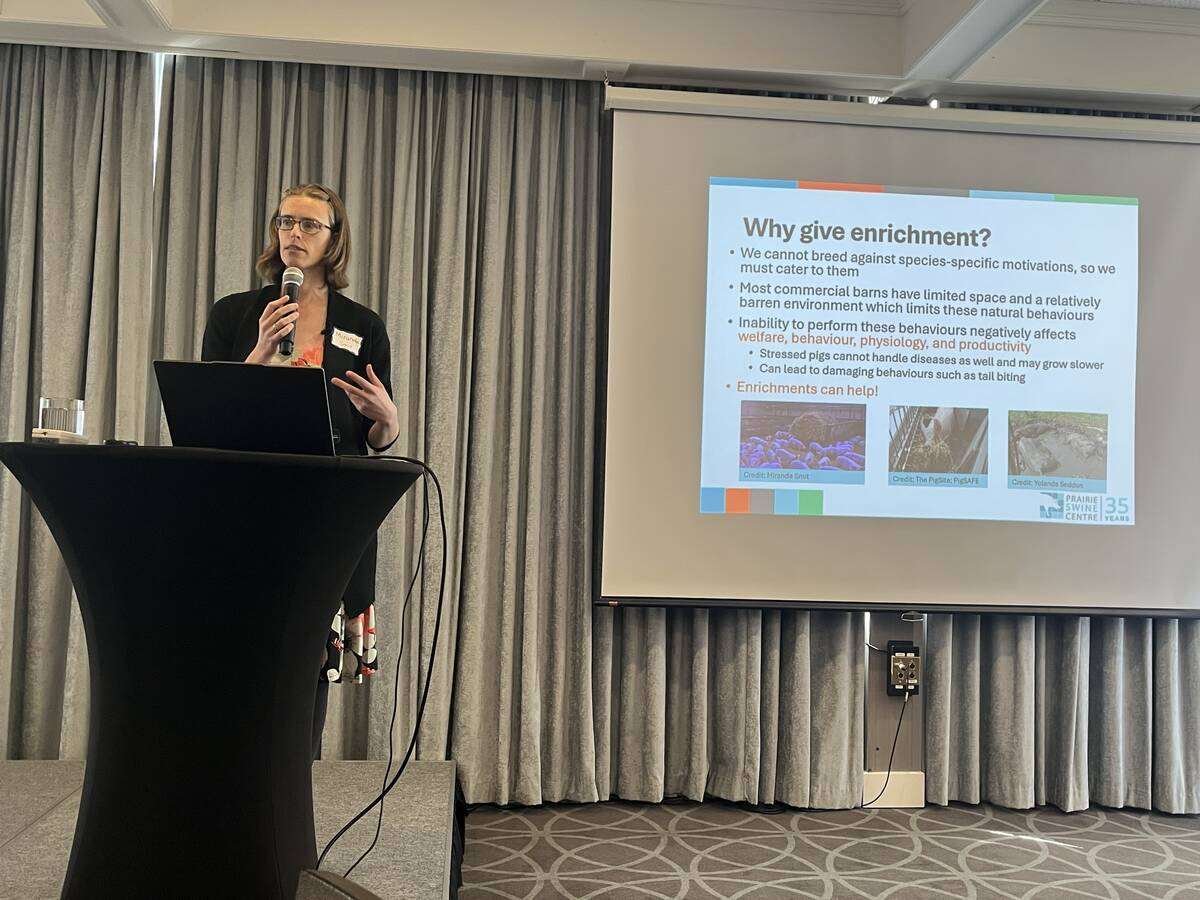
The introduction of enrichments is important to allow them to express their natural behaviour.
“For pigs, this means foraging behaviour, such as rooting, exploring, chewing, nesting behavior for cells, and then thermo-regulatory behaviour. We all know, pigs cannot sweat, so they’ll be wallowing to stay cool,” said Smit, assistant manager of knowledge transfer at PSC.
“The pigs that we have on the farms today, they still have these motivations, because they’re important to the survival of the species, we cannot breed against them. So that means we have to cater to it. Most commercial barns have limited space and a relatively barren environment compared to the wild. So it means that there’s a bit of an inability for these pigs on the farms today to perform these behaviours, and this can have negative impacts, both on welfare, on behaviour, physiology and even on productivity.”
This can include stressed pigs with higher medication use and higher mortality, tail-biting behaviour, and lower growth rates which enrichments can help with.
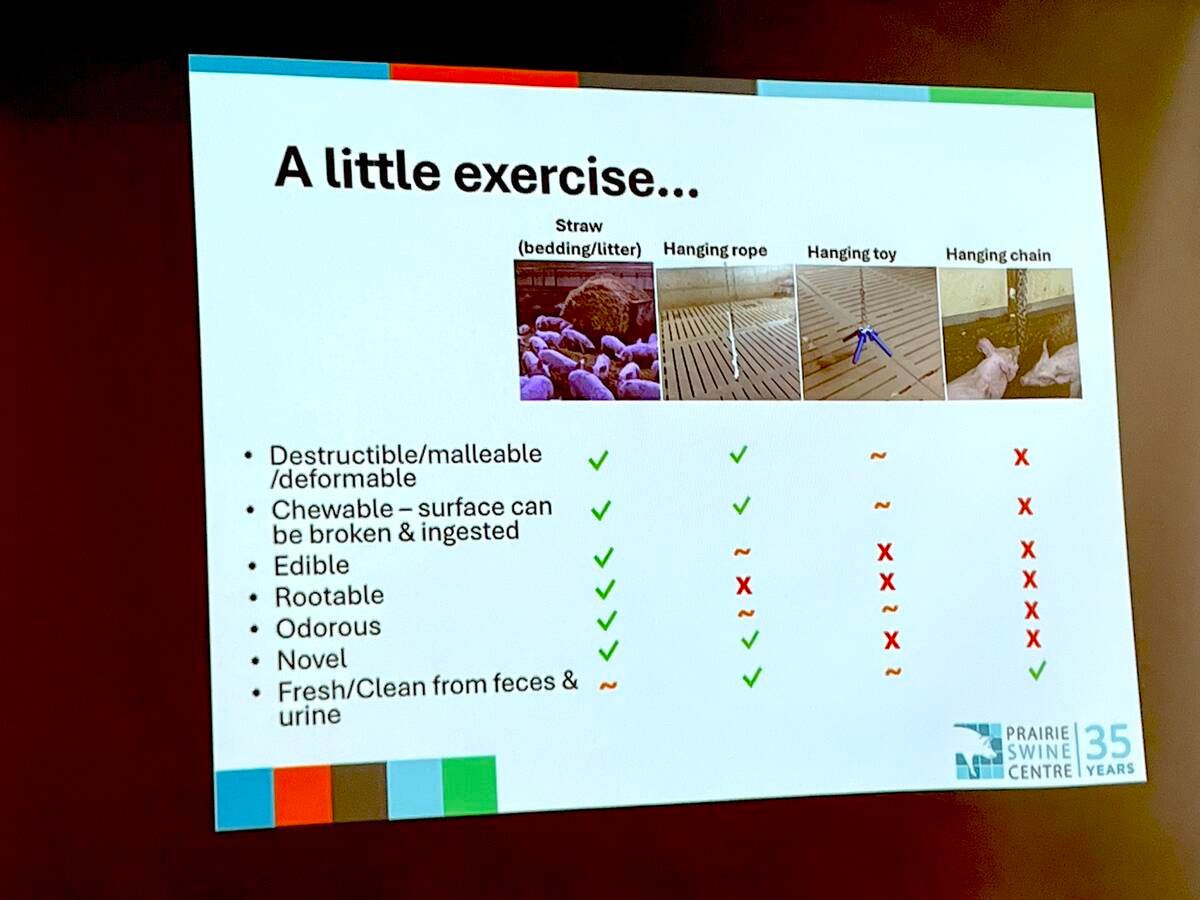
To encourage rooting and chewing, effective enrichments are destructible, malleable, can change shape and are odorous.
“Pigs love things that have a smell, and it needs to be novel and fresh, staying clean from feces and urine,” said Smit.
What makes good pig enrichment?
Prairie Swine Centre research points to seven criteria producers can use to evaluate enrichment options:
- Destructible, malleable or deformable
- Chewable — surface can be broken and ingested
- Edible
- Rootable
- Odorous
- Novel
- Stays fresh and clean from feces and urine
Chains had higher removals, more medication
A research trial was done with a couple of commercial barns and a research farm at PSC to find practical enrichments for pigs that are affordable and not highly labour intensive. Pig performance, carcass traits, the ease of handling of the pigs, level of aggression and damaging/regular behaviour was observed.
Functional groups were 24-28 pigs per pen in the nursery and 24-48 pens for grower/finisher with size of enrichments adjusted and number consistent across groups with chains, static toys and renewables (cardboard rolls/edge protectors/rope/wood).
The highest removals (found dead, euthanized, moved to sick pens) were found in the chain control group, especially in the grower phase. They also had the highest medication use in both commercial barn and PSC settings, to go with worse tail and ear lesion scores in several phases.
Why chain pens posted better carcass weights
An outlier in the chain group was better carcass weights, but Smit cautions it is to be expected given the higher removal rates for animal spacing in pens.
“There’s more feeder space per pig. There’s more space in general, per pig, so they tend to grow better. We think the reason why they had a higher carcass weight and life weight is not because chains do more for the welfare of the pigs. It’s because they had less pigs in the pen,” said Smit.
“When you look at the total amount of carcass weight, so that is the number of carcasses multiplied by the live weight, when you compare that for the groups, you’ll see that there was about 60,000 kilos of carcass weight for the chains and the renewable group, but there was 2,000 extra kilos in the toys room, and this is what you’re getting paid on.”
Finding the right enrichment-to-pig ratio
Static enrichments like blue and yellow luna balls, porky plates and astro toys sprayed with Phytozen (lowers aggression and increases enrichment interest) used across various stages in nursery, grow-finish and finisher pens worked slightly better than renewable enrichments for performance and welfare. It emphasised the quality of the enrichment should stay consistent throughout the pig’s growth phases.
“We think it’s because the rope and the cardboard disappeared within a few days, and then the rest of the week they only had a chain left, whereas the toys, they were staying there the entire time. It’s possible also that the Phytozen may have had some effect,” said Smit.
“There’s a potential for frustration in pigs if they are exposed to very effective and attractive enrichment first, and then it gets taken away.”
Given the trials had differing space available for the pigs in the commercial and PSC centre trials, there were educated guesses on what the sweet spot was for number of enrichments per pen.
“I do think if you want to use enrichment to reduce tail biting and improve the welfare of these animals, which really is what we want to do, then probably one in 24 is not quite enough. So it might be closer to one in nine, maybe one in 15.”
Cookies, crackers and the case against chains
Smit encouraged producers to look for the enrichments that check off the most boxes in destructible, malleable, can change shape, are odorous and be novel and stay fresh. While chains can stay clean, they offer very little other value.
“Imagine you’re a little hungry and you have a craving for something sweet. If you’re having a craving for something sweet, you’re probably going to eat the cookie. You’re going to feel satisfied. But now imagine that all you find is a salty cracker. Is that going to satisfy your craving for something sweet? Probably not,” said Smit.
“Basically, chains are like the salty cracker. If you only provide chains, they will chew on it but it doesn’t provide that positive feedback. Once they’re done chewing on the chain, they’ll move on and find something else to chew on, because they still have that need to chew. But if you provide straw, which is kind of like the muffin. They will chew on the straw. They feel satisfied, so they will not go and look for something else to chew on afterwards. And this is where tail biting issues are found.”
The post Pig enrichment options vary in their effectiveness appeared first on Farmtario.


