
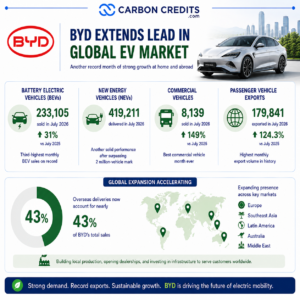
Chinese electric vehicle giant BYD continues to widen its lead in the global EV market. The company sold 233,105 battery electric vehicles (BEVs) in July 2026, up 31% from the same month last year. It was BYD’s third-highest monthly BEV sales on record and another sign that demand remains strong both in China and overseas.
When plug-in hybrids are included, BYD delivered about 419,211 new energy vehicles (NEVs) during the month. That marked another solid performance after the company surpassed the 2 million-vehicle mark earlier this year.
July also showed strength beyond passenger cars. BYD sold 8,139 commercial vehicles, including buses and trucks, up 149% year-over-year. It was the company’s best commercial vehicle month ever and highlights its growing role in electrifying public transport and freight.
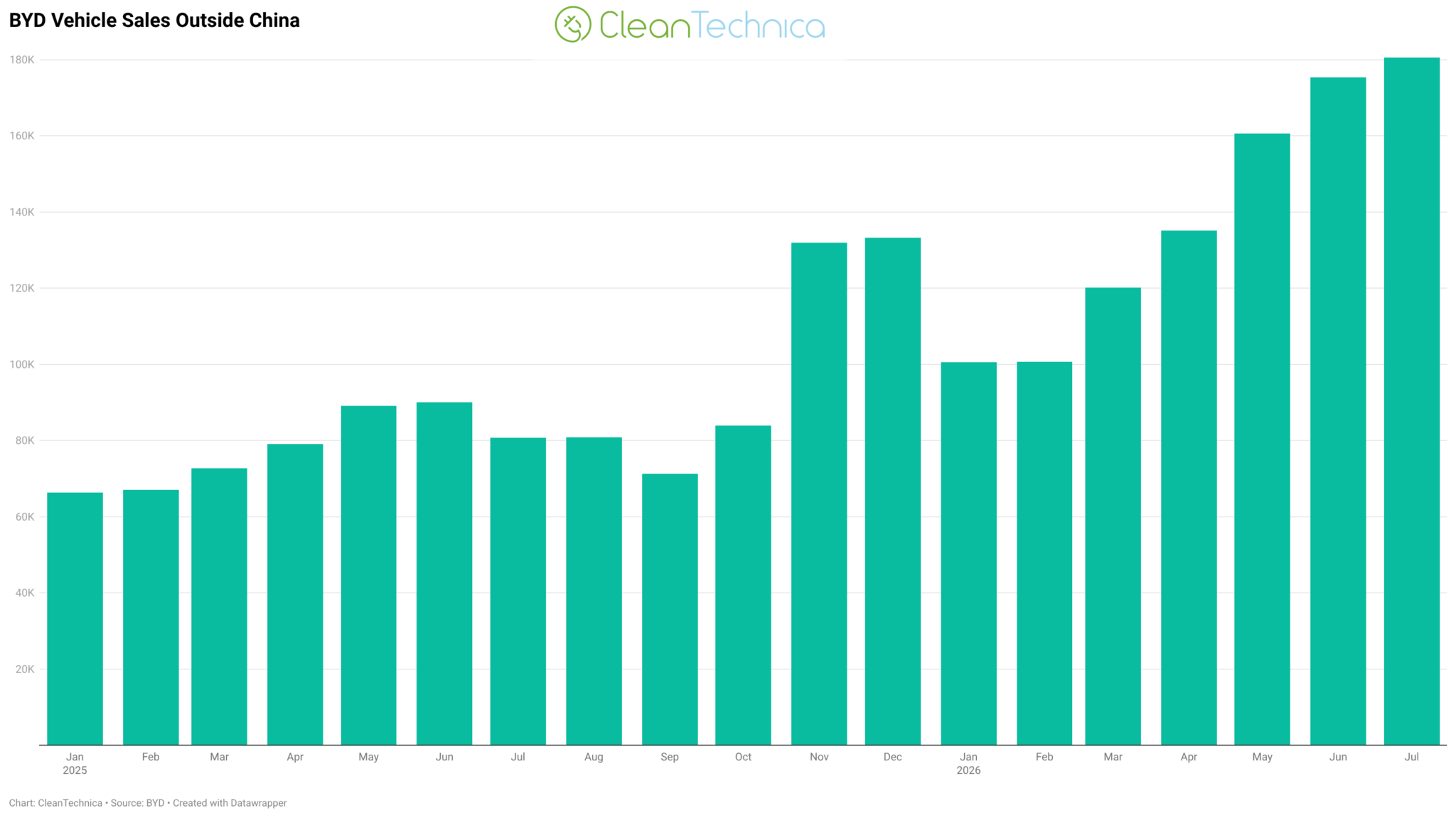
At the same time, BYD achieved another major milestone outside China. The company exported 179,841 passenger vehicles in July, up 124.3% from a year earlier and the highest monthly export volume in its history.
Overseas deliveries now account for nearly 43% of vehicles BYD sells. These results show that international markets are becoming one of the company’s biggest growth drivers.
Record Exports Put BYD in the Global Fast Lane
For years, BYD depended mainly on China’s domestic market. That is changing quickly.
The company is expanding across Europe, Southeast Asia, Latin America, Australia, and the Middle East. It continues to launch new dealerships, open regional headquarters, and build local production facilities to serve overseas customers.
Europe remains one of its biggest targets. BYD now sells vehicles in more than 20 European countries. It is also building passenger car plants in Hungary and Türkiye to shorten delivery times and reduce import costs. Those factories are expected to strengthen BYD’s position as competition grows in Europe’s EV market.
The Chinese EV maker is following a similar strategy in other regions. In Brazil, Thailand, Indonesia, and Mexico, BYD is expanding manufacturing and assembly operations while increasing investments in charging infrastructure and sales networks.
This global push is paying off. Record exports helped offset slower growth in China’s broader auto market and reduced BYD’s dependence on any single country.
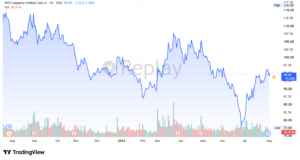
BYD shares rose about 0.8% on August 4, 2026, after the company reported record July exports and another month of strong EV sales. Investors welcomed the continued growth in overseas deliveries, which helped offset weaker demand in China’s domestic market. Analysts said the export momentum reinforces confidence in BYD’s long-term global expansion strategy.
Commercial EVs Become a New Growth Engine
Passenger cars remain BYD’s biggest business, but commercial vehicles are growing even faster. The company’s 149% jump in commercial vehicle sales reflects rising demand for electric buses, trucks, and delivery vehicles.
Cities around the world are replacing diesel buses with electric fleets to improve air quality and reduce emissions. Logistics companies are also adding electric trucks as battery technology improves and operating costs fall.
BYD has become one of the world’s largest electric bus manufacturers. Its buses now operate in more than 400 cities across over 70 countries, according to the company. These vehicles have helped transit agencies lower fuel costs while cutting greenhouse gas emissions from public transportation.
Commercial vehicles could become an increasingly important source of future growth as governments tighten emissions rules and businesses electrify their fleets.
Scaling EV Production While Cutting Carbon
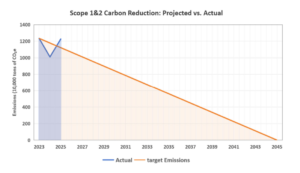
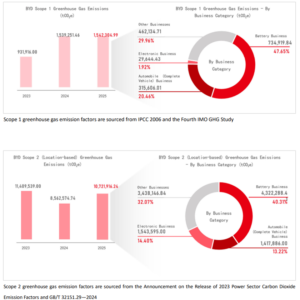
BYD’s rapid growth also supports its broader sustainability strategy. The company has pledged to achieve carbon neutrality across its operations by 2045. It is working toward that goal by expanding renewable energy, improving factory efficiency, and reducing emissions throughout its supply chain.
Battery technology remains one of BYD’s biggest strengths.
Its Blade Battery, introduced in 2020, uses lithium iron phosphate (LFP) chemistry. These batteries avoid nickel and cobalt, improve safety, and typically have a longer operating life. They also help lower production costs, giving BYD a pricing advantage in many markets.
The company continues to expand renewable electricity at its manufacturing sites while improving recycling and energy management. According to its latest sustainability report, BYD has also increased the use of rooftop solar systems and energy-saving technologies across its factories to reduce operational emissions.
These investments support both higher production and lower carbon intensity as the company expands worldwide.
The Global EV Market Keeps Breaking Records
BYD’s strong July results come as the global EV market continues to grow.
According to the International Energy Agency (IEA), global electric car sales exceeded 20 million units in 2025, making up more than 25% of all new car sales worldwide. The agency expects sales to continue rising through the rest of this decade as battery prices fall and more affordable models enter the market.
China remains the world’s largest EV market. The country accounted for more than half of global EV sales in 2024. It also leads the world in battery production, charging infrastructure, and electric bus deployment. These advantages have helped companies like BYD scale production faster than many global rivals.
The market is also becoming more competitive.
Chinese automakers are expanding into Europe, Southeast Asia, Latin America, and the Middle East. At the same time, established brands such as Tesla, Volkswagen, Hyundai, and Ford are introducing new EV models to defend their market share.
Scale Is Giving BYD an Edge
One of BYD’s biggest strengths is that it controls much of its own supply chain. The company designs and builds its own batteries, electric motors, and many of the key parts used in its vehicles. This reduces costs and helps protect production from supply chain disruptions.
It also gives BYD more flexibility to launch new models quickly and keep prices competitive. That advantage has become even more important as battery prices continue to fall and competition increases across the global EV market.
A Bigger Role in the Global Energy Transition
BYD’s latest sales report shows another strong month. The company is becoming one of the biggest forces in the global shift to electric transportation.
Strong domestic demand continues to support its business, but record exports and rapid growth in commercial vehicles show that BYD is now competing on a much larger stage.
At the same time, its investments in cleaner manufacturing, renewable energy, and battery technology support its long-term goal of reaching carbon neutrality by 2045.
As countries work to reduce transport emissions, companies that can produce affordable electric vehicles at large scale will likely play a bigger role in the transition. BYD’s latest results suggest it is becoming one of those companies. Its combination of growing exports, expanding commercial vehicle sales, and continued investment in clean technology is helping shape the next chapter of the global EV market.
The post BYD’s (BYDDY Stock) Record EV Sales Power Its Race Toward Net Zero and Global Market Dominance appeared first on Carbon Credits.


