Ranked: Europe’s Most Powerful Economic Centers
See visuals like this from many other data creators on our Voronoi app. Download it for free on iOS or Android and discover incredible data-driven charts from a variety of trusted sources.
Key Takeaways
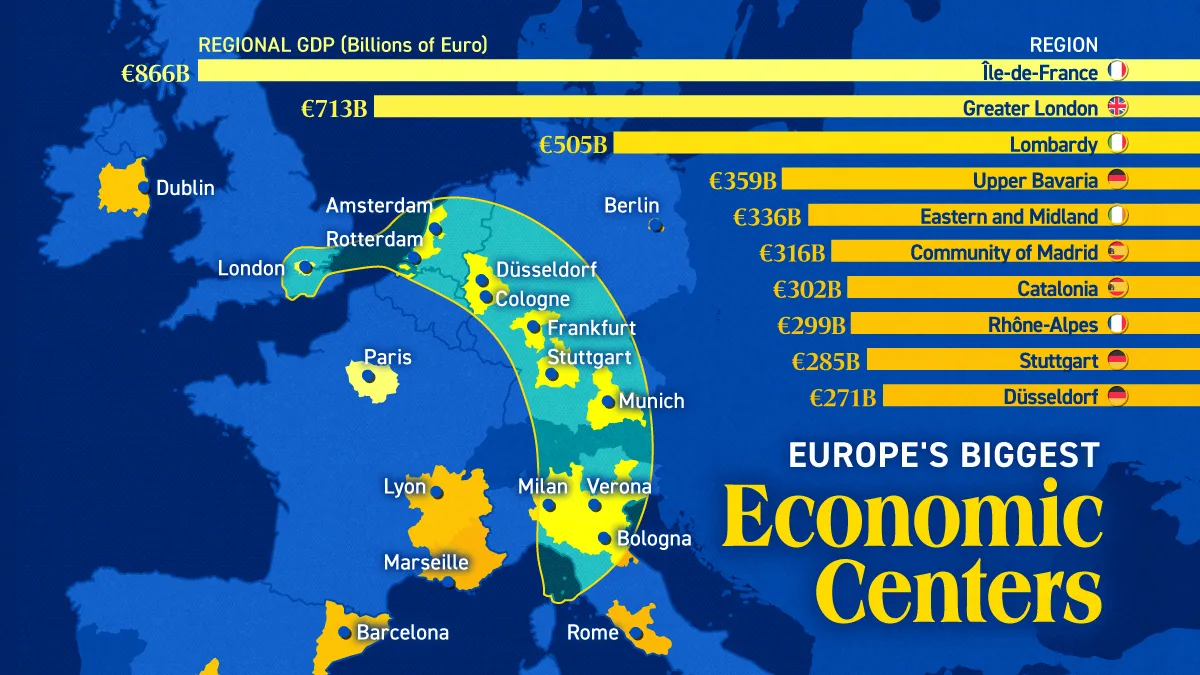
- Paris and London anchor Europe’s two most powerful economic centers, with regional GDPs of €866 billion and €713 billion, respectively.
- Many of Europe’s leading economic centers are concentrated in the Blue Banana, a corridor stretching from southern England to northern Italy.
- Germany places five regions among Europe’s top 20 economic centers, more than any other country.
Europe’s economic power is concentrated in a relatively small number of regions anchored by globally important cities such as Paris, London, Milan, Munich, and Madrid.
This map ranks Europe’s most powerful economic centers by regional GDP using the latest available data from Eurostat and the UK Office for National Statistics. Together, these regions serve as the continent’s leading hubs for finance, industry, technology, trade, and business services.
A clear geographic pattern emerges from the rankings. Many of Europe’s largest regional economies are clustered along the Blue Banana, a corridor running from southern England through the Benelux countries and western Germany to northern Italy that has long formed the backbone of the European economy.
A Tale of Two Cities
Île-de-France ranks as Europe’s most powerful economic center, generating €866 billion in GDP. Anchored by Paris, the region accounts for nearly a third of France’s economic output despite housing only about one-fifth of the country’s population. Its influence extends far beyond France through its roles in finance, business services, luxury goods, tourism, and government.
The following data table lists top European regions by GDP.
| Rank | Region | Regional GDP (billions of euro) | Largest City |
|---|---|---|---|
| 1 |  Île-de-France Île-de-France |
866 | Paris |
| 2 |  Greater London Greater London |
713 | London |
| 3 |  Lombardy Lombardy |
505 | Milan |
| 4 |  Upper Bavaria Upper Bavaria |
359 | Munich |
| 5 |  Eastern and Midland Eastern and Midland |
336 | Dublin |
| 6 |  Community of Madrid Community of Madrid |
316 | Madirid |
| 7 | Catalonia |
302 | Barcelona |
| 8 | Rhône-Alpes |
299 | Lyon |
| 9 | Stuttgart |
285 | Stuttgart |
| 10 | Düsseldorf |
271 | Düsseldorf |
| 11 | Darmstadt |
267 | Frankfurt |
| 12 | Lazio |
246 | Rome |
| 13 |  North Holland North Holland |
243 | Amsterdam |
| 14 | Cologne |
237 | Cologne |
| 15 | South Holland |
231 | Rotterdam |
| 16 | Provence-Alpes-Côte d’Azur |
218 | Marseille |
| 17 | Andalucia |
212 | Seville |
| 18 | Berlin |
208 | Berlin |
| 19 | Veneto |
201 | Verona |
| 20 | Emilia-Romagna |
198 | Bologna |
Equivalent up-to-date data not available for Switzerland or other non-EU states.
The British equivalent to Île-de-France, Greater London, ranks second in Europe with a regional GDP equivalent to €713 billion. Greater London encompasses the urban area surrounding the British capital, which is a global hub for sectors such as finance, insurance, and media.
London and Paris have been two of Europe’s most prominent economic and political centers for centuries. The two cities today anchor regions that attract more international tourists than nearly anywhere else worldwide.
The Blue Banana
European industrial output has been concentrated for decades in a small, non-contiguous corridor beginning in England and extending to northern Italy. Owing to its shape, this corridor has been referred to as the Blue Banana, or the Liverpool–Milan Axis.
The Blue Banana serves as the backbone of the European economy. The corridor is concentrated around German industrial heartlands such as the regions of Cologne (€237 billion), Stuttgart (€285 billion), and Upper Bavaria (€359 billion), the last of which includes Munich.
However, the corridor also extends into the prime Dutch port regions of North (€243 billion) and South (€231 billion) Holland, as well as into productive northern Italian regions such as Lombardy (€505 billion) and Veneto (€201 billion).
Leprechaun Economics
Most of the regions that power the European economy in modern times have been hubs of industrial or mercantile activity for centuries, whether in the North Sea or Western Mediterranean.
One notable exception emerges in the Irish region of Eastern and Midland, which at €336 billion has a larger regional GDP than either Catalonia (€302 billion) or Italy’s capital region of Lazio (€246 billion).
While Eastern and Midland, home to Dublin, is indeed a productive and highly developed area, the region’s massive GDP is attributable in no small part to the accounting practices of major multinationals that maintain European offices in Dublin for tax purposes.
Learn More on the Voronoi App 
Curious how all this economic output translates to people’s pockets? Check out Which European regions have the highest income levels? on Voronoi, the new app from Visual Capitalist.