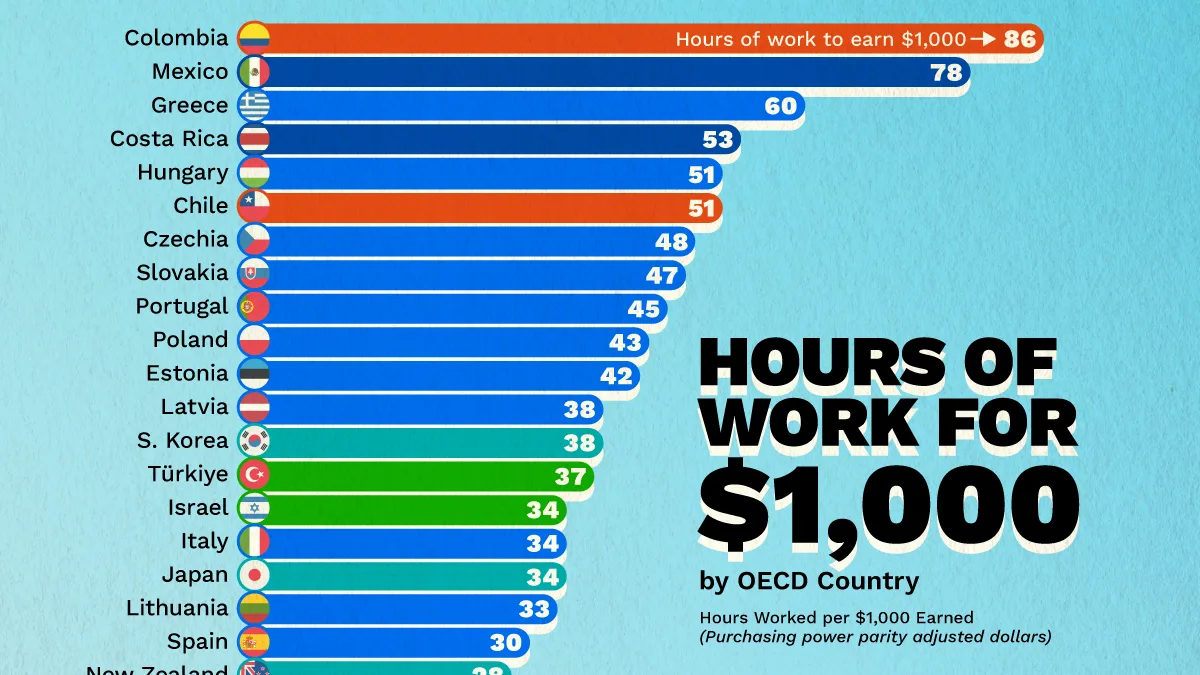
Ranked: The Countries Where $1,000 Takes the Longest to Earn
See visuals like this from many other data creators on our Voronoi app. Download the app for free on iOS or Android and discover data-driven charts from a variety of trusted sources.
Key Takeaways:
- Workers in Colombia need 86 hours to earn $1,000, compared with just 16 hours in Luxembourg and Iceland.
- The gap between the highest- and lowest-ranked countries exceeds fivefold, even after adjusting for differences in local purchasing power.
- The average American worker needs about 22 hours to earn $1,000, placing the U.S. among the stronger earners in the OECD.
How long would you need to work to earn $1,000? In Colombia, the answer is roughly 86 hours. In Luxembourg and Iceland, it’s just 16.
Using data from the OECD on average annual wages and Our World in Data’s figures for annual working hours, this visualization ranks countries by how long it takes the average worker to earn $1,000.
The figures are expressed in purchasing power parity (PPP)-adjusted dollars, which account for differences in local price levels and make incomes more comparable across countries. Taxes are not included.
How Many Hours of Work Earn $1,000?
Workers in the lowest-ranked countries need more than five times as many hours to earn $1,000 as workers in the highest-ranked countries. The gap ranges from 16 hours in Luxembourg and Iceland to 86 hours in Colombia.
The data table below shows the number of hours worked per $1,000 earned by country in purchasing power parity-adjusted dollars:
| Rank | Country | Hours Worked per $1,000 Earned |
|---|---|---|
| 1 |  Colombia Colombia |
86 |
| 2 |  Mexico Mexico |
78 |
| 3 |  Greece Greece |
60 |
| 4 |  Costa Rica Costa Rica |
53 |
| 5 |  Hungary Hungary |
51 |
| 6 |  Chile Chile |
51 |
| 7 |  Czechia Czechia |
48 |
| 8 |  Slovakia Slovakia |
47 |
| 9 |  Portugal Portugal |
45 |
| 10 |  Poland Poland |
43 |
| 11 |  Estonia Estonia |
42 |
| 12 |  Latvia Latvia |
38 |
| 13 |  South Korea South Korea |
38 |
| 14 |  Turkey Turkey |
37 |
| 15 |  Israel Israel |
34 |
| 16 |  Italy Italy |
34 |
| 17 |  Japan Japan |
34 |
| 18 |  Lithuania Lithuania |
33 |
| 19 |  Spain Spain |
30 |
| 20 |  New Zealand New Zealand |
28 |
| 21 |  Ireland Ireland |
27 |
| 22 |  Slovenia Slovenia |
27 |
| 23 |  Finland Finland |
25 |
| 24 |  Canada Canada |
25 |
| 25 |  France France |
25 |
| 26 |  United Kingdom United Kingdom |
24 |
| 27 |  Sweden Sweden |
24 |
| 28 |  Australia Australia |
23 |
| 29 |  United States United States |
22 |
| 30 |  Belgium Belgium |
21 |
| 31 |  Germany Germany |
20 |
| 32 |  Austria Austria |
20 |
| 33 |  Denmark Denmark |
19 |
| 34 |  Netherlands Netherlands |
19 |
| 35 |  Norway Norway |
19 |
| 36 |  Switzerland Switzerland |
18 |
| 37 |  Iceland Iceland |
16 |
| 38 |  Luxembourg Luxembourg |
16 |
Europe dominates the top of the ranking. Luxembourg, Iceland, Switzerland, Norway, Denmark, and the Netherlands all require fewer than 20 hours of work to earn $1,000.
For comparison, the average American worker needs about 22 hours to earn $1,000, placing the U.S. among the stronger earners but still behind multiple European economies.
Latin America Earns Less While Working More
Colombia and Mexico sit at the bottom of the ranking, requiring 86 and 78 hours of work, respectively, to earn $1,000. Both figures are more than triple the U.S. level and more than four times higher than Luxembourg’s.
While workers in these countries often log similar or even greater annual hours than workers in richer economies, average wages remain substantially lower.
Research highlighted by Our World in Data finds that workers in lower-income countries tend to work longer hours while generating less income per hour worked. Economists point to lower productivity levels, a larger informal sector, reduced access to capital, and weaker wage growth as contributing factors.
Nordic Countries and Luxembourg Stand Out
At the other end of the spectrum are Luxembourg and the Nordic economies. Denmark, Norway, Iceland, and Finland combine relatively high wages with advanced, high-productivity economies.
Analysis from the Becker Friedman Institute and CEPR highlights how strong labor-market institutions, high workforce participation, and substantial investments in education contribute to both high wages and relatively compressed income distributions.
Luxembourg benefits from an especially high concentration of financial and professional services jobs, helping support some of the highest average wage levels in the world.
Why Purchasing Power Matters
The analysis uses purchasing power parity (PPP), which adjusts wages to reflect differences in local price levels. PPP adjustments allow economists to compare what incomes can actually buy in a specific country rather than relying solely on market exchange rates.
Without PPP adjustments, workers in lower-cost countries could appear poorer than they actually are, and vice versa.
Learn More on the Voronoi App 
Want to explore wage differences across Europe? Check out Mapped: Average Full-Time Salary in Europe by Country on the Voronoi app.