



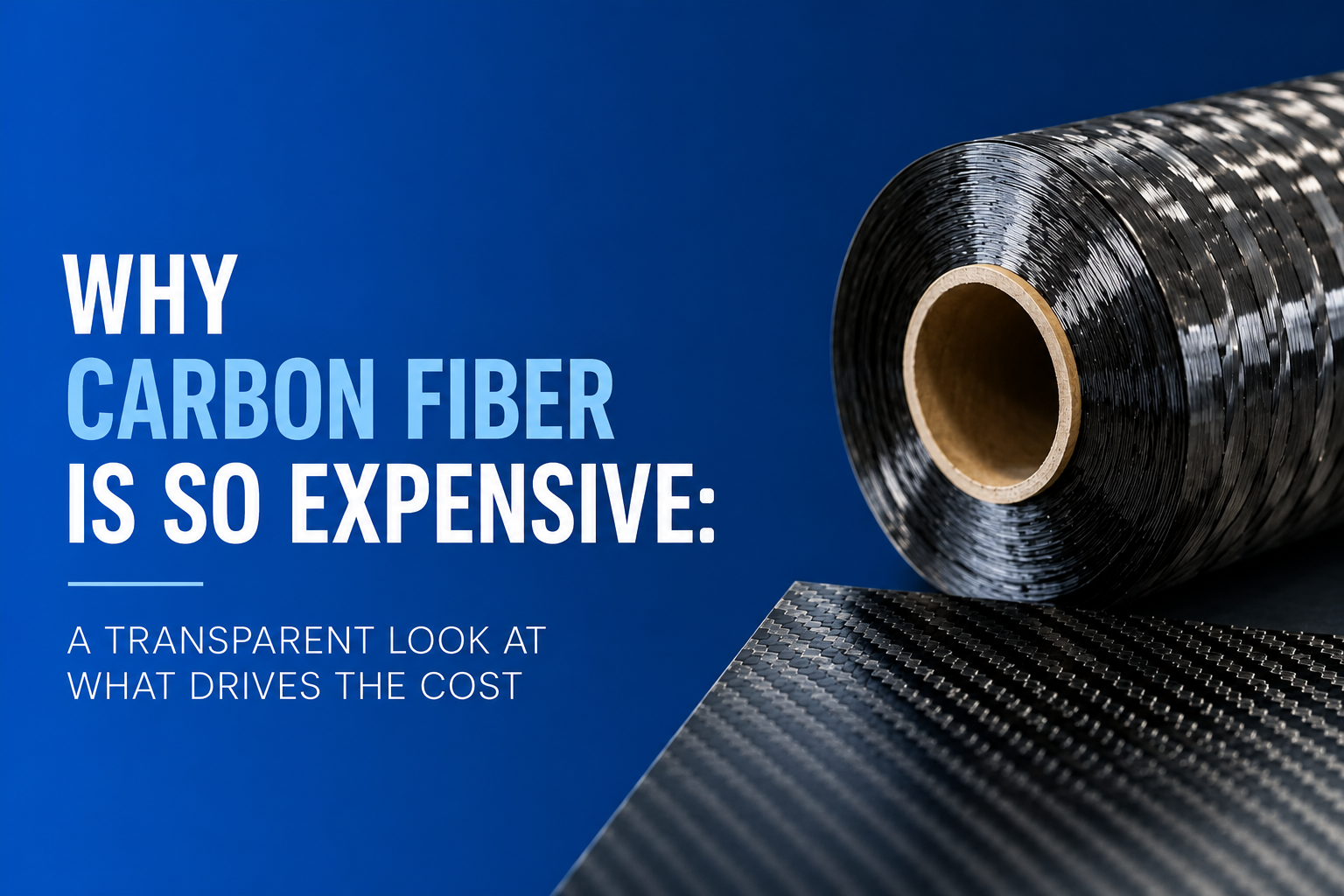
Why Carbon Fiber Is So Expensive: A Transparent Look at What Drives the Cost
Carbon fiber is expensive because every part is built from scratch, engineered, molded, laid up by hand, cured, and finished one at a time. You’re not buying a material. You’re buying engineering hours, hand labor, custom tooling, and a process designed specifically for your part. A custom carbon fiber prototype priced at $6,000 isn’t unusually steep; that’s roughly what a properly engineered, low-volume part actually costs to produce.
This post breaks down where that money goes, in plain language, so you can evaluate quotes with eyes open.
How expensive is carbon fiber compared to metal or plastic?
Carbon fiber typically costs 5 to 20 times more per finished part than aluminum, and even more compared to injection-molded plastic, but the comparison itself is misleading.
The reason is that you don’t make carbon fiber the same way you make metal or plastic. With aluminum, you grab a block and machine away everything that isn’t your part. With injection-molded plastic, you amortize a steel mold across hundreds of thousands of shots, and the per-part cost drops to pennies. Neither of those economics applies to carbon fiber.
Carbon fiber is a composite — fibers held in place by epoxy resin. The strength is in the fibers, and the fibers only carry load in the direction you orient them. That means you can’t just carve a part out of a block. You have to build the part fiber by fiber, layer by layer, in a tool. Every part is essentially constructed from raw material on every run.
So when buyers compare a $200 machined aluminum bracket to a $4,000 carbon fiber version of the same shape, they’re comparing two completely different manufacturing models. One is subtractive and material-cheap. The other is additive, hand-built, and labor-intensive with expensive materials. The price difference reflects the process — not a markup.
Why carbon fiber is built, not cut
Carbon fiber is anisotropic — its strength runs along the fiber direction, not across it. That single property reshapes the entire economics of the material.
Think of wood. The fibers run up the trunk of the tree, which is why a board is strong when you bend it end-to-end and weak when you cup it across the grain side-to-side. Carbon fiber works the same way, except you get to decide which direction the fibers go. That’s a powerful tool — but it means you can’t take a solid block of carbon fiber and machine your part out of it. The fibers wouldn’t be aligned where you need them.
Instead, you mold carbon fiber. You take fabric woven 0/90, unisheet, or unidirectional tape, you wet it with epoxy, you lay it into a mold in a specific stack — your layup schedule — and you cure it. The result is a shell. Almost every carbon fiber part is a shell structure: monocoque tubes, hollow housings, panels, ducts. That’s the same structural strategy used by bird bones, eggs, and bug exoskeletons. High strength-to-weight, but only buildable, never machinable.
That distinction is the root cause of every cost driver below. You’re not just paying for the carbon fiber. You’re paying for the process that turns that fiber into a working part.
Cost driver #1: Engineering and design time
Engineering is the first line item on a custom carbon fiber quote, and on a prototype, it’s often the highest single cost.
Here’s why. With a metal part, you can usually hand a drawing to a machine shop and get back what’s on the print. With carbon fiber, the drawing isn’t enough. Someone has to figure out where the loads enter the part, where they exit, how the fibers need to be oriented to carry those loads, how thick the laminate needs to be, where to put reinforcements, how to handle bolt holes (you really don’t want bolt holes — more on that below), and how the part is going to be released from the mold without hangup.
A balanced, symmetrical layup is non-negotiable. If the layup isn’t symmetrical about the centerline, the part will warp as the epoxy cures, because the resin shrinks, which loads the carbon in compression. Get the orientations wrong, and you get a cupped, twisted part that doesn’t fit anything.
That’s the engineering work. It typically involves finite element stress analysis to size the laminate for adequate strength and stiffness. It is the high stiffness-to-weight ratio that customers usually care about. It also involves designing the process to make the part — the mold, the cure, the trim, the bonding — simultaneously with the part itself. In carbon fiber, the part and the process are inseparable.
For a one-off prototype, expect engineering to run 20-50% of the total quote. For production parts, it gets amortized.
Cost driver #2: Raw materials — fiber, weave, and resin
Raw materials are real money in carbon fiber, and not all carbon is priced the same. Fiber count, weave type, and resin chemistry all move the number.
Carbon comes in different sizes. 3K (3,000 filaments per tow) is the most popular for visible parts because it lays down beautifully and gives that fine checkerboard look people associate with carbon fiber. 12K and 24K are coarser — they cost less per pound because they’re easier to weave, but they don’t drape as nicely over complex curves. Finer weaves, such as 1K, cost more because they’re harder to manufacture.
Then there’s the weave geometry. Plain 0/90 fabric is strong in two directions but weaker on the 45-degree bias. Quasi-isotropic layups stack 0/90 with +45/-45 to get reasonable strength in all directions, but you’re using more material to do it. Unidirectional tape (all fibers running one way) is the strongest per pound in tension and compression but only along its axis. It is used to reinforce bending loads in beams and tubes and as a lock reinforcement.
Resin matters too. Standard room-temperature-cure epoxy is the cheap option, with a glass transition temperature around 160°F. If your part needs to withstand temperatures above that, you move to a 250°F cure system or to specialty resins like phenolics that withstand 500-600°F. Each step up the temperature ladder adds material cost and process cost (you’re now heating the part, which means oven or autoclave time).
For most parts, raw material runs 15-30% of the part cost. It’s rarely the biggest line item, but it’s the one buyers fixate on first.
Cost driver #3: Layup labor — every part is hand-built
Layup labor is the cost most buyers don’t see coming, and it’s often the largest single component of a custom carbon-fiber part.
Every layer of fabric has to be cut, oriented correctly, placed in the mold, debulked, and worked into the corners by a human. A laminate that’s a quarter inch thick might be 30+ layers of 3K fabric. Each one gets placed by hand. Each one gets oriented to the layup schedule. Each one is pressed to remove entrapped air because voids — pockets where the resin didn’t reach — are the most common defect in carbon fiber and weaken the part.
You can’t fully automate this. Some shops use automated tape layup or fiber placement machines for very large parts (think aerospace skins), but for the size and complexity of parts most companies need, it’s manual work. Skilled manual work. The technician laying up the part is making real-time judgments about resin flow, fabric drape, and consolidation. You learn to do this well by ruining a lot of parts. There’s no textbook substitute for the feel of properly wetted-out fabric.
This is also where shop hours stack up fastest. A part with a complicated geometry — sharp inside corners, varying thickness, integrated bosses — can take a full shift or more to lay up. And then it has to cure, which is its own clock. On a low-volume run, layup labor can easily be 30-50% of the total cost.
It’s also why the same part costs less on the second order than the first. Once a technician has built one, the layup goes faster.
Cost driver #4: Tooling and molds
Tooling is the upfront investment you can’t avoid in carbon fiber, and it’s why low-volume parts feel disproportionately expensive.
Every carbon fiber part needs a mold. Sometimes two — one for each side. The mold is itself a precision tool, often machined from aluminum or built up as a tooling-grade composite. It needs to hold tight tolerances, withstand repeated thermal cycles at the cure temperature, release the part cleanly, and last through the production run.
For a one-off prototype, you might get away with a quick fiberglass tool. For production, you’re investing in something more durable, ranging from a few thousand dollars for simple geometry to tens of thousands for a multi-piece tool with internal cores. That cost has to be paid by somebody, and on a small run, it’s the customer.
This is the math that makes carbon fiber expensive at low volumes and reasonable at high volumes. If a $15,000 mold supports 10 parts, it adds $1,500 per part. If it supports 1,000 parts, it adds $15. The material cost barely moves, but the per-part tooling cost collapses.
It’s also why a smart engineer designs the part and the tool together. The geometry needs to be moldable — no undercuts that lock the part in, no negative draft, sensible parting lines. Catching this at the design stage saves the customer from paying for a tool that has to be cut apart to release the first part.
Cost driver #5: Cure cycles, finishing, and inspection
The back end of carbon fiber manufacturing — curing, trimming, finishing, and inspection — is the part most cost estimates underestimate.
Curing takes time. Room-temperature-cure epoxy utilizes a tool for 8-24 hours. Elevated-cure systems run 2-8 hours at temperature, sometimes under vacuum or in an autoclave under pressure. Either way, the part is occupying capacity that must be billed. Autoclaves in particular are expensive to operate.
Trimming is harder than people expect. You can’t get the kind of finish you’d get on a milled aluminum part. Cutting carbon doesn’t polish the edge the way machining metal does — it breaks the fibers and the matrix. So precision trim work often involves diamond tooling, careful fixturing, and sometimes a separate bonding step where two molded sub-assemblies are bonded together to achieve the final tolerance. Bonding itself is a real cost: epoxy adhesives need clean surfaces, controlled bond-line thickness, and a generous bond area to ensure strong joints.
Inspection is the last line item, and on serious parts it’s not optional. Carbon fiber is brittle. Unlike metal, which yields and bends before it fails, carbon fiber goes from fine to broken with very little warning. A microfracture from a stress concentration or a void from a poor layup will permanently weaken the part. Visual inspection catches surface defects. Tap testing or ultrasonic inspection catches internal voids. For aerospace or load-critical applications, this might also include CMM measurement, coupon testing, or non-destructive evaluation.
Together, the back end of the process — cure, trim, bond, inspect — typically runs 15-25% of total part cost.
Why a $6,000 carbon fiber prototype actually pencils out
A $6,000 prototype quote sounds steep until you add up what’s inside it.
Take a typical low-volume engineered tube — say, an instrument support with metal end fittings and a tight deflection spec. Here’s a rough breakdown of where the money goes on a single prototype (These can vary greatly depending on the specifics of a certain part):
|
Cost driver |
Typical share |
|
Engineering and design |
25-40% |
|
Raw materials (fiber, resin, core) |
15-25% |
|
Layup labor |
25-40% |
|
Tooling (amortized over the run) |
10-25% |
|
Cure, trim, bond, inspect |
20-30% |
On a one-off, that arithmetic gets you somewhere between $4,000 and $8,000 for a part of moderate complexity. The headline number is real, but it’s not arbitrary. You’re paying for everything it took to deliver a part that meets the spec on the first try.
The cost also drops sharply on follow-on orders. Engineering is largely done. The mold exists. The layup schedule is proven. The technicians have built the part before. By the second or third order, you’re often looking at a significant reduction of the prototype price per part — which is why the right time to talk about per-unit cost is after the design is locked, not on the first prototype quote.
When custom carbon fiber is worth the cost
Carbon fiber is worth the price when stiffness-to-weight, thermal stability, or geometry rules out the alternatives — and it’s not worth the price when it doesn’t.
Carbon shines in three places. Stiffness-to-weight: carbon fiber has a higher specific stiffness than aluminum, titanium, or steel, which is why it dominates aerospace skins, drone frames, race car tubs, and high-end sporting goods. Low thermal expansion: carbon’s coefficient of thermal expansion is about 0.5 millionths of an inch per degree Fahrenheit, compared to about 14 for aluminum. If your part needs to hold dimensional stability across a temperature range, that 28x difference is decisive. Complex monocoque shapes: a curved, hollow, integrated structure that would take dozens of welded or bolted aluminum subassemblies can be a single molded carbon part.
Carbon is not worth the price when you don’t need any of those properties. If your part doesn’t see weight-critical loads, doesn’t have temperature stability requirements, and doesn’t need a complex shell geometry, then aluminum, steel, or even reinforced plastic will do the job for a fraction of the cost. We turn down conversions to carbon fiber regularly because the customer would be better served by a different material.
The wrong reason to choose carbon is because it looks cool. The right reason is because the engineering problem demands a specific combination of properties only a carbon fiber composite can deliver.
How to get an accurate carbon fiber quote
If you’re evaluating custom carbon fiber for the first time, the fastest way to get a real number is to bring an engineer into the conversation early.
What we ask for at Element 6 when scoping a part:
- The functional requirements. Loads, deflection limits, temperature range, weight target. Not a drawing of an aluminum part — what does the part actually need to do?
- The volume: One-off prototype, low-volume production, or scaling to thousands? Tooling investment makes sense at very different points on that curve.
- Constraints we can’t see. Tolerances on mating surfaces, regulatory requirements, finish expectations, NDA needs. Bond-line thickness has actually mattered in real projects we’ve delivered — that’s the kind of detail that surfaces in a real conversation.
What we don’t recommend: treating a carbon fiber RFQ like a machined-part RFQ. If you send a print designed for aluminum and ask for it in carbon fiber, you’ll get a quote, but you won’t get the right part. Carbon fiber demands its own design — different geometry, different load paths, different connection strategies — and the engineering decisions made up front are what determine whether the part actually performs and what it actually costs.
If you’re at the point of evaluating whether carbon fiber makes sense for your application, start a conversation with our engineering team. We’ll walk through the requirements, tell you honestly whether composite is the right answer, and if it is, give you a quote that breaks down where every dollar goes.
View All Articles
Carbon Fiber Specialists


© 2025 Element 6 Composites. All Rights Reserved
The post Why Carbon Fiber Is So Expensive: A Transparent Look at What Drives the Cost appeared first on Element 6 Composites.


