
Farmers face rising repair costs and are more reliant on authorized repairers to solve increasingly complex problems.
We deserve a right to repair that recognizes this reality.
The right to repair means goods, owned or leased, are repairable at a reasonable price, within a reasonable time frame by the owner or a repair service of the owner’s choice.
For years, the National Farmers Union has been advocating for farmer-first right-to-repair legislation at both the federal and provincial levels.
Right-to-repair legislation is currently being presented in the Manitoba Legislature, and though the bill is Manitoba-specific, it carries significance for farmers across the country.
Bill 15, the Consumer Protection Amendment Act, proposes a right to repair for Manitobans.
It enables consumers to access effective repairs at a reasonable price and within a reasonable time frame. The bill also gives Manitobans access to information, such as repair manuals and proper tools, either for free or at a reasonable price.
Consumer goods are the targets of Bill 15, but what about farm machinery? At a recent hearing on the bill, we heard that the definition of “consumer good” could be left up to regulations and may include farm machinery.
Currently, Manitoba has the Farm Machinery and Equipment Act (FMEA), which provides a 10-year guarantee on parts availability within 14 days of the farmers’ request, and delivery of emergency replacement parts within 72 hours, or a working alternative if those parts are not available.
We’re concerned that defining agricultural machinery as a consumer good under the regulation will undermine the current protections provided to farmers under the FMEA.
Farmers deserve a right to repair that reduces costs and choice in repair services.
We are often locked into getting repairs from authorized dealers, which control when and how farmers access repair services and tools. Subsequently, the price for farm machinery repairs in Canada has increased. In 2024, Canadian farmers paid more than $540 million in repair costs, a sizable expense for a low-margin business.
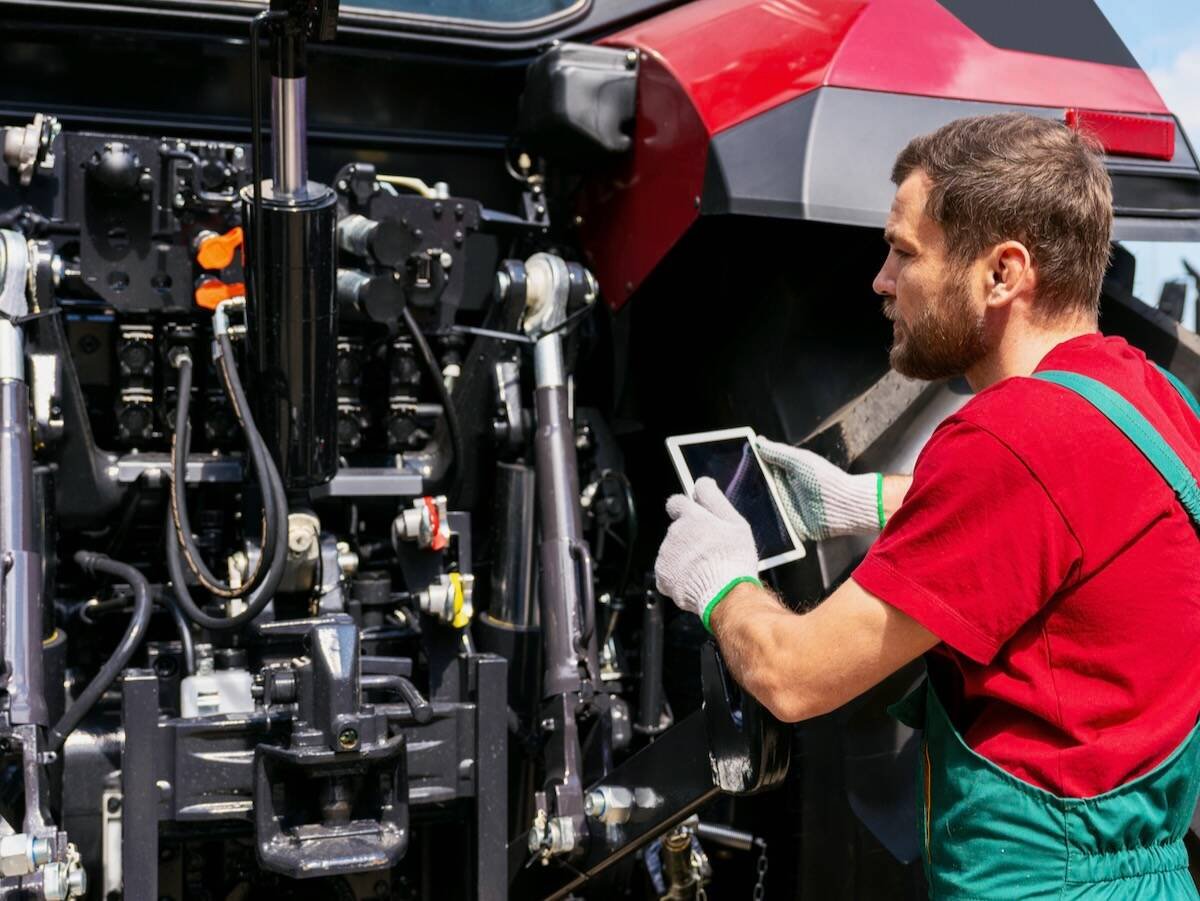
New digital features on farm equipment often call for proprietary diagnostic software to resolve error codes, to which third-party or independent repairers may not have unrestricted access, the NFU says. Photo: Igor Barilo/iStock/Getty Images
These costs have increased for several key reasons:
- Use of proprietary parts and repair tools that only authorized dealers can access.
- Parts pairing, which forces farmers to buy authorized parts and use authorized repair services by tying serial numbers of specific parts to a machine using software tracking.
- Dealership concentration and closures.
In addition to Bill 15, amendments should also be made to the FMEA that would bolster the right to repair for farmers. Changes should include an increase in the parts guarantees for farm machinery from 10 to 15 years and an explicit ban on parts pairing.
Amendments to the FMEA would give farmers and independent repair shops access to proper diagnostic software and make sure that manufacturers can’t void warranty for seeking repairs from qualified third-party repairers.
Bill 15 should be changed to put the onus on manufacturers, not suppliers, who are often small- or medium-sized businesses.
Finally, the term “reasonable” used in “repair at a reasonable price” and “in a reasonable time” must be defined in the act. The definition of “reasonable” is important for protecting the accessibility of repair and must be favourable to repairers and users.
Legislation is the best place to guarantee robust and clear definitions, rights and responsibilities. If the Manitoba government makes these changes to Bill 15, it will serve as a model for the other provinces to adopt to ensure a right to repair that works for farmers.
Dean Harder is a member of the National Farmers Union. Kate Storey is the regional co-ordinator for National Farmers Union Region 5.
The post One province’s right-to-repair bill encouraging, but needs more for farmers appeared first on Farmtario.


