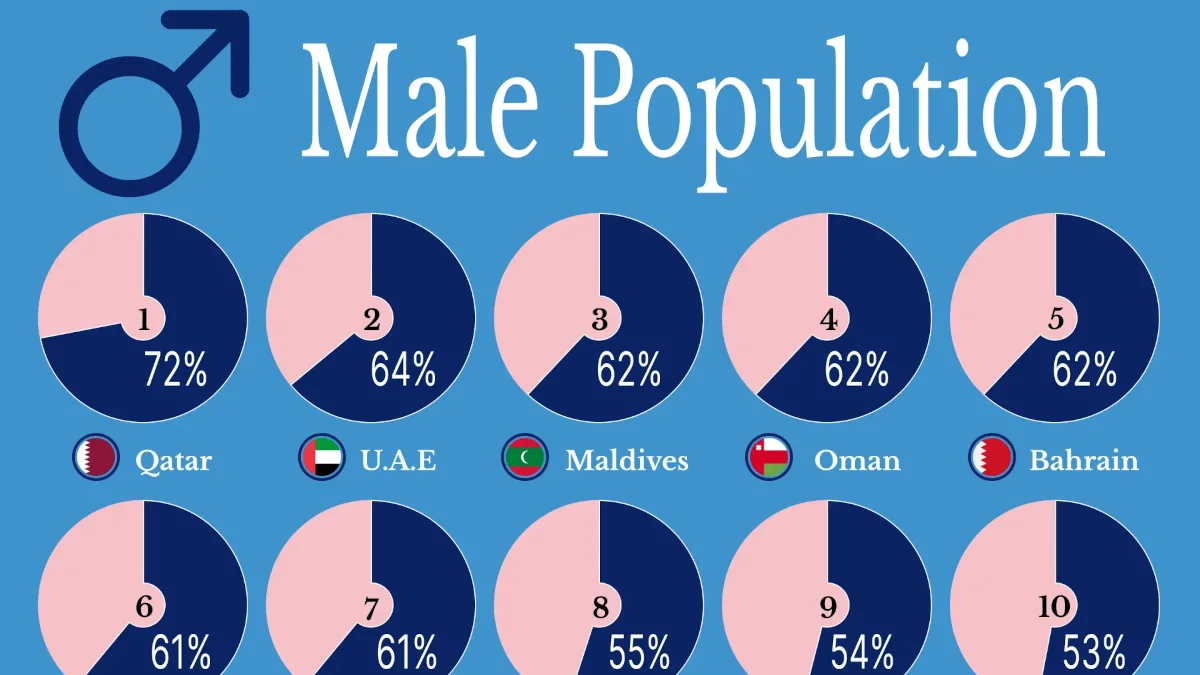
Countries With the Highest Percentage of Male Population
This was originally posted on our Voronoi app. Download the app for free on iOS or Android and discover incredible data-driven charts from a variety of trusted sources.
Key Takeaways:
- Qatar has the world’s highest male share of population, at roughly 72%.
- Four of the top five countries are in the Gulf, where male migrant labor is a major driver.
- Globally, the natural baseline is already slightly male-biased at birth, at around 105 boys for every 100 girls.
Most countries have populations that are split close to evenly between men and women.
But a handful stand far apart from the global norm. In Qatar, nearly three out of every four residents are men, while several neighboring Gulf economies also have unusually high male shares driven largely by labor migration.
This visualization, created by Harris Saleem, ranks countries by the male share of their total population, using the latest available data from the World Bank.
Where Men Make Up the Largest Share
At the top of the ranking is Qatar, with a 72% male share. The United Arab Emirates follows at about 64%, with Oman, Bahrain, Kuwait, and Saudi Arabia also standing well above the global norm.
Here are the countries with the highest percentage of male population:
| Rank | Country | Percentage Male Population |
|---|---|---|
| 1 |  Qatar Qatar |
72% |
| 2 |  U.A.E U.A.E |
64% |
| 3 |  Maldives Maldives |
62% |
| 4 |  Oman Oman |
62% |
| 5 |  Bahrain Bahrain |
62% |
| 6 |  Kuwait Kuwait |
61% |
| 7 |  Saudi Arabia Saudi Arabia |
61% |
| 8 |  Seychelles Seychelles |
55% |
| 9 |  Palau Palau |
54% |
| 10 |  Bhutan Bhutan |
53% |
| 11 |  Brunei Darussalam Brunei Darussalam |
53% |
| 12 |  Equatorial Guinea Equatorial Guinea |
53% |
| 13 |  Greenland Greenland |
53% |
| 14 |  Malaysia Malaysia |
52% |
| 15 |  Malta Malta |
52% |
These countries are major outliers compared with most of the world, where the male and female shares typically sit close to 50/50.
Why Gulf Countries Rank So High
The biggest factor is labor migration. Countries with large construction, energy, services, and infrastructure sectors often attract vast numbers of foreign workers, many of whom are men.
This can dramatically skew the population balance, especially in smaller countries where migrant labor makes up a large share of residents.
Gulf economies like Qatar dominate the top of the list, while countries like Bhutan, Equatorial Guinea, India, and Papua New Guinea show more moderate male majorities.
Birth Ratios Also Play a Role
Even without migration, populations tend to begin with a slight male bias. Biologically, around 105 boys are born for every 100 girls, according to research by the BBC and Our World in Data.
In some Asian countries, this imbalance can be amplified by sex-selective practices and cultural preferences for male heirs. These dynamics are one reason broader conversations around the global gender gap often include demographic patterns alongside economic and social indicators.
A high male population share is a population imbalance that does not have a single explanation. In Gulf states, it is largely tied to migration and labor demand. Elsewhere, birth ratios, cultural preferences, life expectancy, and migration patterns can all influence the balance.
To compare the other side of the demographic divide, check out Countries With The Highest Percentage Of Female Population.
- Source: https://www.visualcapitalist.com/cp/countries-with-the-highest-percentage-of-male-population/