
Cooperl’s OptiSort system brings 3D scanning to the hog industry, but it’s more than a way to weigh pigs — it’s a more-efficient system to manage finishing pig flow.
Cooperl is a French farmers’ pig processing co-operative that also invests in technology that makes pig production more efficient for farmers and produces the data needed to make its processing operations run optimally.
The German OptiSort technology is a good example. It was brought into the company when Cooperl purchased H+L.
“We have a lot of data from sows. We have a lot of data from slaughterhouses. There’s one big gap, that’s finishing,” said Bart Hooijer, who works in international business development for Cooperl’s equipment group. Hooijer spoke during the Ontario Pork Congress June 17 and 18 in Stratford.
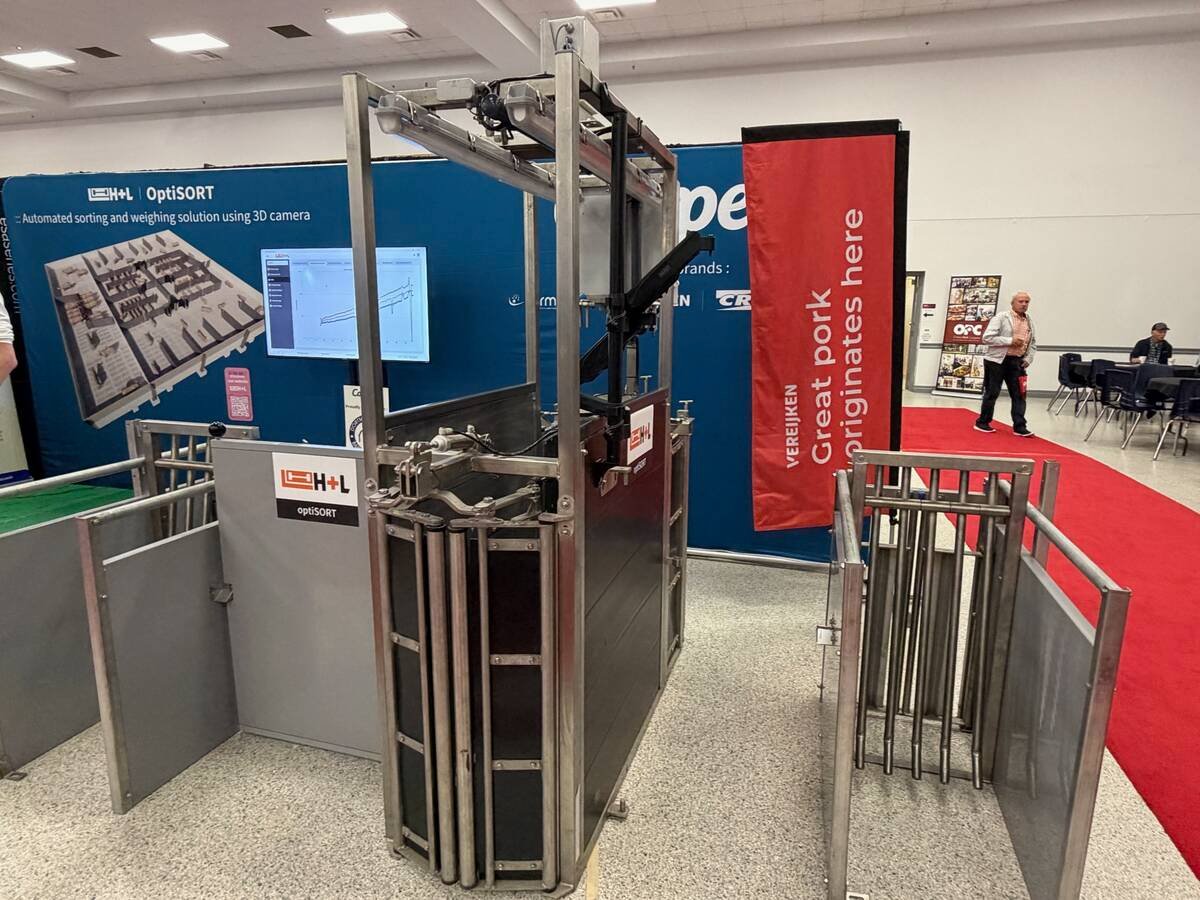
OptiSort helps create the data that hasn’t been available to manage finishing pigs precisely in the finishing phase.
Cooperl also has an impact on the genetics used by its members, with Nucléus, its hog genetics division, which supplies about 40 per cent of the pig genetics in France.
Adding H+L allowed the co-operative to complete the data loop and make the finishing phase more efficient.
Using a 3D camera is a benefit compared to a mechanical scale because there are fewer mechanical parts to break, and the camera gives more detail than a scale, including how individual cuts of the pig are developing and their size, said Hooijer.
The camera is on the chute frame that pigs go through and scans them quickly.
The camera is 98 per cent accurate in weight measurement, which is more than enough to automate pig flow through the barn and to the processing plant.
Hitting the optimal weight needed by the processing plant is a profitable practice, not just in Cooperl’s integrated system in Europe, but in Ontario too.
“With this we could suddenly bring the selection from the pigs all the way to 95 per cent in the right window. This brings money,” said Hooijer.
He said that once pigs can be sorted, they can be put into a barn design system that uses up to 25 per cent less space.
Each sorter manages about 450 pigs.
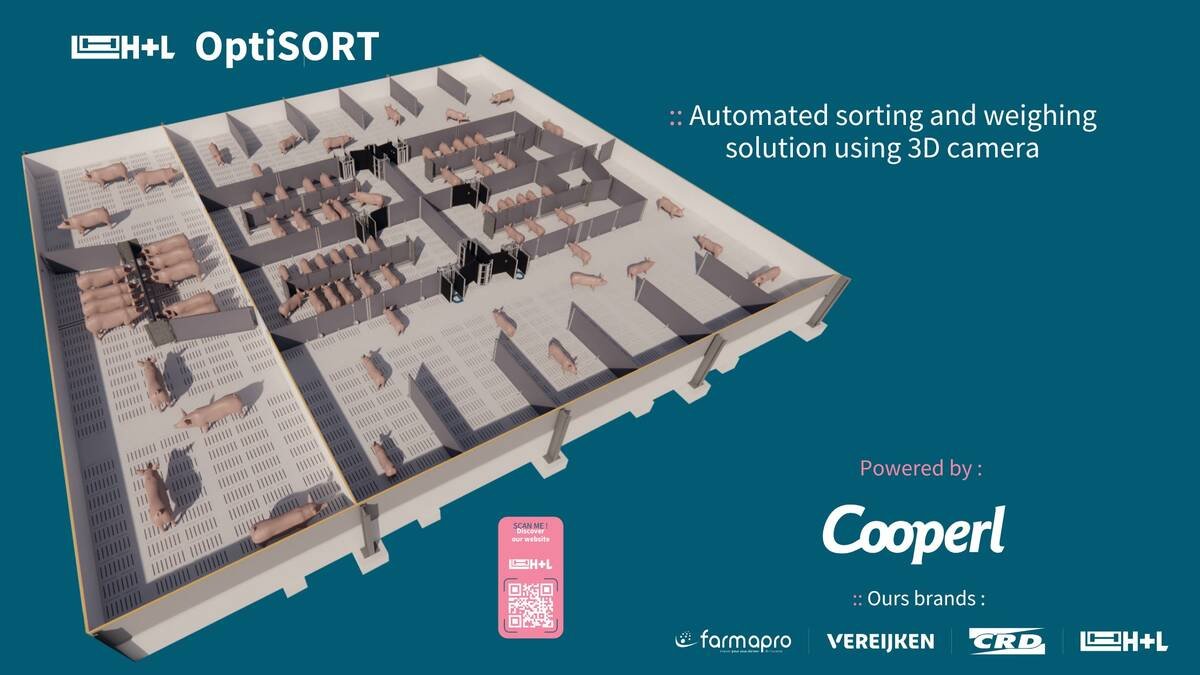
Two-room system
The two-room system manages pigs to group and feed them according to similar growth rates to optimally hit the grid, but also to maximize truck traffic and pig flow into the processing plant.
Pigs that are in their fastest growth phase can be fed a higher ration that meets their growth potential. Pigs that are closer to slaughter weight slow down their growth and need a different ration. Eight different feed profiles can be created to vary the feed ration.
With proper sorting, that can be accomplished, and feed savings can be found.
Pigs are sorted into above and below 50-kilogram groups. Then, the first 10 per cent of the heaviest pigs are sorted out in week 14, the next 25 per cent in week 15.
The Cooperl sort system puts pigs that need to be separated in the smaller second room. As the main room nears closeout, the last group of pigs to be finished is sorted into the second room. The first room can then be closed off, disinfected, and a new group of 25 kg pigs can be started in that room.
The new group won’t need the overflow room for space until they are larger, and by that time, it will have been emptied and disinfected.
Hooijer says that Cooperl acquired H+L in 2024, so it is still working on new innovations it can bring to the 3D camera system.
The first system has been sold in Ontario. Cooperl products are available in Ontario through Dortmans Bros. Barn Equipment.
The post How a 3D camera creates new finishing pig management options appeared first on Farmtario.


