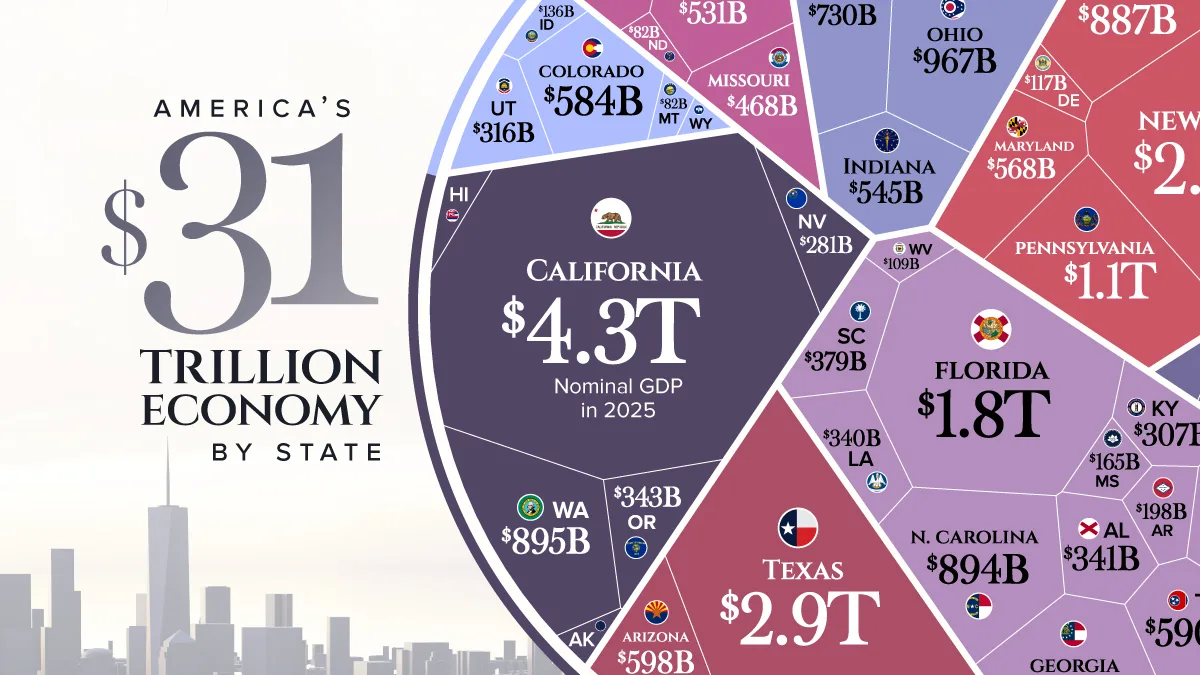
America’s $31 Trillion Economy by State
See visuals like this from many other data creators on our Voronoi app. Download it for free on iOS or Android and discover incredible data-driven charts from a variety of trusted sources.
Key Takeaways
- California remains America’s largest state economy with $4.3 trillion in GDP, accounting for nearly 14% of national output.
- Only six states now generate more than $1 trillion in annual economic activity.
- Together, those six states produce nearly half of the entire U.S. economy.
As the United States approaches its 250th anniversary in 2026, its economy has grown to nearly $31 trillion, making it the world’s largest by a wide margin.
Using the latest estimates from the U.S. Bureau of Economic Analysis (BEA), this visualization ranks every state by nominal GDP in 2025, showing how each contributes to national output.
California: The Economic Engine of America
If California were an independent country, it would have the world’s fourth-largest economy, behind only the U.S., China, and Germany, and ahead of all other nations. It is currently the world’s largest subnational economy.
This data table lists U.S. states by their 2025 nominal GDP.
| Rank | State | Nominal GDP in 2025 (billions $) | Share of U.S. GDP (%) |
|---|---|---|---|
| 1 | California | 4,251 | 13.8 |
| 2 | Texas | 2,904 | 9.4 |
| 3 | New York | 2,468 | 8.0 |
| 4 | Florida | 1,835 | 6.0 |
| 5 | Illinois | 1,202 | 3.9 |
| 6 | Pennsylvania | 1,056 | 3.4 |
| 7 | Ohio | 967 | 3.1 |
| 8 | Georgia | 925 | 3.0 |
| 9 | Washington | 895 | 2.9 |
| 10 | North Carolina | 894 | 2.9 |
| 11 | New Jersey | 887 | 2.9 |
| 12 | Massachusetts | 820 | 2.7 |
| 13 | Virginia | 798 | 2.6 |
| 14 | Michigan | 730 | 2.4 |
| 15 | Arizona | 598 | 1.9 |
| 16 | Tennessee | 590 | 1.9 |
| 17 | Colorado | 584 | 1.9 |
| 18 | Maryland | 568 | 1.8 |
| 19 | Indiana | 545 | 1.8 |
| 20 | Minnesota | 531 | 1.7 |
| 21 | Wisconsin | 473 | 1.5 |
| 22 | Missouri | 468 | 1.5 |
| 23 | South Carolina | 379 | 1.2 |
| 24 | Connecticut | 376 | 1.2 |
| 25 | Oregon | 343 | 1.1 |
| 26 | Alabama | 341 | 1.1 |
| 27 | Louisiana | 340 | 1.1 |
| 28 | Utah | 316 | 1.0 |
| 29 | Kentucky | 307 | 1.0 |
| 30 | Nevada | 281 | 0.9 |
| 31 | Iowa | 277 | 0.9 |
| 32 | Oklahoma | 274 | 0.9 |
| 33 | Kansas | 241 | 0.8 |
| 34 | Arkansas | 198 | 0.6 |
| 35 | Nebraska | 198 | 0.6 |
| 36 | District of Columbia | 193 | 0.6 |
| 37 | Mississippi | 165 | 0.5 |
| 38 | New Mexico | 153 | 0.5 |
| 39 | Idaho | 136 | 0.4 |
| 40 | New Hampshire | 126 | 0.4 |
| 41 | Hawaii | 125 | 0.4 |
| 42 | Delaware | 117 | 0.4 |
| 43 | West Virginia | 109 | 0.4 |
| 44 | Maine | 103 | 0.3 |
| 45 | Rhode Island | 84 | 0.3 |
| 46 | Montana | 82 | 0.3 |
| 47 | North Dakota | 82 | 0.3 |
| 48 | South Dakota | 81 | 0.3 |
| 49 | Alaska | 75 | 0.2 |
| 50 | Wyoming | 53 | 0.2 |
| 51 | Vermont | 48 | 0.2 |
| – |  U.S. U.S. |
30,762 | 100.0 |
California is a powerful, diversified economy in which different sectors dominate different areas. Los Angeles, for example, is a major media hub, while San Francisco and the Bay Area’s Silicon Valley remain a global center for many of the world’s most valuable tech firms.
The Central Valley, meanwhile, serves as one of the most productive agricultural areas in the world, with high output in dairy products, wine, nuts, fruits, and vegetables.
Beyond these well-known sectors, the Golden State is also a major player in energy, particularly solar power, as well as a key logistics hub owing to the massive ports of Long Beach and Los Angeles.
The Trillion-Dollar Club
Beyond California, five other states have a GDP exceeding a trillion dollars as of 2025: Texas ($2.9 trillion), New York ($2.5 trillion), Florida ($1.8 trillion), Illinois ($1.2 trillion), and Pennsylvania ($1.1 trillion).
Some of these state economies, like Illinois and New York, are highly concentrated in one major city, such as Chicago or New York City. Others, like Florida and Texas, are more diffuse. Four Texan cities, for example, number among the country’s 10 most populous as of 2025.
In line with its diversified economy, Texas is a major agricultural, defense, and energy player. The Lone Star State also has more Fortune 500 companies than any other state.
The Diversified U.S. Economy
While technology and entertainment drive California, Texas combines energy, manufacturing, agriculture, and defense.
Elsewhere, states specialize in industries ranging from finance and pharmaceuticals to tourism and farming. This geographic diversity helps make the U.S. economy more resilient, as slowdowns in one industry or region can be offset by strength in others.
The Great Plains, for example, are major producers of agricultural goods like soy and corn, as seen in the Iowan ($277 billion) and Nebraskan ($198 billion) economies. These states are particularly sensitive to droughts or trade disputes with major agricultural markets like China or Mexico.
Meanwhile, other states depend more on tourism, particularly in major cities. Nevada’s $281-billion economy, for example, is heavily concentrated in Las Vegas, making the state vulnerable to drops in tourist numbers.
Learn More on the Voronoi App 
Curious how each U.S. state ranks in terms of its business reputation? Check out Ranking the Best State Economies in 2024 on Voronoi, the new app from Visual Capitalist.