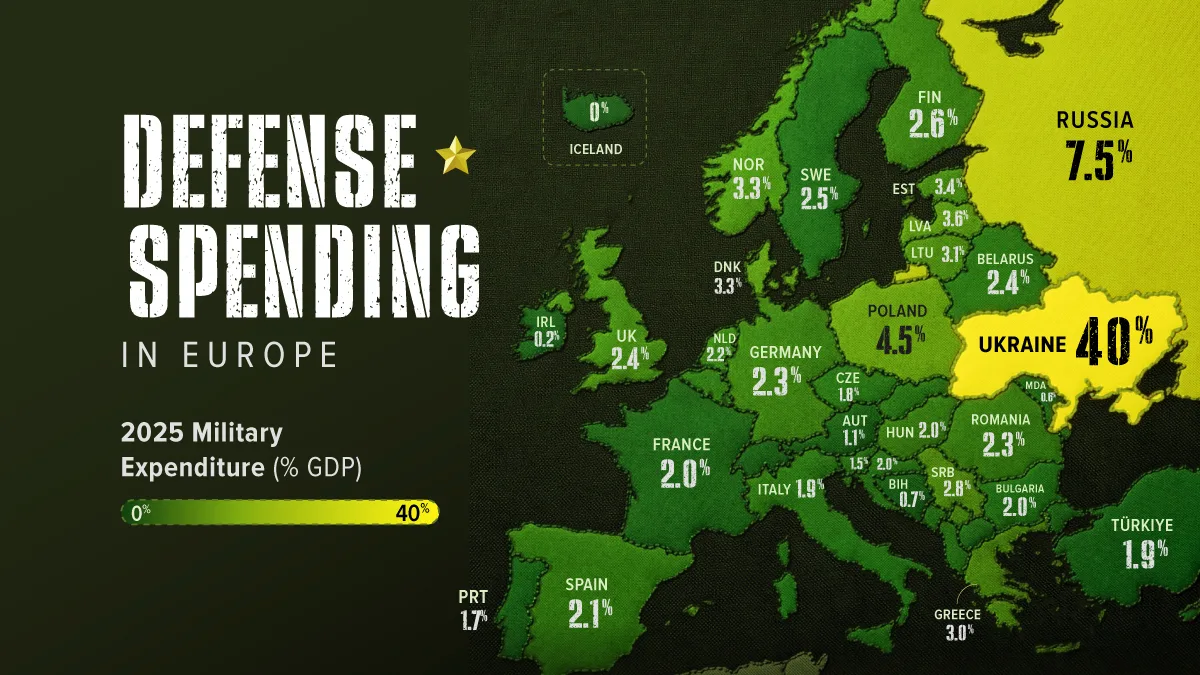
Mapped: Europe’s Military Spending by GDP
See visuals like this from many other data creators on our Voronoi app. Download it for free on iOS or Android and discover incredible data-driven charts from a variety of trusted sources.
Key Takeaways
- Ukraine spent nearly 40% of GDP on defense in 2025, by far the highest share in Europe.
- Excluding Ukraine, European countries spent an average of roughly 2% of GDP, with eastern NATO members generally spending the most.
- NATO members have pledged to raise defense spending toward 5% of GDP by 2035, reflecting Europe’s accelerating rearmament.
After decades of relative peace, Europe faces heightened military tensions following Russia’s 2022 invasion of Ukraine. Most Western European countries, however, continue to spend relatively little on defense.
This map highlights countries’ military spending as a percentage of gross domestic product (GDP) in 2025 using the latest data available from the SIPRI Military Expenditures Database.
The continental average is 2.94% of GDP, although Ukraine’s exceptionally high military spending raises that figure considerably.
The War Economies
Ukraine is by far the largest relative military spender on the continent. In 2025, the war-torn Eastern European country spent the equivalent of 39.56% of its GDP, higher in percentage terms than the next 11 countries combined.
Neighboring Russia, which has a far larger economy, spends the equivalent of 7.50% of GDP on its military, well ahead of the rest of the continent. Russia is able to finance roughly double Ukraine’s overall military expenditure even as international sanctions have impacted its growth.
This data table lists European countries alongside their 2025 military spending as a percentage of GDP.
| Rank | Country | 2025 military spending (% of GDP) |
|---|---|---|
| 1 |  Ukraine Ukraine |
39.56% |
| 2 |  Russia Russia |
7.50% |
| 3 |  Poland Poland |
4.50% |
| 4 |  Latvia Latvia |
3.61% |
| 5 |  Estonia Estonia |
3.37% |
| 6 |  Norway Norway |
3.28% |
| 7 |  Denmark Denmark |
3.25% |
| 8 |  Serbia Serbia |
2.76% |
| 9 |  Finland Finland |
2.57% |
| 10 |  Sweden Sweden |
2.47% |
| 11 |  Belarus Belarus |
2.40% |
| 12 |  United Kingdom United Kingdom |
2.35% |
| 13 |  Romania Romania |
2.28% |
| 14 |  Germany Germany |
2.27% |
| 15 |  Netherlands Netherlands |
2.19% |
| 16 |  Spain Spain |
2.13% |
| 17 |  Hungary Hungary |
2.04% |
| 18 |  Albania Albania |
2.03% |
| 19 |  France France |
2.03% |
| 20 |  Slovakia Slovakia |
2.03% |
| 21 |  Croatia Croatia |
2.02% |
| 22 |  Belgium Belgium |
2.01% |
| 23 |  Bulgaria Bulgaria |
2.01% |
| 24 |  North Macedonia North Macedonia |
1.97% |
| 25 |  Türkiye Türkiye |
1.91% |
| 26 |  Italy Italy |
1.89% |
| 27 |  Montenegro Montenegro |
1.89% |
| 28 |  Kosovo Kosovo |
1.85% |
| 29 |  Czechia Czechia |
1.84% |
| 30 |  Lithuania Lithuania |
1.83% |
| 31 |  Georgia Georgia |
1.75% |
| 32 |  Portugal Portugal |
1.71% |
| 33 |  Cyprus Cyprus |
1.61% |
| 34 |  Slovenia Slovenia |
1.54% |
| 35 |  Greece Greece |
1.17% |
| 36 |  Austria Austria |
1.10% |
| 37 |  Luxembourg Luxembourg |
0.85% |
| 38 |  Switzerland Switzerland |
0.76% |
| 39 |  Bosnia and Herzegovina Bosnia and Herzegovina |
0.73% |
| 40 |  Moldova Moldova |
0.56% |
| 41 |  Malta Malta |
0.45% |
| 42 |  Ireland Ireland |
0.22% |
| 43 |  Iceland Iceland |
0.00% |
Russia invaded Ukraine in late February 2022. More than four years later, both countries have transitioned into war economies in which industrial and manufacturing output is increasingly concentrated on defense.
In Ukraine, this has taken the form of a world-class drone fleet, which Kyiv uses to help offset Moscow’s significant numerical and logistical advantages on the battlefield. Ukraine has also relied on aid packages and loans from Western allies, particularly the European Union.
Defense Spending: East vs. West
Russia’s other European neighbors have taken notice and boosted their own military spending to deter further aggression.
Poland leads the way with defense spending equal to 4.50% of GDP. Latvia and Estonia also rank among Europe’s largest relative military spenders at 3.61% and 3.37%, respectively, while Lithuania spends 1.83%. Further north, Finland spends 2.57% of GDP on defense, while neighboring Norway reaches 3.28%.
In contrast, the large Western European powers spend relatively little compared with the size of their economies. The United Kingdom reaches 2.35% of GDP, followed by Germany at 2.27%, Spain at 2.13%, and France at 2.03%. Italy trails the group at 1.89% of GDP.
While factors such as nuclear weapons and economic size also play a role, the split in defense spending between countries that border Russia and the rest of Europe has become increasingly pronounced in recent years.
NATO and the Five-Percent Rule
A total of 30 European countries belong to the North Atlantic Treaty Organization (NATO) as of 2026, including its newest members, Finland (2.57%) and Sweden (2.47%), as well as Black Sea regional power Türkiye (1.91%). The alliance has pledged to raise defense spending to 5% of GDP by 2035, although Spain is exempt.
Russian aggression and the war in Ukraine have driven this shift toward rearmament. Increased pressure from the United States, NATO’s largest military power, has also played a role, particularly during the second presidency of Donald Trump.
Long-standing U.S. frustration with European underspending on defense has led White House officials to consider withdrawing from NATO or refusing to aid any European country invaded by Russia. Those concerns have helped motivate greater defense spending increases in non-nuclear countries such as Germany, Norway, and the Baltic states.
Learn More on the Voronoi App 
Wondering which companies are profiting most from this rearmament? Check out The Top 10 Largest Defense Contractors in America on Voronoi, the new app from Visual Capitalist.