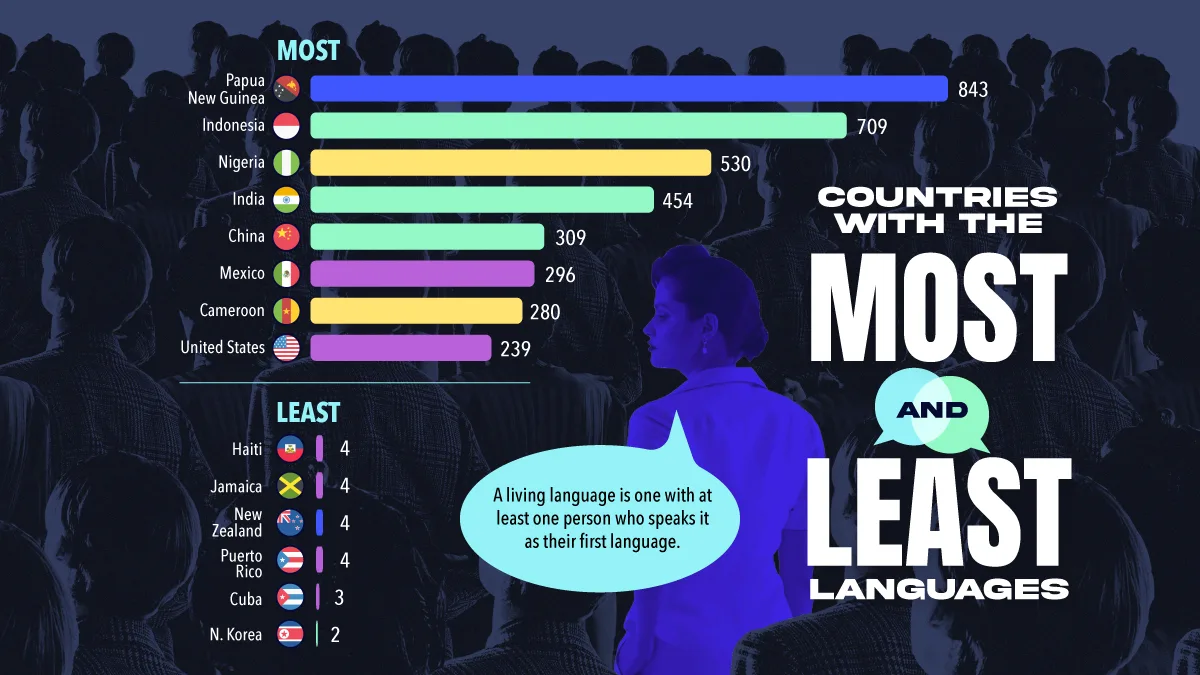
Ranked: Countries With the Most and Least Languages
See visuals like this from many other data creators on our Voronoi app. Download it for free on iOS or Android and discover incredible data-driven charts from a variety of trusted sources.
Key Takeaways
- Papua New Guinea tops the world with 843 living languages, while North Korea has just two.
- Only 20 countries are home to at least 100 living languages.
- Geography, isolation, migration, and history have played major roles in shaping linguistic diversity.
Why do some countries have hundreds of living languages while others have only a handful?
Using data from the Summer Institute of Linguistics International via Our World in Data, this graphic ranks the countries with the most and fewest living languages, illustrating the remarkable range of linguistic diversity around the world.
From Papua New Guinea’s 843 languages, the highest in the world, to North Korea’s two, the data highlights how geography, migration, isolation, and history have influenced the languages spoken across nations.
The Countries With the Most Living Languages
Although it is home to fewer than 12 million people, Papua New Guinea has extraordinary linguistic diversity. Its rugged terrain, hundreds of islands, and isolated communities have helped preserve nearly twice as many languages as India, despite having less than 1% of its population.
Indonesia, an archipelago of roughly 17,000 islands, ranks second with 709 living languages, followed by Nigeria, India, and China. A living language is one with at least one native speaker.
| Rank | Country | Number of Living Languages 2025 | Region |
|---|---|---|---|
| 1 |  Papua New Guinea Papua New Guinea |
843 | Oceania |
| 2 |  Indonesia Indonesia |
709 | Asia |
| 3 |  Nigeria Nigeria |
530 | Africa |
| 4 |  India India |
454 | Asia |
| 5 |  China China |
309 | Asia |
| 6 |  Mexico Mexico |
296 | Americas |
| 7 |  Cameroon Cameroon |
280 | Africa |
| 8 |  United States United States |
239 | Americas |
| 9 |  Australia Australia |
225 | Oceania |
| 10 |  Brazil Brazil |
222 | Americas |
| 11 |  DR Congo DR Congo |
211 | Africa |
| 12 |  Philippines Philippines |
184 | Asia |
| 13 |  Malaysia Malaysia |
133 | Asia |
| 14 |  Chad Chad |
129 | Africa |
| 15 |  Tanzania Tanzania |
127 | Africa |
| 16 |  Myanmar Myanmar |
125 | Asia |
| 17 |  Nepal Nepal |
123 | Asia |
| 18 |  Russia Russia |
119 | Europe |
| 19 |  Vietnam Vietnam |
111 | Asia |
| 20 |  Canada Canada |
101 | Americas |
| 21 |  Peru Peru |
95 | Americas |
| 22 |  Ethiopia Ethiopia |
92 | Africa |
| 23 |  Colombia Colombia |
89 | Americas |
| 24 |  Côte d’Ivoire Côte d’Ivoire |
88 | Africa |
| 25 |  Laos Laos |
88 | Asia |
| 26 |  Ghana Ghana |
83 | Africa |
With 239 living languages, the United States ranks eighth globally. Most are Indigenous languages, many of which are endangered after centuries of displacement and assimilation. Nearly 50 have already disappeared.
Overall, only 20 countries are home to at least 100 living languages. Together, they account for a remarkable share of the world’s linguistic heritage, spanning nearly every inhabited continent.
Why Some Countries Have So Few
Following the division of the Korean Peninsula after World War II, North Korea became one of the world’s most isolated societies. Today, it has just two living languages, Korean and Korean Sign Language, the fewest of any country.
| Country | Number of Living Languages 2025 | Region |
|---|---|---|
 North Korea North Korea |
2 | Asia |
 Cuba Cuba |
3 | Americas |
 Haiti Haiti |
4 | Americas |
 Jamaica Jamaica |
4 | Americas |
 New Zealand New Zealand |
4 | Oceania |
 Puerto Rico Puerto Rico |
4 | Americas |
 Burundi Burundi |
5 | Africa |
 Djibouti Djibouti |
5 | Africa |
 Dominican Republic Dominican Republic |
5 | Americas |
 Eswatini Eswatini |
5 | Africa |
 Lesotho Lesotho |
5 | Africa |
 Qatar Qatar |
5 | Asia |
 South Korea South Korea |
5 | Asia |
 Bahrain Bahrain |
6 | Asia |
 El Salvador El Salvador |
6 | Americas |
 Kuwait Kuwait |
6 | Asia |
 Rwanda Rwanda |
6 | Africa |
 Tunisia Tunisia |
6 | Africa |
 Uruguay Uruguay |
6 | Americas |
 Belarus Belarus |
7 | Europe |
 Bosnia and Herzegovina Bosnia and Herzegovina |
7 | Europe |
 Denmark Denmark |
7 | Europe |
 Hong Kong Hong Kong |
7 | Asia |
 Mauritania Mauritania |
7 | Africa |
 Sri Lanka Sri Lanka |
7 | Asia |
 Trinidad and Tobago Trinidad and Tobago |
7 | Americas |
Cuba and the Dominican Republic have relatively few living languages because Spanish became dominant after colonization, while Indigenous languages disappeared and later African linguistic influences were largely absorbed into Spanish.
Many countries with few living languages once had greater linguistic diversity. Over centuries, colonization, assimilation, and the decline of Indigenous languages left them with only a small number of native languages that continue to be spoken today.
Learn More on the Voronoi App 
To learn more about this topic, check out this graphic on America’s most spoken languages after English and Spanish.