
U.S. climate tech firm Spiritus has teamed up with Saudi Aramco on a new direct air capture (DAC) system. This system will remove carbon dioxide (CO₂) from the air at a lower cost.
If successful, the partnership could help solve one of the biggest challenges facing carbon removal today: scaling the technology while making it affordable. The announcement shows that big energy companies are increasingly interested in carbon removal. This comes as governments and businesses aim for net-zero emissions.
Direct Air Capture Moves Toward Commercial Scale
Spiritus and Aramco have signed an agreement to advance Spiritus’ DAC technology and explore how it can be deployed on a larger scale. The companies will test the technology in various operating conditions. They will also examine its potential for commercial use.
Spiritus has developed a new sorbent material that captures CO₂ directly from the atmosphere. Their DAC system, called the Carbon Orchard , has a modular design that can ramp up deployment to megaton capacity.
The company stated:
“The companies that figure out how to make DAC cheap and modular will end up supplying decarbonization infrastructure to the hardest-to-abate sectors on the planet, not just carbon credits to sustainability teams. That’s the market we’re building toward, and partners like Aramco are how we get there faster.”
The company says its process requires less energy than many existing DAC systems, helping lower operating costs. Reducing costs is widely seen as the biggest hurdle for the industry.
These are the three main advantages of the company’s DAC system:
- Lower energy use: The process uses over 50% less energy than many traditional DAC methods.
- Lower cost potential: Target costs below US$100 per ton.
- Scalable design: A modular system could scale quickly to megaton-level CO₂ removal.
Spiritus hasn’t shared a timeline for commercial deployment yet. However, this partnership allows them to tap into Aramco’s engineering skills, research abilities, and experience with big industrial projects.
Why the World Needs Direct Air Capture
DAC differs from traditional carbon capture. While traditional methods take emissions from factories or power plants before they reach the atmosphere, DAC pulls CO₂ directly from the air.
Scientists suggest this will be necessary to reach global climate goals. The Intergovernmental Panel on Climate Change (IPCC) says the planet needs to remove carbon dioxide with major cuts in emissions to keep global warming in check.
The challenge is scale.
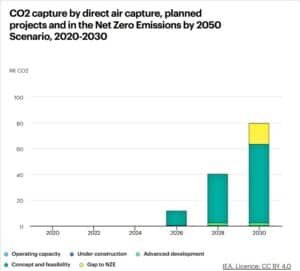
The International Energy Agency (IEA) reports that DAC plants around the world capture only about 0.01 million tonnes (Mt) of CO₂ each year. The agency says capacity needs to rise to over 80 Mt each year by 2030. Then, it should reach nearly 1 billion tonnes per year by 2050 to meet global net-zero goals.
That means today’s industry is still far from where it needs to be, as shown in the chart above.
Lower Costs Could Unlock a Bigger Market
High costs remain the biggest obstacle for direct air capture.
Most commercial DAC projects today cost between US$250 and US$600 per tonne of CO₂ removed, depending on the technology and project design. Those costs are too high for widespread adoption without government support or long-term purchase agreements.
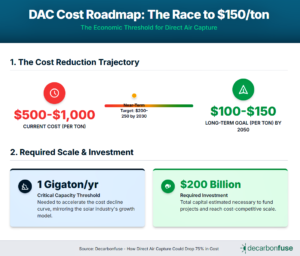
Spiritus aims to change that. The company says its technology has the potential to reduce capture costs significantly by using lower-energy materials and a simpler regeneration process.
Although the technology still needs to prove itself at a commercial scale, lower costs could make DAC more attractive to companies seeking durable carbon removal.
Demand is already increasing. The IEA says that voluntary carbon markets are driving most direct air capture projects.
According to CDR.fyi, purchases of durable carbon removal reached another record in 2025 as companies expanded long-term buying commitments. Major buyers include Microsoft, Google, Stripe, Shopify, and the Frontier buyers coalition. They have committed billions of dollars to help scale new carbon removal technologies.
Their long-term deals have helped lower DAC carbon credit prices to around US$600 per tonne. Still, that is still about six times higher than the highest carbon prices in compliance markets. The IEA also says Article 6 of the Paris Agreement could create new opportunities for DAC credits once international accounting rules are finalized.
Aramco Sees Carbon Removal as a Crucial Part of Its Net-Zero Strategy
The Spiritus partnership also fits into Aramco’s broader climate strategy. The company has pledged to achieve net-zero Scope 1 and Scope 2 greenhouse gas emissions across its wholly owned and operated assets by 2050.
To reach that goal, Aramco is investing in carbon capture and storage (CCS), hydrogen, renewable energy, methane reduction, and energy efficiency. The target does not include Scope 3 emissions, which come from customers using the company’s oil and gas products.
According to Aramco’s Sustainability report, the company’s greenhouse gas emissions increased in 2025, mainly because of higher natural gas production to meet rising domestic demand in Saudi Arabia.
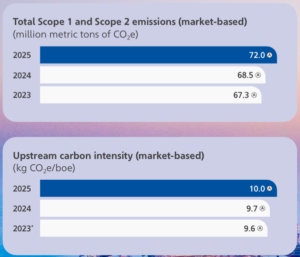
The company reported 58.0 million tonnes of Scope 1 emissions and 14.0 million tonnes of market-based Scope 2 emissions in 2025. This brings its total operational emissions to 72.0 million tonnes of CO₂e, up 5.1% from 2024.
Despite the increase in emissions, the world’s largest energy firm maintains its target of achieving net-zero Scope 1 and Scope 2 emissions across wholly owned operated assets by 2050.
Other climate metrics reported for 2025 include:
- Upstream carbon intensity: 10.0 kg CO₂e per barrel of oil equivalent (boe) (up from 9.7 kg CO₂e/boe in 2024).
- Upstream methane intensity: 0.04%, unchanged from 2024 and still within the Oil and Gas Climate Initiative (OGCI) aspiration of “well below 0.20%.”
Aramco is also working with the Saudi government to expand carbon management technologies. Saudi Arabia’s Vision 2030 and Saudi Green Initiative aim to reduce emissions while diversifying the economy.
The country plans to capture and store up to 44 million tonnes of CO₂ each year by 2035. This will make it one of the largest carbon capture hubs in the world.
For Aramco, direct air capture could become another tool to help remove emissions that are difficult to eliminate.
Demand for Durable Carbon Removal Is Rising, but Cutting Costs Is Critical
Demand for durable carbon removal continues to rise.
According to CDR.fyi, companies purchased a record amount of durable carbon removal in 2025. Technology firms remain the biggest buyers, led by Microsoft, Google, Stripe, Shopify, and Frontier. Together, they have signed long-term agreements worth billions of dollars to help new carbon removal projects reach commercial scale.
As seen in the chart below, DAC (under DACCS) gets the biggest investment share from investors, per the CDR.fyi data.
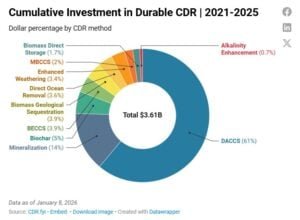
The market is still small, but it is growing quickly. The Boston Consulting Group (BCG) says the carbon removal market could reach $100 billion to $135 billion by 2050. This is possible if countries stay on track for net-zero emissions.
Experts say lower-cost technologies will be essential to reach that scale. Without major cost reductions, direct air capture will remain too expensive for widespread use.
This is where partnerships like Spiritus and Aramco could make a difference. If Spiritus can prove its technology works at a lower cost, it could help make durable carbon removal available to more companies and industries.
The Next Test Is Scaling Carbon Removal
The partnership between Spiritus and Aramco reflects a broader shift in climate technology. The discussion is no longer about whether carbon removal is needed. The focus is now on how quickly it can scale and how much it will cost.
For now, emissions reductions remain the world’s top climate priority. But many experts agree that reducing emissions alone will not be enough to reach global net-zero goals. High-quality carbon removal will also be needed to address emissions from sectors that are difficult to decarbonize.
For Aramco, the partnership expands its portfolio of lower-carbon technologies. For the carbon market, it is another sign that durable carbon removal is moving closer to the mainstream as governments and businesses invest in the next generation of climate solutions.
The post Saudi Aramco and Spiritus Join Forces to Cut Direct Air Capture Costs and Scale Carbon Removal appeared first on Carbon Credits.


