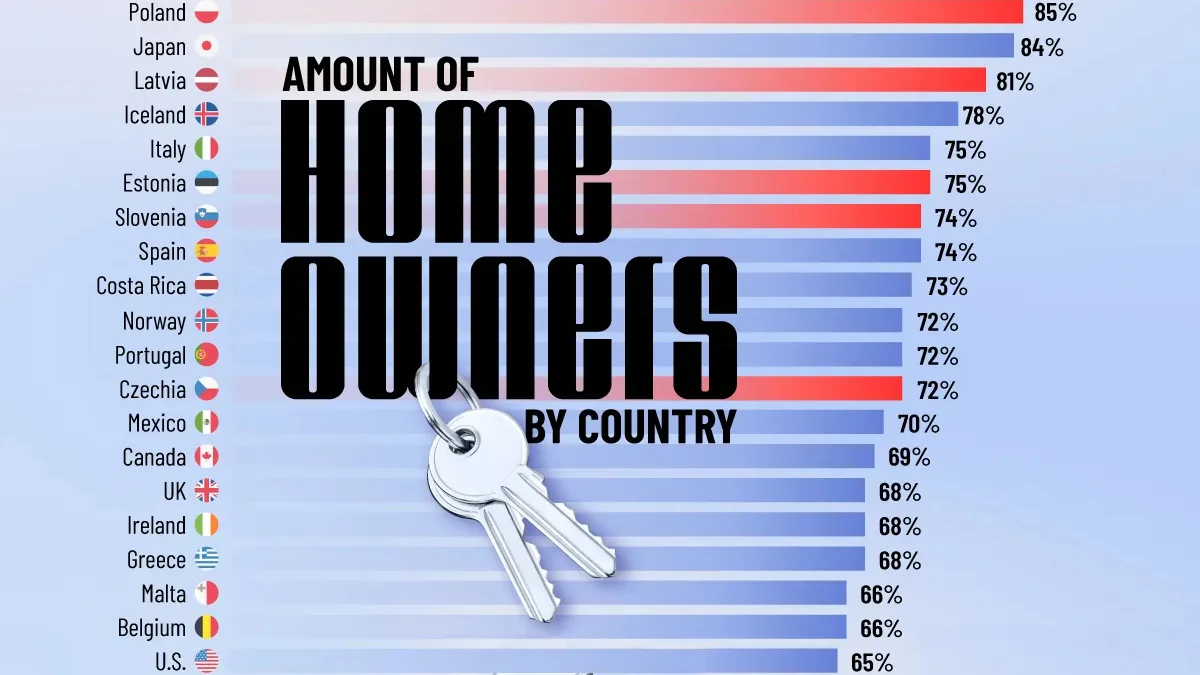
Ranked: Homeownership Rates Around the World
See visuals like this from many other data creators on our Voronoi app. Download it for free on iOS or Android and discover incredible data-driven charts from a variety of trusted sources.
Key Takeaways
- Eight of the top 10 countries in the ranking are current or former communist states, led by Slovakia (93.5%) and Romania (92.8%).
- China ranks fourth after 1990s housing reforms transferred millions of state-owned homes into private ownership.
- Germany (41.0%) and Switzerland (38.2%) have some of the lowest homeownership rates shown despite being among Europe’s wealthiest economies.
Owning a home is often viewed as a hallmark of financial success, but the countries with the highest homeownership rates may not be the ones many people expect.
This graphic ranks countries by the share of households that own the home they live in, using data from the OECD Affordable Housing Database. China’s figure comes from Clark, Huang, and Yi (2019).
The results show how decades-old housing policies continue to shape ownership patterns around the world.
Eastern Europe Dominates the Rankings
Slovakia leads the ranking with a homeownership rate of 93.5%, followed closely by Romania and Croatia.
Current and former communist states dominate the top of the list, with Lithuania, Bulgaria, Poland, and Latvia also placing in the top 10.
| Rank | Country | Homeownership rate |
|---|---|---|
| 1 |  Slovak Republic Slovak Republic |
93.5% |
| 2 |  Romania Romania |
92.8% |
| 3 |  Croatia Croatia |
90.4% |
| 4 |  China China |
90.0% |
| 5 |  Lithuania Lithuania |
86.9% |
| 6 |  Bulgaria Bulgaria |
85.2% |
| 7 |  Poland Poland |
84.8% |
| 8 |  Japan Japan |
84.0% |
| 9 |  Latvia Latvia |
80.6% |
| 10 |  Iceland Iceland |
78.4% |
| 11 |  Italy Italy |
75.2% |
| 12 |  Estonia Estonia |
75.0% |
| 13 |  Slovenia Slovenia |
73.9% |
| 14 |  Spain Spain |
73.6% |
| 15 |  Costa Rica Costa Rica |
73.2% |
| 16 |  European Union European Union |
72.5% |
| 17 |  Norway Norway |
72.3% |
| 18 |  Portugal Portugal |
72.1% |
| 19 |  Czechia Czechia |
71.9% |
| 20 |  OECD average OECD average |
70.1% |
| 21 |  Mexico Mexico |
69.6% |
| 22 |  Canada Canada |
68.6% |
| 23 |  United Kingdom United Kingdom |
68.4% |
| 24 |  Ireland Ireland |
68.2% |
| 25 |  Greece Greece |
68.1% |
| 26 |  Malta Malta |
66.0% |
| 27 |  Belgium Belgium |
65.9% |
| 28 |  United States United States |
65.3% |
| 29 |  New Zealand New Zealand |
63.9% |
| 30 |  Cyprus Cyprus |
63.5% |
| 31 |  Australia Australia |
62.7% |
| 32 |  Luxembourg Luxembourg |
62.3% |
| 33 |  Finland Finland |
61.0% |
| 34 |  France France |
58.5% |
| 35 |  Sweden Sweden |
58.2% |
| 36 |  South Korea South Korea |
58.0% |
| 37 |  Netherlands Netherlands |
57.9% |
| 38 |  Chile Chile |
57.1% |
| 39 |  Türkiye Türkiye |
55.7% |
| 40 |  Denmark Denmark |
52.2% |
| 41 |  Austria Austria |
47.9% |
| 42 |  Germany Germany |
41.0% |
| 43 |  Switzerland Switzerland |
38.2% |
| 44 |  Colombia Colombia |
36.0% |
This pattern reflects the legacy of socialist housing systems, under which state-owned homes were often privatized and sold to occupants at heavily discounted prices following the fall of communism.
China’s Housing Reforms Created a Nation of Homeowners
China ranks fourth with a homeownership rate of 90.0%.
Much of this can be traced to sweeping housing reforms introduced during the 1990s, when many publicly owned apartments were sold to residents at subsidized prices.
The reforms rapidly expanded private homeownership and helped make residential property a major store of household wealth for many Chinese families. Today, China’s housing market remains central to both consumer wealth and the country’s broader economy.
Many Wealthy Countries Have Lower Ownership Rates
Several of the world’s richest economies rank surprisingly low on the list.
Germany has a homeownership rate of 41.0%, while Switzerland sits at 38.2%, the lowest among the countries shown.
Strong rental markets, tenant protections, and relatively affordable long-term renting can reduce the pressure to buy in these countries.
Canada (68.6%), the United States (65.3%), Australia (62.7%), and France (58.5%) all sit near or below the OECD average of 70.1%. Together, the rankings suggest that housing policy, financing systems, and rental markets can influence homeownership as much as national income.
Learn More on the Voronoi App 
If you enjoyed today’s post, check out Ranked: The Countries Where $1,000 Takes the Longest to Earn on Voronoi.