Ranked: The Countries Gaining and Losing the Most Tourists
See visuals like this from many other data creators on our Voronoi app. Download it for free on iOS or Android and discover incredible data-driven charts from a variety of trusted sources.
Key Takeaways
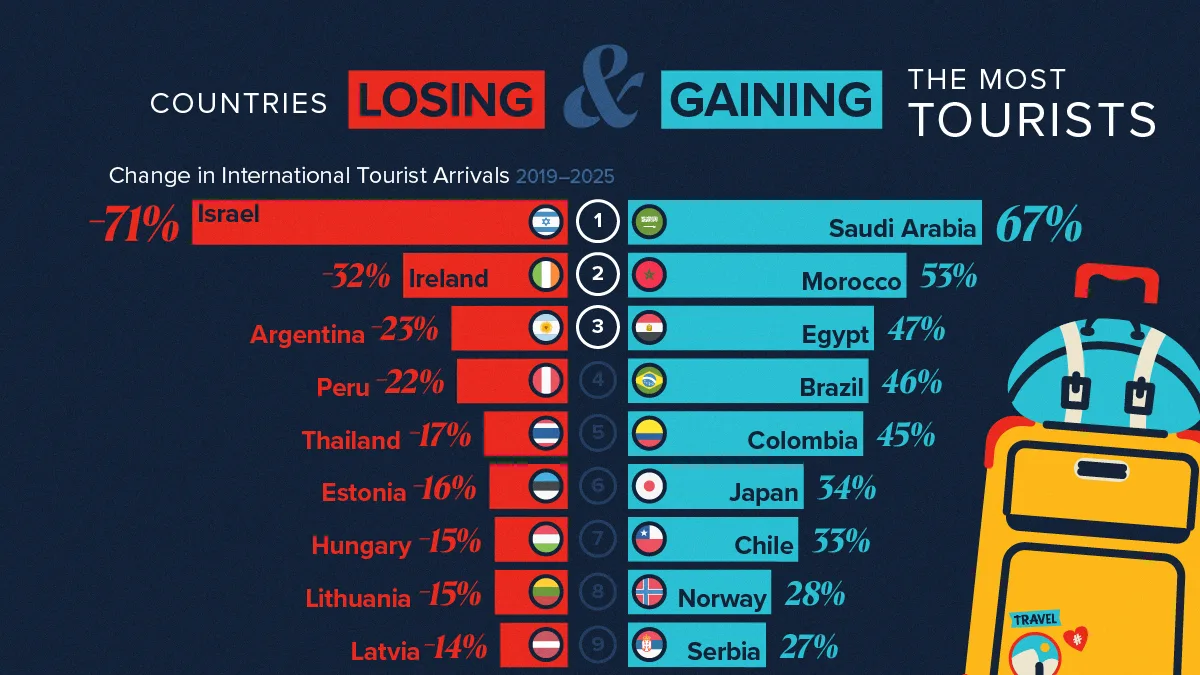
- Saudi Arabia recorded the largest increase in international tourist arrivals, up 67% from 2019.
- Israel saw the steepest decline, with arrivals falling 71% following the outbreak of war in October 2023.
- Tourism growth was strongest in the Middle East, North Africa, and parts of South America.
International travel patterns have shifted since 2019, with some countries attracting far more visitors and others remaining below their pre-pandemic levels.
This graphic ranks OECD and partner economies by the percentage change in international tourist arrivals between 2019 and 2025. The data comes from the OECD Tourism Trends and Policies 2026.
Saudi Arabia Leads the Tourism Boom
Saudi Arabia leads the dataset, attracting 67% more international tourists than in 2019.
The increase reflects the country’s push to diversify its economy through Vision 2030, including easier tourist visas, expanded airline capacity, and major investments in cultural attractions and entertainment.
| Rank | Country | Change in tourists (2019-2025) |
|---|---|---|
| 1 |  Saudi Arabia Saudi Arabia |
+67% |
| 2 |  Morocco Morocco |
+53% |
| 3 |  Egypt Egypt |
+47% |
| 4 |  Brazil Brazil |
+46% |
| 5 |  Colombia Colombia |
+45% |
| 6 |  Japan Japan |
+34% |
| 7 |  Chile Chile |
+33% |
| 8 |  Norway Norway |
+28% |
| 9 |  Serbia Serbia |
+27% |
| 10 |  Denmark Denmark |
+22% |
| 11 |  Türkiye Türkiye |
+21% |
| 12 |  Portugal Portugal |
+20% |
| 13 |  Luxembourg Luxembourg |
+19% |
| 14 |  Slovenia Slovenia |
+16% |
| 15 |  Spain Spain |
+16% |
| 16 |  Iceland Iceland |
+14% |
| 17 |  France France |
+12% |
| 18 |  Greece Greece |
+11% |
| 19 |  Netherlands Netherlands |
+11% |
| 20 |  Sweden Sweden |
+11% |
| 21 |  South Korea South Korea |
+8% |
| 22 |  Mexico Mexico |
+6% |
| 23 |  EU-27 EU-27 |
+6% |
| 24 |  Austria Austria |
+5% |
| 25 |  OECD OECD |
+5% |
| 26 |  World World |
+4% |
| 27 |  South Africa South Africa |
+3% |
| 28 |  Finland Finland |
+3% |
| 29 |  Bulgaria Bulgaria |
+2% |
| 30 |  Croatia Croatia |
+2% |
| 31 |  Poland Poland |
+1% |
| 32 |  Belgium Belgium |
0% |
| 33 |  Czechia Czechia |
0% |
| 34 |  Switzerland Switzerland |
-1% |
| 35 |  Slovak Republic Slovak Republic |
-2% |
| 36 |  Indonesia Indonesia |
-4% |
| 37 |  Romania Romania |
-4% |
| 38 |  Italy Italy |
-5% |
| 39 |  Australia Australia |
-6% |
| 40 |  Costa Rica Costa Rica |
-6% |
| 41 |  Germany Germany |
-6% |
| 42 |  New Zealand New Zealand |
-9% |
| 43 |  Canada Canada |
-11% |
| 44 |  United States United States |
-14% |
| 45 |  Latvia Latvia |
-14% |
| 46 |  Lithuania Lithuania |
-15% |
| 47 |  Hungary Hungary |
-15% |
| 48 |  Estonia Estonia |
-16% |
| 49 |  Thailand Thailand |
-17% |
| 50 |  Peru Peru |
-22% |
| 51 |  Argentina Argentina |
-23% |
| 52 |  Ireland Ireland |
-32% |
| 53 |  Israel Israel |
-71% |
Morocco (+53%) and Egypt (+47%) also posted strong gains, supported by demand for Mediterranean and North African travel.
In South America, Brazil (+46%), Colombia (+45%), and Chile (+33%) all surpassed their 2019 visitor levels.
Europe Sees Broad Recovery
Most European destinations have returned to or exceeded their pre-pandemic tourism levels, though their gains were generally smaller than those recorded in the Middle East and North Africa.
Norway (+28%), Serbia (+27%), Denmark (+22%), Portugal (+20%), Spain (+16%), and France (+12%) all recorded notable increases in international arrivals.
However, Germany (-6%), Italy (-5%), and Ireland (-32%) remained below their 2019 levels.
Conflict Weighs on Tourism
Israel experienced the sharpest decline in the dataset, with international tourist arrivals falling 71% amid the conflict in Gaza.
Several Asia-Pacific destinations also remained below their pre-pandemic totals. Thailand (-17%), New Zealand (-9%), Australia (-6%), and Indonesia (-4%) were among the countries with slower recoveries following the region’s extended border closures during the pandemic.
The United States recorded a 14% decline in international arrivals compared with 2019, while Canada was down 11%.
Learn More on the Voronoi App 
If you enjoyed today’s post, check out The World’s Biggest Tourism Spenders on the Voronoi app.