
BHP finished fiscal year 2026 with strong results. It reported record iron ore production and nearly 2 million tonnes of copper. This success came despite inflation, higher fuel costs, and supply chain issues. These results enhance BHP’s position as a top supplier of metals for steelmaking, electrification, and clean energy.
The company also advanced major growth projects in Chile, Argentina, Australia, Canada, and the United States. They aim to expand their copper business and add new commodities like potash to their portfolio.
Record Iron Ore Production Boosts Performance
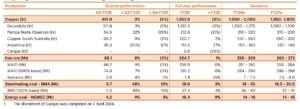
The latest report states that BHP produced a record 265 million tonnes of iron ore in FY2026. This was a 1% increase from the previous year. Its Western Australia Iron Ore (WAIO) operations hit their highest production levels. Strong mining performance, better rail operations, and record shipments supported this achievement.
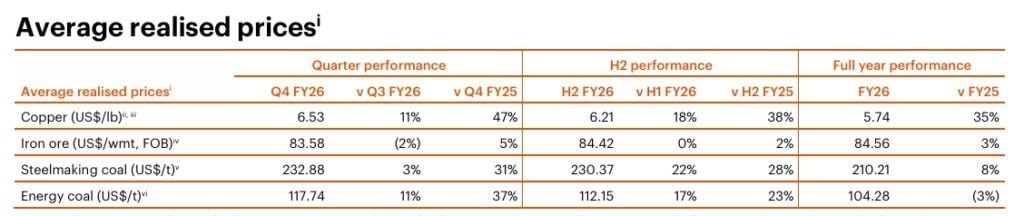
Average iron ore prices also rose to US$84.56 per wet metric tonne, helping to offset higher operating costs.
-
The company expects strong iron ore production in FY2027, forecasting output between 260 million and 272 million tonnes.
BHP is investing in future production by approving the US$900 million Ministers North project in Western Australia. This project is expected to add around 20 million tonnes per year once fully operational, with first ore expected in FY2029.
Iron ore remains BHP’s biggest earnings contributor. Although demand from China’s property sector has slowed, infrastructure investment and steel production continue to support long-term consumption.
Copper Production Stays Near Historic High
Copper has also been a bright spot for BHP.
The miner produced 1.953 million tonnes of copper in FY2026, marking its second straight year near 2 million tonnes. Production fell a bit from FY2025 because of lower ore grades at Escondida. However, operational improvements kept output strong.
-
Escondida, the world’s largest copper mine, delivered 1.261 million tonnes despite processing lower-grade ore. Record material mined, higher concentrator throughput, and better recovery rates offset the decline.
-
Copper South Australia also performed well, with production up 2% to 321,000 tonnes. Olympic Dam achieved its highest copper production in 20 years, while Carrapateena and Prominent Hill showed strong mining performance.
However, not all operations performed equally.
Production at Spence fell due to more complex ore and lower feed grades. BHP has approved two new projects to improve recoveries and handle more challenging ore, both expected to start production in 2028.
-
For FY2027, the company expects copper production to range between 1.65 million and 1.80 million tonnes. This is mainly because Escondida will continue mining lower-grade ore.
Why Copper Matters More Than Ever
Copper demand is expected to rise steadily over the coming decades.
The metal is essential for electric vehicles, renewable energy projects, power grids, batteries, and rapidly expanding AI data centers. Electric vehicles require significantly more copper than conventional cars, while wind farms, solar installations, and electricity networks also consume large volumes of the metal.
The International Energy Agency (IEA) estimates that achieving global clean energy goals will require substantial growth in copper supply over the next two decades.
At the same time, developing new copper mines has become increasingly difficult because of permitting delays, declining ore grades, and higher construction costs. That supply challenge is supporting higher long-term copper prices.
- During FY2026, BHP benefited from this trend, with its average realized copper price increasing about 35% year over year to US$5.74 per pound.
Expanding Copper Projects Around the World
Beyond current production, BHP continued investing heavily in future growth.
In Chile, the company submitted an Environmental Impact Assessment to restart the Cerro Colorado mine and potentially extend its operating life by another 20 years.
In Argentina, the Vicuña project received approval under the country’s Large Investment Incentive Regime (RIGI). The approval provides the project with long-term fiscal stability for 4 decades and keeps it on track for a final investment decision in 2026.
BHP is also expanding its footprint in the United States.
The company increased its investment in Faraday to help develop a new copper hub in Arizona, combining existing infrastructure with the Copper Creek project. It also continues advancing the Resolution and Globe-Miami projects, strengthening its long-term position in North American copper production.
These projects could become increasingly important as governments seek secure domestic supplies of critical minerals.
Potash Adds Another Growth Engine
While copper and iron ore remain the company’s biggest businesses, BHP is preparing to enter another important commodity market.
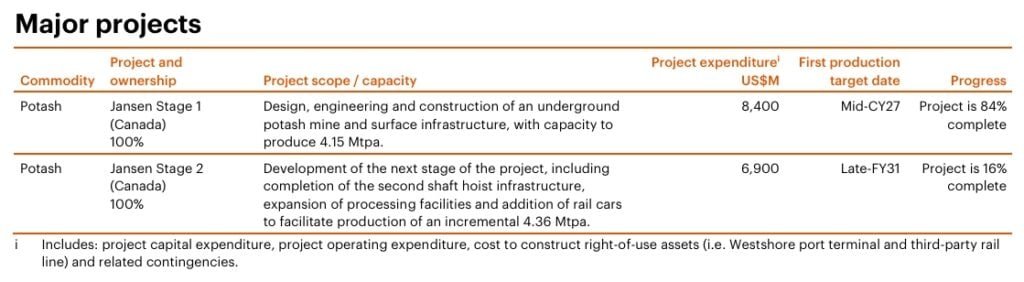
Its Jansen project in Canada remains on schedule to begin potash production next year. Potash is a key fertilizer ingredient used to improve crop yields and support global food production.
Adding potash further diversifies BHP’s revenue sources while reducing dependence on iron ore and copper. The investment also aligns with long-term trends including population growth, rising food demand, and global food security.
Cost Control Remains a Key Strength
Mining companies worldwide continue facing rising labor costs, inflation, expensive diesel fuel, and equipment shortages. Despite these pressures, BHP said nearly all of its operations are expected to finish within their cost guidance ranges.
The company credited disciplined operational management, productivity improvements, and higher by-product credits for keeping costs under control.
Maintaining low production costs is particularly important during periods of commodity price volatility, helping protect profits even if metal prices weaken.
BHP’s Climate Goals Stay on Track
BHP also reported progress toward its climate commitments.
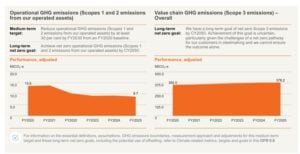
The company says it remains on track to reduce operational greenhouse gas emissions by at least 30% by FY2030 compared with its FY2020 baseline. Importantly, it said these reductions are being achieved without relying on carbon credits or offsets.
- According to the report, operational emissions fell to 8.7 million tonnes of CO₂ equivalent in FY2025, about 5% lower than the previous year. The reduction was mainly driven by renewable power agreements and the temporary suspension of Western Australia Nickel operations.
- But Scope 3 emissions inventory increased by 0.1 %
Looking ahead, the miner plans to further reduce emissions by electrifying mining equipment, increasing renewable electricity use, and deploying technologies to cut methane emissions from its operations.
For instance: it advanced trials of two Cat® 793 XE battery-electric haul trucks at its Western Australia Iron Ore (WAIO) operations. The project, conducted with Rio Tinto and Caterpillar, marks an industry-first collaboration to help reduce greenhouse gas emissions from large-scale mining.
Outlook
BHP enters FY2027 with strong momentum. Record iron ore production, resilient copper output, disciplined cost management, and a growing pipeline of major projects position the miner to benefit from long-term demand for critical minerals.
While lower ore grades will likely reduce copper production next year, the company’s expanding portfolio across copper, iron ore, and potash provides multiple avenues for future growth.
As countries invest in clean energy, electrification, artificial intelligence infrastructure, and food security, demand for the commodities BHP produces is expected to remain strong. By continuing to expand production while keeping costs under control and advancing lower-emission operations, the company is positioning itself to play a central role in supplying the materials needed for the global economy’s next phase of growth.
The post BHP Delivers Record Iron Ore Output While Boosting Copper for the Clean Energy Transition appeared first on Carbon Credits.


