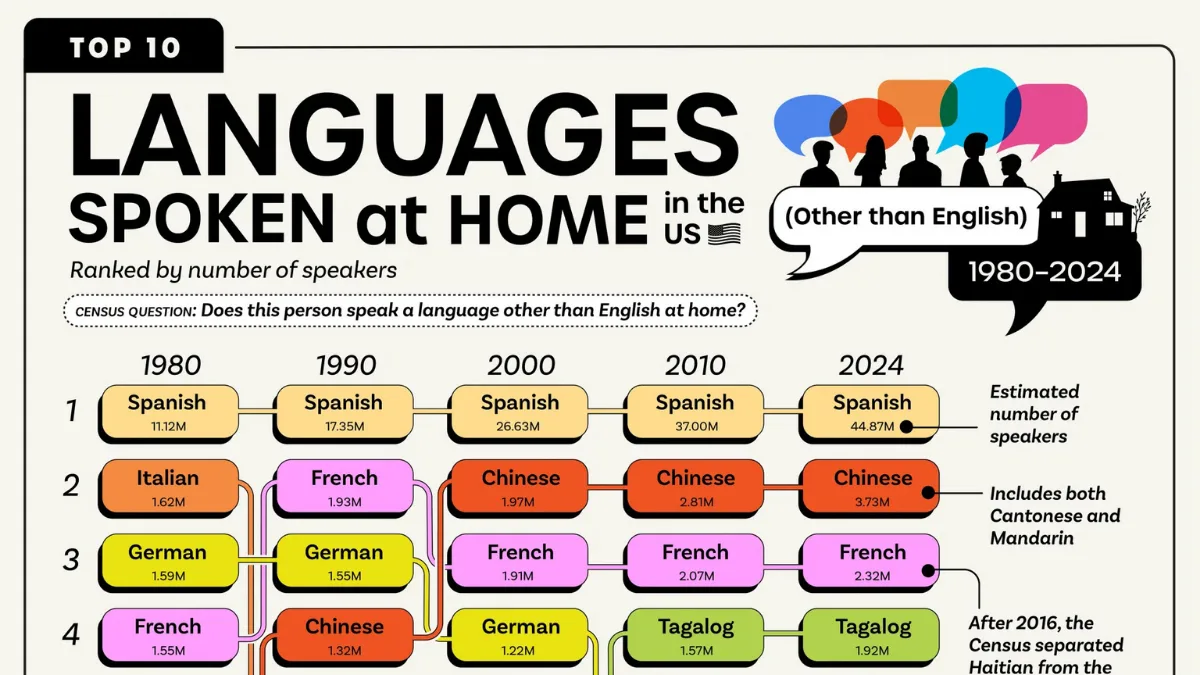
America’s Most-Spoken Languages Besides English (1980–2024)
Key Takeaways:
- Spanish is by far America’s most common non-English language spoken at home, rising from 11.1 million speakers in 1980 to 44.9 million in 2024.
- Chinese climbed from sixth place in 1980 to second in 2024, while Tagalog rose from seventh to fourth.
- German and Italian both fell out of the top 10 by 2024, while Hindi entered the ranking for the first time.
The languages spoken in American households have changed substantially over the last four decades, reflecting shifting immigration patterns as well as how languages are retained across generations.
This graphic, created by Julie R. Peasley, ranks the 10 most-spoken languages at home in the U.S. besides English, using data from the United States Census Bureau. The Census has used the same basic series of questions about language spoken at home since 1980.
Spanish Dominates America’s Multilingual Landscape
The table below shows the most-spoken non-English languages at home by decade.
| Rank | 1980 Language | 1980 Speakers | 2024 Language | 2024 Speakers |
|---|---|---|---|---|
| 1 | Spanish | 11.12M | Spanish | 44.87M |
| 2 | Italian | 1.62M | Chinese | 3.73M |
| 3 | German | 1.59M | French | 2.32M |
| 4 | French | 1.55M | Tagalog | 1.92M |
| 5 | Polish | 820K | Vietnamese | 1.60M |
| 6 | Chinese | 630K | Arabic | 1.48M |
| 7 | Tagalog | 470K | Korean | 1.15M |
| 8 | Greek | 400K | Portuguese | 1.10M |
| 9 | Portuguese | 350K | Hindi | 1.06M |
| 10 | Japanese | 340K | Russian | 1.02M |
Spanish stands in a league of its own. Its 44.9 million home speakers in 2024 were more than 12 times the 3.7 million speaking Chinese, the second-ranked language.
Spanish’s presence in the U.S. predates the country itself. Spanish-speaking communities have existed for centuries in territories that later became parts of the United States, particularly across the Southwest and Florida. More recent immigration from Latin America has substantially expanded its use.
This helps explain why Spanish is also the most common language after English across much of the country.
From European to Asian Languages
In 1980, four of the five languages behind Spanish were European: Italian, German, French, and Polish. By 2024, only French remained in the top five alongside Spanish.
Over the same period, Chinese climbed from sixth to second place, while Tagalog rose from seventh to fourth. Vietnamese reached fifth place, and Arabic climbed from outside the top 10 in 2000 to sixth place in 2024, with 1.48 million speakers.
These shifts illustrate how immigration has reshaped America’s linguistic landscape. Research on U.S. language diversity notes that immigrant languages often decline across generations as descendants adopt English, meaning continued migration can play an important role in sustaining their prevalence.
Some of these languages can also present very different learning curves for English speakers. For instance, several Asian languages appear among the most difficult languages for English speakers to learn.
How Much the Ranking Has Changed
Some of the biggest shifts become clear when comparing the endpoints. Italian ranked second in 1980 with 1.62 million home speakers, while German ranked third with 1.59 million. Neither language remained in the top 10 by 2024.
Meanwhile, several languages absent from the 1980 top 10 entered the ranking by 2024, including Vietnamese, Arabic, Korean, Hindi, and Russian. Hindi entered the top 10 for the first time in 2024.
The ranking will continue to evolve as migration patterns change and languages are retained or lost across generations.
Learn More on the Voronoi App
To see how America’s linguistic landscape compares globally, check out The World’s Most Spoken Languages by Total Speakers on the Voronoi app.
- Source: https://www.visualcapitalist.com/cp/americas-most-spoken-languages-besides-english-1980-2024/