China Is Now Viewed More Favorably Than America
This was originally posted on our Voronoi app. Download the app for free on iOS or Android and discover incredible data-driven charts from a variety of trusted sources.
Key Takeaways:
- China is now viewed more favorably than the U.S. across the countries surveyed, marking a historic reversal in Pew’s global polling.
- Nine of 36 countries rate the U.S. more favorably than China.
- Pakistan records the largest pro-China gap, with favorability ratings of 90% for China and 15% for the U.S.
Public opinion toward the world’s two leading powers has undergone a notable shift. Pew Research Center’s Spring 2026 Global Attitudes Survey reveals significant differences in how countries perceive China and the United States.
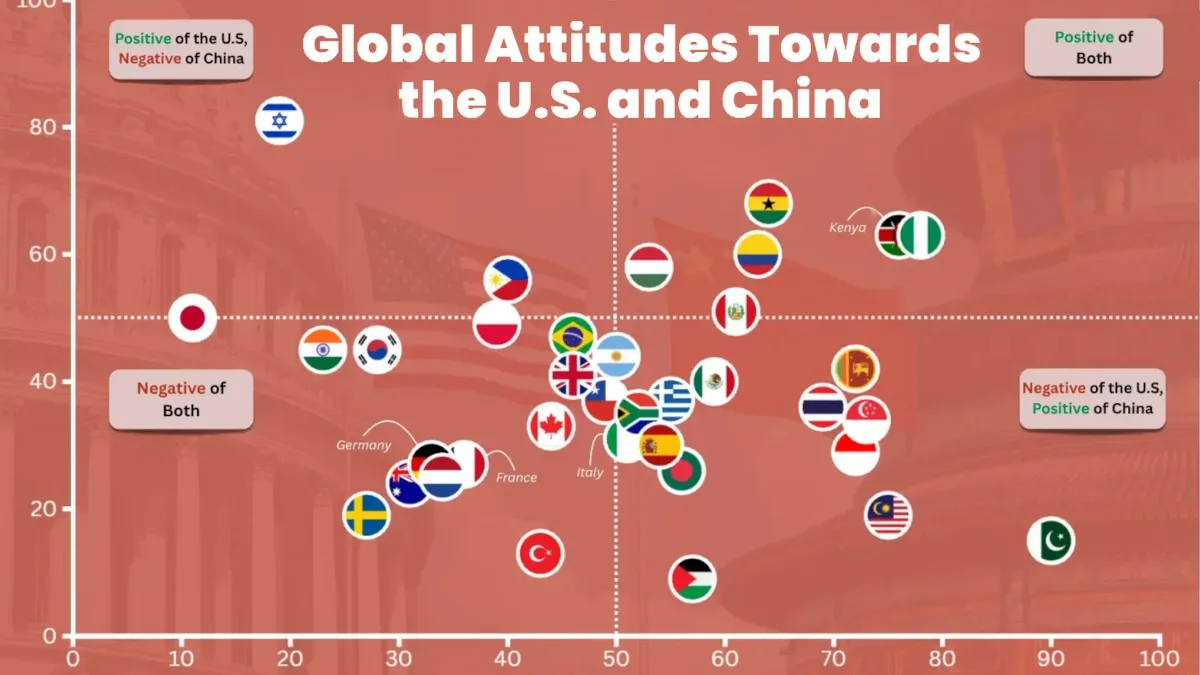
The visualization below, created by Iswardi Ishak using Pew Research Center data, compares favorability toward both countries across 36 nations, showing where each holds the strongest public support and where opinions remain closely divided.
How the World Views the U.S. and China
The chart below plots favorable opinions of China and the U.S. using Pew Research Center’s Spring 2026 Global Attitudes Survey.
| Country | Favorable Opinion of China (%) | Favorable Opinion of the U.S. (%) |
|---|---|---|
 Argentina Argentina |
50 | 44 |
 Australia Australia |
31 | 24 |
 Bangladesh Bangladesh |
56 | 26 |
 Brazil Brazil |
46 | 47 |
 Canada Canada |
44 | 33 |
 Chile Chile |
49 | 37 |
 Colombia Colombia |
63 | 60 |
 France France |
36 | 27 |
 Germany Germany |
33 | 27 |
 Ghana Ghana |
64 | 68 |
 Greece Greece |
55 | 37 |
 Hungary Hungary |
53 | 58 |
 India India |
23 | 45 |
 Indonesia Indonesia |
72 | 29 |
 Israel Israel |
19 | 81 |
 Italy Italy |
51 | 31 |
 Japan Japan |
11 | 50 |
 Kenya Kenya |
76 | 63 |
 Malaysia Malaysia |
75 | 19 |
 Mexico Mexico |
59 | 40 |
 Netherlands Netherlands |
34 | 25 |
 Nigeria Nigeria |
78 | 63 |
 Pakistan Pakistan |
90 | 15 |
 West Bank/East Jerusalem (Palestine) West Bank/East Jerusalem (Palestine) |
57 | 9 |
 Peru Peru |
61 | 51 |
 Philippines Philippines |
40 | 56 |
 Poland Poland |
39 | 49 |
 Singapore Singapore |
73 | 34 |
 South Africa South Africa |
52 | 35 |
 South Korea South Korea |
28 | 45 |
 Spain Spain |
54 | 30 |
 Sri Lanka Sri Lanka |
72 | 42 |
 Sweden Sweden |
27 | 19 |
 Thailand Thailand |
69 | 36 |
 Turkiye Turkiye |
43 | 13 |
 United Kingdom United Kingdom |
46 | 41 |
Regional differences are pronounced. Many countries in Africa, Southeast Asia, and parts of Latin America express more favorable views of China. The U.S. leads in nine countries: Brazil, Ghana, Hungary, India, Israel, Japan, the Philippines, Poland, and South Korea.
The Development Divide
The scatterplot reveals several broad clusters. Wealthier Western democracies generally remain skeptical of both countries, with Germany, France, Sweden, Australia, and the Netherlands posting relatively low favorability ratings for each.
Much of the developing world falls into the opposite quadrant, where China receives majority support while views of the U.S. lag behind. Pakistan stands out with a 90% favorable opinion of China versus 15% for the United States. Large gaps also appear in Malaysia (75% vs. 19%) and Indonesia (72% vs. 29%).
Several African countries, including Ghana, Kenya, and Nigeria, express positive views of both powers. This suggests many respondents see value in maintaining relationships with each country rather than viewing them as mutually exclusive.
Why China’s Image Has Improved
China’s improving standing reflects both rising favorability toward Beijing and declining perceptions of the United States. Recent reporting indicates that this reversal has been especially pronounced among several longstanding U.S. partners, including Canada and countries across Europe.
Public opinion rarely hinges on a single issue. Analysts point to expanding Chinese trade and diplomatic engagement, alongside changing perceptions of U.S. foreign policy and reliability. As countries deepen economic ties with Beijing, trade has become an increasingly important factor in international relationships.
Coverage from the BBC and analysis from the Council on Foreign Relations also suggest that many countries are pursuing pragmatic relationships with both powers, balancing security partnerships with growing economic ties to China.
Soft Power Remains a Global Competition
Although China receives stronger favorability ratings across most countries surveyed, the results do not necessarily translate directly into geopolitical alignment.
Instead, the survey points to an increasingly multipolar world in which economic influence, trade, diplomacy, and public perception all contribute to global power. As China expands its international presence and the U.S. works to maintain longstanding alliances, competition between the two superpowers is increasingly measured not only in economic and military terms, but also through global public opinion.
Learn More on the Voronoi App 
How does public opinion compare with hard power? Explore The U.S. and China Account for 49% of Global Military Spending on the Voronoi app to see how the world’s two leading powers compare in defense spending.