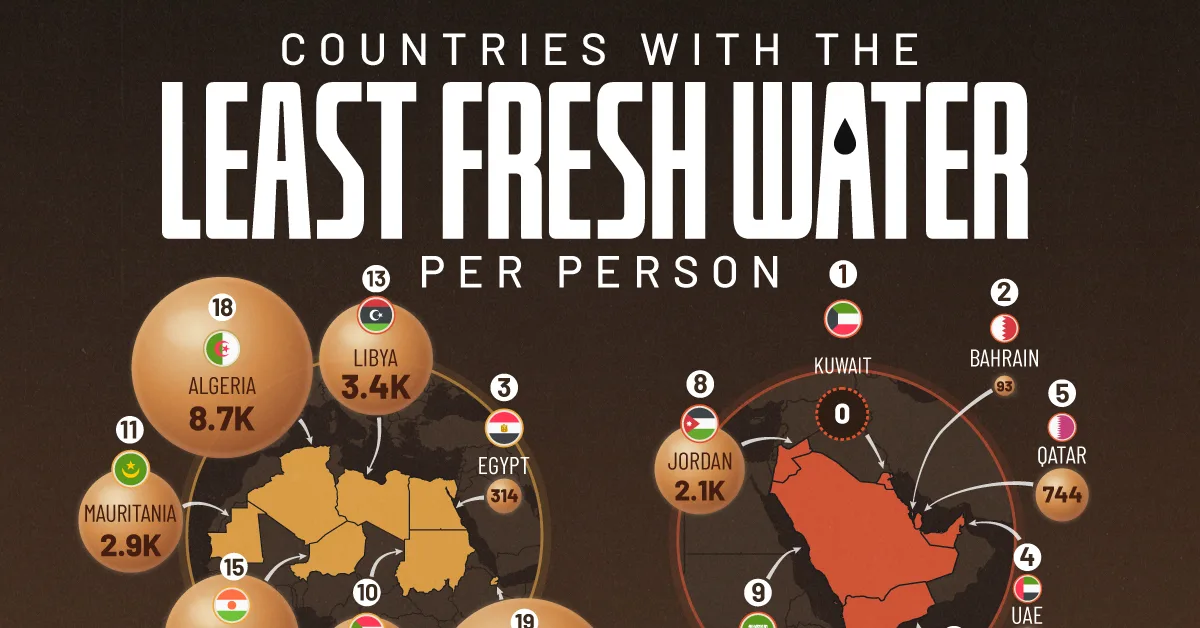
Ranked: Countries With the Least Fresh Water Per Person
See visuals like this from many other data creators on our Voronoi app. Download it for free on iOS or Android and discover incredible data-driven charts from a variety of trusted sources.
Key Takeaways
- With no rivers or lakes, Kuwait has 0 cubic feet of renewable internal freshwater resources per person, the lowest figure in the world.
- Seven of the 20 countries with the least fresh water per person are located in the Middle East, while another seven are in Africa.
- Europe and the Americas each have just one country in the ranking: Malta in 12th place and Barbados in 20th.
Fresh water is one of the world’s most unevenly distributed yet vital natural resources.
Although only about 1% of the world’s fresh water is readily available for human use, some countries have large river systems, lakes, and rainfall patterns that provide abundant renewable supplies. Others must rely on limited groundwater, desalination, or imported food and goods to reduce pressure on scarce local resources.
This visualization ranks the countries with the least renewable internal freshwater resources per person in 2022, the latest available data as of July 2026. The data comes from the World Bank via Our World in Data and is measured in cubic feet of renewable internal freshwater resources per capita.
Kuwait Has the World’s Lowest Domestic Freshwater Availability
With virtually no freshwater resources, Kuwait ranks first among countries with the least renewable internal freshwater resources per person. The country has no rivers or lakes, leaving it dependent on desalinated seawater to meet its drinking water needs.
| Rank | Country | Cubic Feet of Freshwater Per Person |
Cubic Meters of Freshwater Per Person |
Region |
|---|---|---|---|---|
| 1 |  Kuwait Kuwait |
0 | 0 | Middle East |
| 2 |  Bahrain Bahrain |
93 | 3 | Middle East |
| 3 |  Egypt Egypt |
314 | 9 | Africa |
| 4 |  UAE UAE |
526 | 15 | Middle East |
| 5 |  Qatar Qatar |
744 | 21 | Middle East |
| 6 |  Yemen Yemen |
1,940 | 55 | Middle East |
| 7 |  Maldives Maldives |
2,021 | 57 | Asia |
| 8 |  Jordan Jordan |
2,140 | 61 | Middle East |
| 9 |  Saudi Arabia Saudi Arabia |
2,634 | 75 | Middle East |
| 10 |  Sudan Sudan |
2,860 | 81 | Africa |
| 11 |  Mauritania Mauritania |
2,897 | 82 | Africa |
| 12 |  Malta Malta |
3,358 | 95 | Europe |
| 13 |  Libya Libya |
3,422 | 97 | Africa |
| 14 |  Singapore Singapore |
3,759 | 106 | Asia |
| 15 |  Niger Niger |
4,883 | 138 | Africa |
| 16 |  Turkmenistan Turkmenistan |
6,862 | 194 | Asia |
| 17 |  Pakistan Pakistan |
7,970 | 226 | Asia |
| 18 |  Algeria Algeria |
8,734 | 247 | Africa |
| 19 |  Djibouti Djibouti |
9,317 | 264 | Africa |
| 20 |  Barbados Barbados |
10,007 | 283 | Americas |
| — |  Global Average Global Average |
190,699 | 5,400 |
Nearby, Bahrain ranks second with just 93 cubic feet of fresh water per person. Egypt, the first African nation in the ranking, follows in third place with 314 cubic feet per person, despite the Nile River flowing through it.
The gap between these countries and the global average of 190,700 cubic feet per person is massive—more than 2,000 times Bahrain’s level.
The Middle East Dominates the Ranking
The Middle East accounts for seven of the 20 countries with the least fresh water per person. These are Kuwait, Bahrain, the United Arab Emirates (UAE), Qatar, Yemen, Jordan, and Saudi Arabia.
Several are among the driest countries in the world, with limited rainfall and few permanent surface water sources.
This helps explain why desalination and water management are central to the region’s infrastructure. For many Middle Eastern countries, water security depends largely on technology, imports, and conservation.
Freshwater Scarcity Extends Beyond the Middle East
Africa also has seven countries in the top 20, matching the Middle East’s total. Egypt, Sudan, Mauritania, Libya, Niger, Algeria, and Djibouti all appear on the list.
The Asian countries with the least fresh water per capita are the Maldives, Singapore, Turkmenistan, and Pakistan. Despite ranking 16th, Turkmenistan has the world’s highest per-capita water use, driven by its cotton industry and extensive irrigation withdrawals from the Amu Darya River.
Singapore, with just 3,800 cubic feet of fresh water per person, is another notable case because of its limited land area and few natural water resources relative to its population of more than six million.
Small island nations can also face significant freshwater constraints. Malta, the only European nation in the ranking, ranks 12th with 3,400 cubic feet per capita, while Barbados, the only representative from the Americas, rounds out the top 20 with 10,000 cubic feet per person.
Most Countries on the List Are Far Below the Global Average
Among the 20 countries shown, 15 have less than 5,000 cubic feet of renewable internal fresh water per person, placing them at a tiny fraction of the global average.
Inadequate freshwater access not only threatens public health but can also constrain economic development by limiting agriculture and contributing to geopolitical tensions over water resources.
These figures highlight that water scarcity is not just about total national supply. Population size, geography, and climate all shape how much renewable fresh water is available per person, with scarcity likely to worsen in the future.
Learn More on the Voronoi App 
If you enjoyed today’s post, check out Mapped: Safe Drinking Water on Voronoi.