
Artificial intelligence and advanced sensing technologies are helping farmers better understand poultry health and behaviour, which are increasingly linked.
Why it matters
Aside from traditional flock health challenges, poultry producers face new pressures driven by disease, climate, consumer expectations, labour shortages, and production efficiencies.
“AI should be a flashlight, not a verdict. It can provide a continuous second set of eyes and ears, but the producer remains the decision-maker,” said Suresh Raja Neethirajan, associate professor and research chair at Nova Scotia’s Dalhousie University’s Department of Animal Science and Aquaculture.
Photo: Dalhousie University
Neethirajan’s research has been adopted globally, resulting in AI-enabled decision-support platforms and mobile applications that support animal welfare assessment, sustainability benchmarking, environmental monitoring, and operational decision-making.
“We combine behavioural, thermal, acoustic, and environmental indicators rather than treating any single signal as a complete welfare score,” he explained. “A bird is more complicated than one number on a dashboard.”
In practical terms, the indicators may prompt a producer to inspect ventilation when conditions suggest rising heat load or investigate changing social behaviour before it becomes more difficult to manage, he said.
With these factors in play, Neethirajan said the objective is more precise attention, not more technology for technology’s sake. He said good welfare and good management should not occupy separate dashboards but integrate what the bird’s behaviour is telling us.
Scale vs Attention
He said one of the greatest challenges facing farmers in poultry management is scale versus attention.
As AI continues to be integrated into more farm operations, Neethirajan noted that welfare and productivity often overlap, but they are not interchangeable.
While routine walk-throughs remain essential, Neethirajan said, with AI, a producer gains an ongoing record of how the flock is responding, which is especially impactful for commercial barns with thousands to tens of thousands of birds.
Heat load, poor air quality, competition for resources, and persistent social disruption can affect both how birds experience their environment and how the flock performs, he said.
“Productivity alone is not a welfare measure, but recognizing welfare-relevant changes earlier may help producers protect bird well-being and operational stability,” he explained. “AI can add continuous, objective, welfare-relevant indicators that complement formal welfare assessment and good stockmanship.”
He said these are potential cues for inspection, not diagnoses.
Bioacoustic analysis
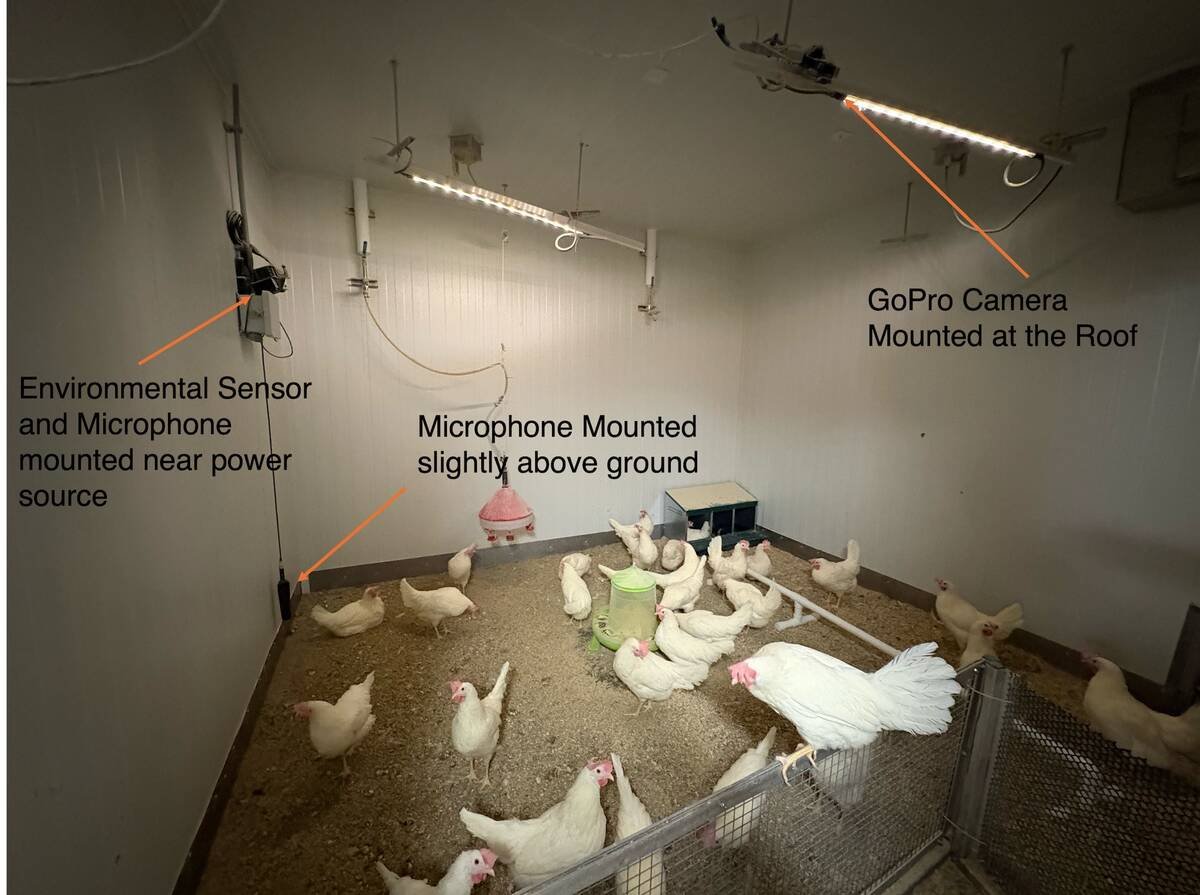
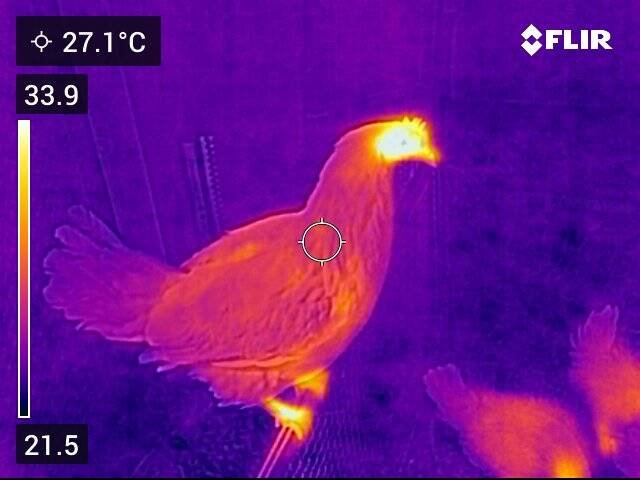
Neethirajan added that bioacoustic analysis characterizes changes in flock sounds that may be relevant to arousal, thermal conditions, or social context, while thermal imaging measures surface-temperature patterns, which must be interpreted in conjunction with barn temperature and humidity.
“It does not measure core body temperature or diagnose disease. Environmental sensors provide the physical context surrounding those behavioural and thermal responses. Machine learning is the connective tissue,” he noted. “It integrates these streams, characterizes the flock’s baseline, and identifies deviations that may become reliable alerts once validated. Any one sensor provides only a partial view and can sometimes mislead.”
As a result, Neethirajan added, the signals provided by all these monitoring tools provide “complementary context and may reduce ambiguity, provided the sensors and models are properly validated.”
He said this is where the digital-twin concept enters the picture.
“HenTwin is a research framework moving toward a flock-level digital twin. It is not yet a closed-loop commercial product. A fully developed twin would maintain an evolving computational representation of the flock, connect current observations with historical patterns, and eventually support carefully bounded ‘what if’ management scenarios,” he said.
HenTwin’s longitudinal research followed 150 hens across five controlled research rooms for more than 27 weeks, demonstrating that multimodal patterns can be measured and interpreted over time.
“That is essential groundwork, but it is not yet a validated disease-diagnosis system,” Neethirajan said, adding that published research suggests certain acoustic and activity patterns may be associated with thermal stress, respiratory conditions, or developing behavioural problems.
Cautious AI integration
Despite the push towards AI, Neethirajan said producers are smart to be cautious.
“I share their skepticism about technology that adds cost and complexity without earning its place in the barn. Implementation should therefore be incremental. In many barns, it could begin by integrating microphones or cameras with existing housing and control systems,” he said.
Neethirajan said thermal or environmental sensors can be added to address a clearly defined management need. The analysis should run quietly in the background, he added, and provide only what matters: understandable alerts and supporting evidence, not a flood of raw data.
“The honest expectation is decision support, not automation of the farmer. Potential practical benefits include earlier targeted inspections, fewer late surprises, more consistent records, and better use of the producer’s time. Our controlled studies establish technical feasibility,” he said.
Rigorous multi-site validation on full-scale commercial farms is the essential next step before making claims about return on investment or measurable welfare and productivity gains, he added.
“The test is simple: Does the technology help the producer make a useful decision? If an AI system requires a data scientist standing beside the feeder to interpret it, it is not ready for the farm.”
On-farm application
Al Dam, an Ontario Ministry of Agriculture, Food and Agribusiness poultry specialist, said that more AI integrated into poultry farming through data collection and evaluation could be the future. Technology can be used to set benchmarks against other farms to identify management, disease, environmental and other production parameters, he added.
A positive early AI technology application was the use of cameras in the barn or on the robots, he said, adding it helped “to pick up dead birds and to identify lame, ill, compromised birds for evaluation.”
Dam recommends taking time to understand how robust a system your operation requires before investing, adding that there are several useful questions producers should ask before pulling the trigger.
“Are you a beta tester for the system or an early adopter? Are you ok sharing your data Where is it being stored? What is collected and how secure is the systems you are using? Is it a monitoring tool or are you giving the system control of your barn?” he posed, pointing to potential ventilation, feeding, and lighting systems applications.
Dam noted he would like to see more data based on proper interpretation before broader implementation.
Poultry’s AI future
When asked where he sees the industry moving in terms of AI in the next five to 10 years, Neethirajan predicted AI will improve decisions and fundamentally change poultry farms.
“In the near term, AI will mainly help producers make better-informed decisions through potential earlier warnings, sharper insight, and less guesswork. The farmer will remain firmly in charge. Individual sensing applications are being evaluated now, while integrated digital twins still require commercial validation,” Neethirajan said.
Over the next five to 10 years, Neethirajan expects progress toward what he calls the computational poultry farm, meaning a potential digital twin that combines weather forecasts, current barn conditions, and the flock’s previous responses to estimate emerging risks and support earlier action.
He said this approach would gradually move management from reactive toward predictive, but only after rigorous biological and commercial validation.
“The goal is not a farmerless farm. AI should give stockmanship a longer reach, not push the farmer out of the picture,” he said. “The farms that benefit most will use these tools to pay greater attention to their birds, not less.”
The post AI gives poultry farmers a new set of eyes and ears for bird health appeared first on Farmtario.


