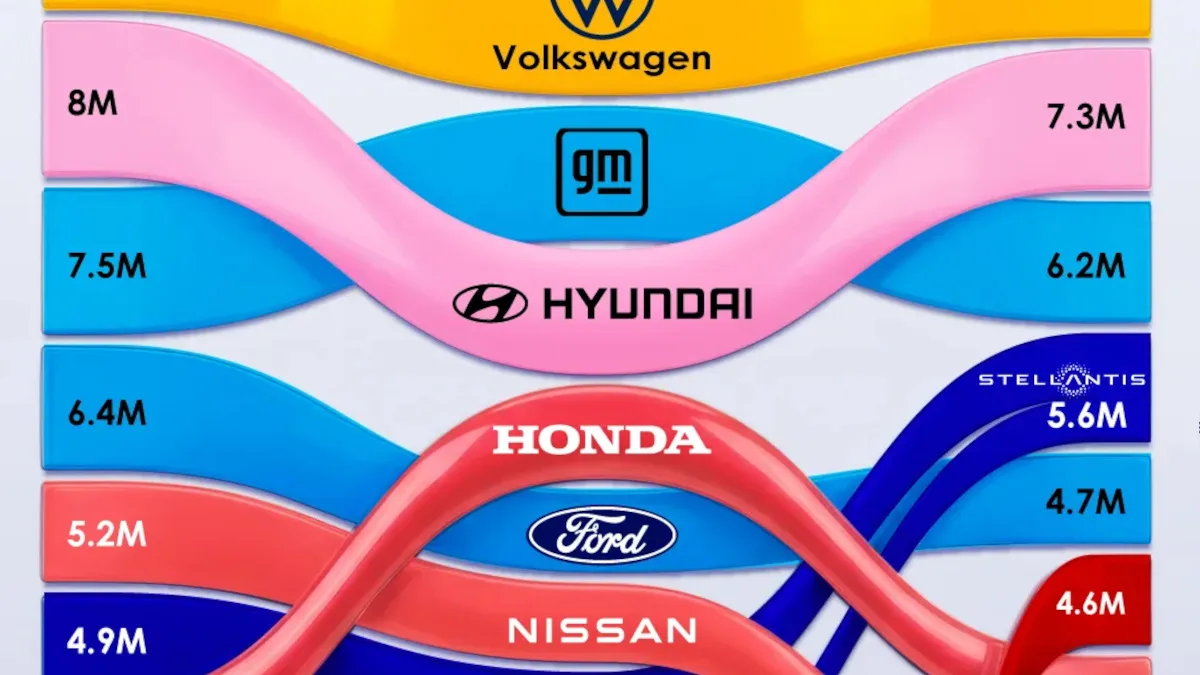
How the World’s Biggest Automakers Have Changed Since 2015
Key Takeaways
- Toyota has remained the world’s top automaker for over a decade, with 2025 vehicle sales exceeding 11 million.
- Chinese automakers have gained ground, with BYD selling nearly as many vehicles as Ford in 2025.
- Stellantis, formed through a major merger in 2021, ranked as the world’s fifth-largest automaker in 2025.
The global automotive industry has undergone a major reshuffling over the past decade, as Chinese manufacturers climbed the rankings and established automakers faced growing competition.
This visualization tracks the world’s leading automakers in 2015, 2020, and 2025, using vehicle sales figures and historical rankings from F&I Tools, BYD, OICA, and Focus2Move.
Familiar Leaders, New Challengers
Toyota and Volkswagen continued to dominate global vehicle sales in 2025, with approximately 11.3 million and 9 million vehicles sold, respectively. Hyundai and Kia together followed with 7.3 million, maintaining South Korea’s strong position among the industry’s biggest players.
Further down the rankings, the competitive landscape looked substantially different. China’s BYD sold 4.6 million vehicles, nearly matching Ford’s annual total, while Stellantis (5.6 million) brought several longstanding American and European brands together under one corporate roof.
The table below ranks the world’s top automakers in 2025 by vehicle sales.
| Rank | 2025 Firm | Vehicles Sold (2025) |
|---|---|---|
| 1 |  Toyota |
11,322,575 |
| 2 |  Volkswagen |
8,983,978 |
| 3 |  Hyundai Kia |
7,272,453 |
| 4 |  GM |
6,183,928 |
| 5 |  Stellantis |
5,600,000 |
| 6 | Ford |
4,650,000 |
| 7 |  BYD |
4,602,436 |
| 8 | Honda |
3,521,905 |
| 9 | Suzuki |
3,295,013 |
| 10 | Nissan |
3,202,137 |
| 11 | Geely |
3,024,567 |
| 12 | Changan |
2,913,177 |
| 13 | BMW |
2,463,715 |
| 14 |  Renault |
2,336,807 |
| 15 | Mercedes |
2,160,354 |
BYD’s proximity to Ford captures the scale of the change. Their reported sales volumes were separated by fewer than 50,000 vehicles, putting the Chinese manufacturer on roughly equal footing with one of America’s most recognizable automotive names.
Geely and Changan also exceeded 2.9 million vehicle sales each in 2025, showing that China’s growing presence extends beyond a single breakout company.
China’s EV Rise
The shift toward electric vehicles created a major opening for Chinese manufacturers, particularly following the pandemic. In 2025, Chinese automakers accounted for 60% of global electric car sales, including battery-electric vehicles and plug-in hybrids. Within China, these vehicles represented nearly 55% of new car sales, providing domestic manufacturers with an enormous home market.
Affordability has helped sustain that expansion. Around 70% of battery-electric cars sold in China in 2025 cost less than the average conventional car. China also accounted for over 80% of global battery-cell production, concentrating a crucial part of the electric vehicle supply chain alongside its car factories.
That competitive pressure is increasingly reaching overseas markets. Chinese electric car exports doubled to more than 2.5 million in 2025, while Chinese brands accounted for over half of all electric cars sold in Southeast Asia. Intense competition and squeezed margins at home have added an incentive to seek customers abroad.
The Big Merger Era
Stellantis illustrates another force behind the changing automotive hierarchy: consolidation. Fiat Chrysler and PSA completed their merger in January 2021, combining brands including Jeep, Ram, Dodge, and Fiat with Peugeot, Citroën, Opel, and others.
Before the merger, Fiat Chrysler and PSA Group were major automakers in their own right, ranking seventh and 11th, respectively, in 2015.
| Rank | 2025 Firm | Vehicles Sold (2025) |
|---|---|---|
| 1 | Toyota |
11,322,575 |
| 2 | Volkswagen |
8,983,978 |
| 3 | Hyundai |
7,272,453 |
| 4 | GM |
6,183,928 |
| 5 | Ford |
5,600,000 |
| 6 | Nissan |
4,650,000 |
| 7 |  Fiat |
4,602,436 |
| 8 | Honda |
3,521,905 |
| 9 | Suzuki |
3,295,013 |
| 10 | Renault |
3,202,137 |
| 11 | PSA |
3,024,567 |
| 12 | BMW |
2,913,177 |
| 13 | SAIC |
2,463,715 |
| 14 | Daimler |
2,336,807 |
| 15 | Mazda |
2,160,354 |
The commercial logic behind mergers is scale. Developing vehicles, purchasing components, and funding new technology require substantial investment. Combining businesses creates opportunities to spread those costs across more vehicles and brands, although realizing the savings depends on successful integration.
For consumers, familiar automotive brands can remain recognizable even as the companies behind them change. Stellantis represents one path toward greater scale through consolidation, while BYD and other Chinese manufacturers illustrate how rapidly growing competitors can challenge established industry leaders.
Together, these developments show how the global automotive hierarchy has been reshaped by both mergers among established manufacturers and the rise of new competitors.
Learn More on the Voronoi App
For a closer look at one major U.S. manufacturer, check out Tesla is the Most American Automaker on Voronoi.