

Anthropic’s plan to go public is drawing attention to the money flowing into artificial intelligence (AI). However, the company’s latest financial disclosures also highlight a growing challenge for the industry: how to power the rapid expansion of AI without adding to climate change.
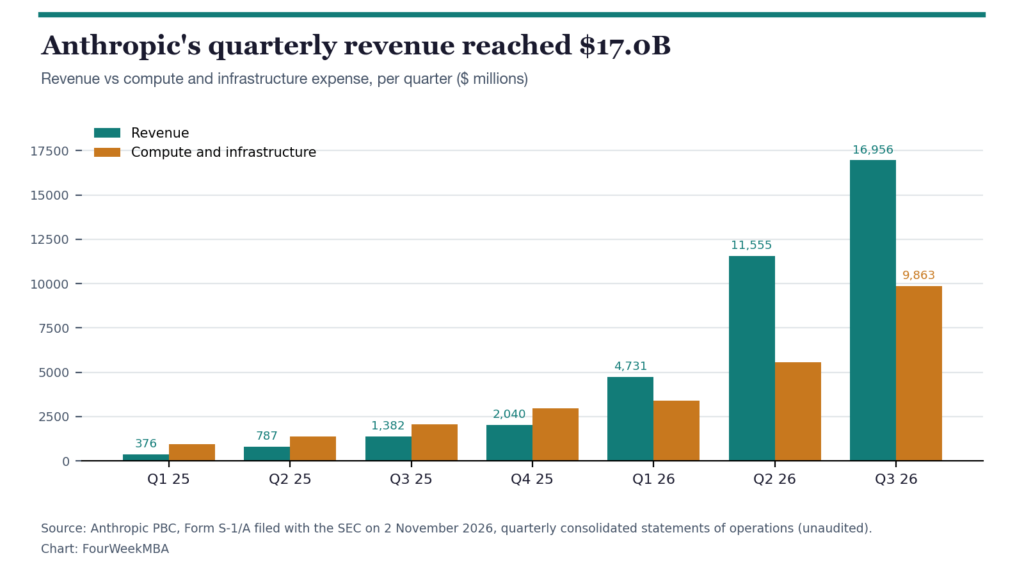
The maker of Claude AI filed an updated registration statement with the U.S. Securities and Exchange Commission (SEC) on November 2, 2026. The filing revealed that Anthropic made almost $17 billion in revenue in the third quarter. At the same time, its costs for computing power and infrastructure kept increasing.
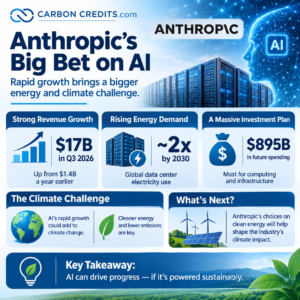
The company has also committed to about $895.4 billion in future spending, most of it linked to computing and infrastructure. These commitments support the data centres and computing systems needed to develop and run its AI models.
The filing is not an announcement that Anthropic has already completed its initial public offering (IPO). Instead, it gives investors a closer look at the company before its planned stock market debut. It also reveals the growing importance of energy to the AI business.
As Anthropic expands, access to reliable electricity, natural gas, water, and data center capacity could affect both its costs and its environmental footprint.
Anthropic’s Revenue Surges to Near $17B as Computing Costs Rise
Anthropic’s latest results show how quickly demand for its AI services is growing. The company reported third-quarter revenue of about $17 billion, up from $11.6 billion in the second quarter and $1.4 billion a year earlier. However, its quarter-on-quarter revenue growth slowed to 47%, compared with 144% in the second quarter.
Higher costs also affected its results. Anthropic reported an operating loss of $567 million in the third quarter, compared with operating income of $974 million in the previous quarter. The company attributed much of the pressure to higher computing costs, including computing capacity purchased through short-term agreements.
The Claude AI maker also reported a net loss of $23.3 billion for the quarter. Much of that loss was linked to an accounting charge related to the rising value of its convertible notes, rather than cash spent running its operations.
These figures matter because developing advanced AI requires more than software and research. Companies need powerful chips, large data centers, cooling systems, and reliable electricity supplies.
Anthropic’s filing shows that computing capacity has become a major business expense and a key factor in its future growth. The company is investing in longer-term infrastructure arrangements to help meet demand and reduce its reliance on more expensive short-term computing capacity.
AI’s Growing Demand for Electricity
The financial growth of AI companies comes with a growing need for power. Data centers use electricity to run servers, process information, train AI models, and answer user requests. They also need cooling systems to prevent equipment from overheating.
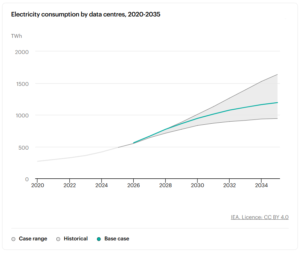
The International Energy Agency (IEA) estimates that global data centers consumed about 485 terawatt-hours (TWh) of electricity in 2025, which accounts for around 1.5% of the world’s total electricity demand. The agency expects data center electricity consumption to more than double to about 950 TWh by 2030, with AI serving as the main driver of the increase. One terawatt-hour equals one billion kilowatt-hours.
This growth creates challenges for power grids. New data centres need large amounts of electricity, but building power plants and transmission lines can take years. In some regions, limited grid capacity is already delaying projects.
The IEA expects renewable energy to supply a large share of the additional electricity needed by data centers. However, natural gas and other power sources will also contribute. The climate impact depends on where data centers are located, which energy sources power them, and how fast cleaner energy becomes available.
Anthropic Plans to Use On-Site Natural Gas Power
Anthropic’s SEC filing offers a closer look at how the company plans to address its growing power needs. The company says some planned data center facilities will rely on dedicated on-site, natural-gas-fired power generation. These systems supply electricity directly to a facility rather than relying entirely on the wider electricity grid.
This approach could help data center developers secure power in areas where grid connections are delayed or insufficient. But it also creates risks tied to fuel prices, gas supplies, pipeline capacity, and environmental requirements.
Natural gas produces carbon dioxide when burned. Methane can also escape during gas production and transport, adding to its climate impact.
Anthropic’s filing warns that competition among data-centre operators for natural gas could increase costs or make fuel supplies harder to secure. It also notes that access to newer power sources, including solar, wind, batteries, nuclear, and geothermal energy, may be limited by availability, timing, or cost.
The company does not provide a complete emissions estimate for these planned facilities in the sections of its filing addressing energy and infrastructure risks. As a result, the full climate impact of its planned power supply cannot be calculated from these disclosures alone.
This distinction is crucial. On-site natural gas can help a data center get electricity faster. However, it doesn’t mean the facility is low-emissions by default. The outcome depends on the power mix, the amount of energy used, and any steps taken to reduce emissions.
Anthropic’s Expansion Raises Wider Environmental Concerns
Anthropic’s filing also highlights environmental concerns linked to data center growth, including electricity demand, water use, land use, and pressure on local resources.
Data centers need power to run servers and water to cool some of their equipment. Their climate impact also depends on the electricity they use. Facilities powered mainly by fossil fuels can produce more emissions than those supplied by cleaner energy.
The Claude AI creator says it has committed to covering electricity price increases for consumers caused by its data centers, including costs linked to power supplies and grid infrastructure. Such measures may help address community concerns, but they do not replace the need to track and reduce greenhouse gas emissions.
AI Companies Face Pressure to Report Emissions
Anthropic’s filing talks about energy and environmental risks. However, it doesn’t fully cover the company’s greenhouse gas emissions from its operations and supply chain.
For AI companies, emissions can come from electricity use, on-site fuel burning, chip and server manufacturing, data center construction, and equipment transport. These sources fall into three reporting categories:
- Scope 1: Direct emissions from sources a company owns or controls.
- Scope 2: Emissions linked to purchased electricity, heating, and cooling.
- Scope 3: Other indirect emissions across the value chain, including suppliers and equipment manufacturing.
Clear reporting helps investors assess whether companies are reducing their environmental impact as they grow. Efficiency gains alone may not lower total emissions if demand for AI services rises faster than energy use per task falls.
Can AI Growth Be Matched With Cleaner Energy?
AI can also support climate action. It can help energy companies forecast electricity demand, manage power grids, and integrate renewable energy. Other applications may help factories and buildings use less energy or detect methane leaks.
Per the IEA analysis, AI optimization can cut energy costs by 3% to 10% in high-use industries with low profit margins. If adoption barriers are cleared, these proven use cases could save 3% of global energy consumption by 2035.
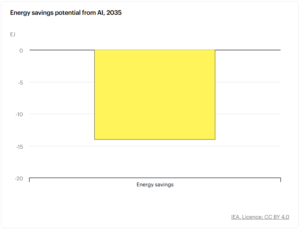
However, these potential benefits do not automatically cancel out AI’s own emissions. The overall impact depends on the energy needed to run AI systems. It also hinges on whether these systems provide clear emissions reductions.
For Anthropic, the challenge is to expand its computing capacity while managing its energy needs and environmental risks. Its filing makes clear that access to power is central to its business strategy.
What Anthropic’s IPO Means for the AI Industry
Anthropic’s planned IPO highlights both the financial potential of AI and the resources needed to support its growth. The company’s disclosures reveal strong revenue growth. They also show major infrastructure investments and rising costs linked to computing power.
As AI companies expand, access to electricity, water, land, and data center capacity could affect their costs, project timelines, and emissions. Investors may therefore need to look beyond revenue and earnings to assess energy sources, resource use, and environmental performance.
The filing does not establish how much Anthropic’s total emissions will rise or fall. However, it shows that energy supply is already a key business concern.
The central question is whether AI companies can keep growing while securing reliable, affordable, and lower-emissions power. Their financial success depends on computing capacity, while their climate impact will partly depend on how that capacity is built and powered.
The post Anthropic’s New IPO Filing Puts AI and Data Center’s Energy and Emissions in Focus appeared first on Carbon Credits.


