
What We Learned in Part 5
In Part 5 of this series, we introduced the biological cast of characters that make nutrient cycling actually happen: the Soil Food Web. We drew the line between abiotic nutrient release (slow, rock-and-weather-driven processes) and biotic cycling (fast, life-driven processes measured in minutes and days), and walked through the six kingdoms of life that inhabit the soil. From there, we zoomed into the rhizosphere, the thin zone around every root where plants and microbes strike a deal: plants exude sugars and compounds to feed bacteria and fungi, and in return those microbes unlock nutrients the plant couldn’t reach on its own.
We also covered some of the most striking discoveries in soil biology, including the rhizophagy cycle, where plants actively draw microbes into their root tips, strip nutrients from them, and eject the survivors back into the soil to be recaptured later. We looked at mycorrhizal fungi, which extend a plant’s reach far beyond its own root system, and saprophytic fungi, nature’s recycling crew that returns nutrients to circulation almost as soon as an organism dies. Finally, we met the rest of the “underground herd,” protozoa, nematodes, springtails, mites, beetles, ants, termites, and earthworms, and saw how this whole web of competition, cooperation, and predation keeps nutrients cycling continuously through the soil.
This brings us to important matters… organic matters. Organic matter is the physical record of the living critters Part 5 talked about. If the Soil Food Web is the cast of characters, organic matter is them plus the stage they leave behind: the bodies, residues, and byproducts of all that biological activity, in every stage from freshly dead to nearly unrecognizable. It’s easy to think of organic matter as one uniform “thing” in the soil, but it’s really a graveyard in motion. Some of it is consumed and cycled within days, some of it is locked away in forms that resist decomposition for years or decades. In this article, we’ll break down why organic matter matters so much to nutrient cycling: how carbon-to-nitrogen ratios determine whether decomposition feeds your crop or steals nitrogen from it, why organic matter’s chemistry gives it an outsized ability to hold and release nutrients compared to sand, silt, and clay, and how modern practices like tillage have been quietly drawing down this resource for centuries.
Missed part 5? Check it out here.
The Importance of Organic Matter
Most organic matter is dead
If there’s a singular takeaway message from this article, it’s that the Nutrient Cycle needs living organisms to function properly. Roots, microbes, earthworms, and all the rest of the underground herd transform and translocate nutrients at a ferocious pace compared to soil without biological activity. In fact, that’s essentially what staying alive means: the continual transformation and translocation of nutrients in order to gain energy and raw material. Pretty simple, but what happens when soil organisms die? More importantly, what happens to all of those valuable nutrients?
To paraphrase the words of my university Ecology professors, “From a nutrition standpoint, the best diet for an organism is one of its own kind. The amount and ratios of nutrients that are unique to each species are already found in their bodies.” While I’m not usually one to argue for cannibalism, there is a point to be made that a dead organism contains the elements of life (carbon, hydrogen, oxygen, nitrogen, and all the rest) in one convenient pre-packaged location. Compare this to the bulk soil where those nutrients are scattered about and likely in a hard-to-access form. For this reason, many saprophytic soil organisms exude enzymes that break down dead plant residues, dead microbes, and/or dead animals for the purpose of consuming the nutrients contained inside.
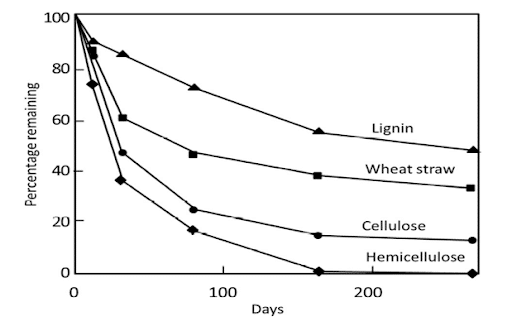
However, not every organism gets directly consumed or completely digested. Far from it. Most necromass (“necro-” meaning death; “-mass” meaning amount of matter) is strewn across the soil. And rates at which dead microbial and plant cells decompose differ tremendously, even within the same organism. This might be difficult to understand at first, but think about the bodies of animals. Soft tissue like skin and organs decompose much quicker than compounds like teeth and bone. If this weren’t the case, we wouldn’t have dinosaur skeletons in museums! We will return to this topic later in the article when detailing how the carbon-to-nitrogen of compounds also affects the rate of decomposition.
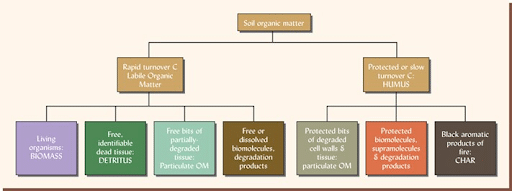
Suffice it to say for right now, compounds in microbes and plant cells like simple sugars and proteins break down (or ooze out) quickly, while the more chemically resistant parts, like cell walls, lignin and cellulose, are left intact for a longer period of time (pictured below, bottom right).
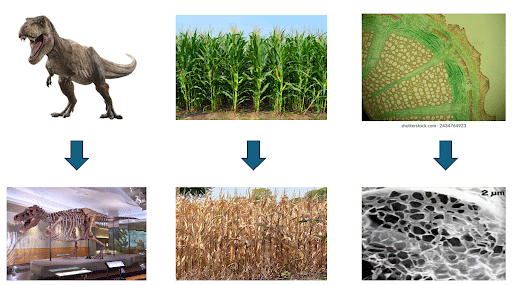
The bodies of these organisms attach to the outside of soil minerals or find themselves slowly rolled up inside soil aggregates, where they are both physically and chemically protected from further breakdown. Chemical and physical protection leaves the soil looking like a graveyard with dead bodies in various stages of decomposition laying around. As spooky as that sounds, this is an excellent way to increase nutrient cycling efficiency in the soil, because organic matter is primarily composed of dead and decaying material from organisms.47
Carbon to Nitrogen (C:N) Ratio of organic matter
Much of the first half of this series was spent attempting to undo decades of nitrogen bias, so allow me to put this section in its proper context and not seem like I’m speaking out of both sides of my mouth. Nitrogen is hugely important because it’s a building block in the DNA, RNA, and proteins of all living organisms. Therefore, nitrogen is needed in larger amounts compared to nutrients not named carbon, hydrogen, and oxygen. The point made earlier was that the rest of the nutrients have different jobs, and they are all required if an organism is to be healthy and well. Carbon, hydrogen, oxygen, and nitrogen make up the bulk of biological compounds, like plastic and rubber used in a TV remote control. Other nutrients, particularly the metals, are needed in much smaller quantities. These nutrients facilitate electron movement (a.k.a. chemical reactions), which allows biological compounds to function, like the zinc, potassium, and manganese atoms inside of the AA batteries that cause the TV remote control to do its job.
With all of that said, carbon, and nitrogen’s quantitative prowess make them uniquely important as biological compounds decompose. Carbon is the backbone of all major biological compounds, and living organisms need a constant intake of carbon for two reasons. First, they need it as a raw material to build their own biological compounds. Second, living organisms gain energy to do things by breaking apart carbon bonds and harvesting the energy. This is why many people equate carbon with energy. Check out this article on cellular respiration to see how aerobic organisms like us accomplish this task.
Nitrogen, on the other hand, is mostly important for its function as a building block. Therefore, a handy way to think about energy and building material is to calculate how much carbon and nitrogen are contained inside of an organism. We call this the Carbon to Nitrogen (C:N) ratio. This concept was briefly introduced when discussing bacterial C:N ratios versus predatory nematode C:N ratios. Plants also differ in their C:N ratios. Young, green plants are made up of nitrogen in a decently high ratio. As plants age, carbon accumulates in the form of lignin and cellulose, which are long chains of hard-to-decompose carbon structures. These carbon-based molecules allow plants to stand up as they grow bigger and heavier. In essence, they behave like the plant’s skeletal system. Young plants don’t have as many of these compounds quite yet, so they are mainly composed of simple, easy-to-break down compounds higher in nitrogen. This is why they have low C:N ratios.
If you are confused, think about a 1:1 ratio (1 Carbon for every 1 Nitrogen). Now, let’s add 9 carbons and 0 nitrogens to our 1:1 ratio, for example. This gives a 10:1 ratio (10 carbons for every 1 nitrogen). Take a look at the chart below to see actual values.
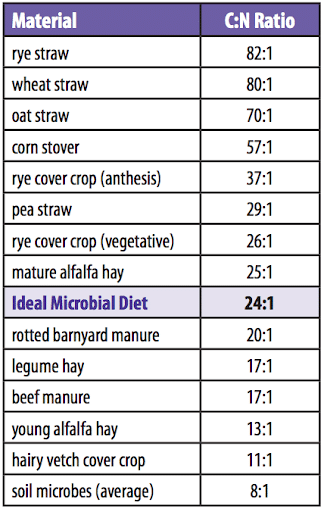
Farmers and ranchers already have an idea of the buildup of complex carbon compounds in mature plants because wheat straw takes much longer to decompose compared to young, green plants. Farmers and ranchers also know that their crops often show signs of nitrogen deficiency when they are planted into wheat, corn, or rye stubble. The reason is that decomposing bacteria and fungi have C:N ratios around the 3:1-10:1 range. This means the amount of nitrogen in their bodies is fairly high compared to the amount of carbon. Compare this to wheat straw which has a C:N ratio of 80:1, meaning there are few nitrogen atoms surrounded by a sea of carbons.
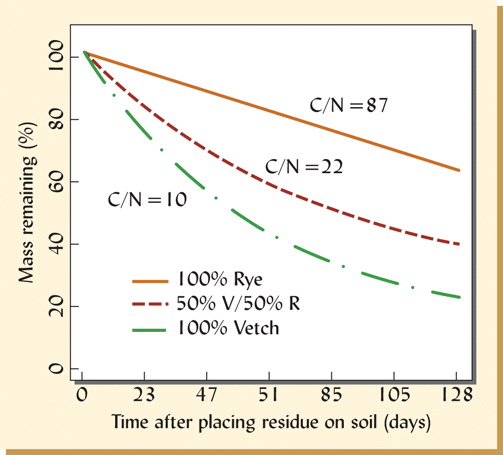
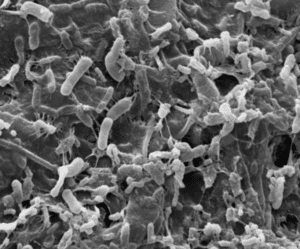
Bacteria and fungi that consume wheat straw accumulate carbon much faster than nitrogen. This carbon is used in energy production and as building material in the construction of carbohydrates, proteins, genetic material, and lipids. So, imagine that the construction of proteins and genetic material begins. Carbon locks into place as the backbone of these molecules, but there is not enough nitrogen to finish construction. Bacteria and fungi are then forced to scavenge the soil for accessible nitrogen to finish the job. Due to their large population sizes, these microbes consume accessible nitrogen quickly, which leaves very little for plant roots to absorb, and we see symptoms of plant nitrogen deficiency.

On the flip side, microbes are forced to scavenge the soil for carbon when decomposing organic material with low C:N ratios. This is the case for high protein crops, like legumes. So, imagine a field of young alfalfa is terminated and decomposing. Microbes consume a plethora of nitrogen, which they utilize to build protein and genetic material. However, the young alfalfa does not provide enough carbon to complete the construction of these molecules, so microbes are forced to scavenge the soil for carbon.
This can lead to soil compaction because a common form of accessible carbon is the carbohydates48 and glycoproteins49 (glycoprotein = Carbohydrate + protein molecules. glyco means carbohydrate; Protein means… protein) that hold soil aggregates together. Think of these structures as a mesh bag holding a group of small pebbles together. In this analogy, microbes consume the mesh bags, which allows the pebbles to spill out. The longer microbes aren’t fed carbon, the more mesh bags are consumed and the more pebbles pile on top of each other.
Proper aggregation is essential for good soil structure, which provides a healthy mix of aerobic and anaerobic sites for nutrient cycling. Nitrogen-fixation, for example, requires anaerobic conditions! Soil compaction and loss of soil aggregation is devastating for larger members, such as protozoa and nematodes that require macroaggregation and water to swim and find food. This potential collapse of soil structure is why producers are cautioned against planting cover crop mixes too high in legumes and brassicas for many years on end. Just like everything else, it’s all about balance.
C:N ratios of microbes
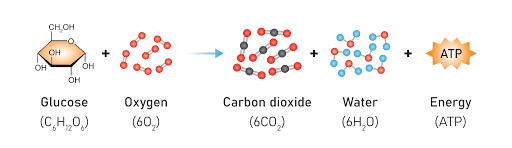
Turn your attention to the equation for cellular respiration below. This is the process by which aerobic organisms use oxygen to unlock energy from carbon-based glucose (a sugar). This process explains why the ideal microbial diet is described in the purple chart above as residue with a 24:1 ratio. Cellular respiration results in the loss of around two-thirds of the total carbon consumed. These carbon atoms gas off as carbon dioxide (CO2). This leaves only one-third of the carbon to be used as raw building material as decomposers break down residue. So, if we assume the average C:N ratio of a bacteria or fungi is 8:1, they would ideally consume material with a 24:1 C:N ratio because two-thirds of the 24 carbons (16 of them) will be released as CO2, which leaves 8 carbons for every 1 nitrogen. Perfect!
Nutrient-holding ability of organic matter
The importance of soil organic matter (SOM) in nutrient cycling, soil function and profitability can’t be overstated. Just briefly, the word “organic” in scientific terms refers to carbon-based living and dead organisms. And as I said above, SOM is primarily dead and decomposing organisms, nearly 90% by most estimates. This differs fundamentally from the sand, silt, and clay minerals in soil that derive from lifeless rock.
Organic matter is one of the most important factors in a soil’s ability to hold and distribute nutrients, which is quite astounding considering it comprises less than 5% of soil in most places. One reason why organic matter punches above its weight is because of its high Cation Exchange Capacity (CEC). Recall that chemistry is simply the movement of electrons. Certain compounds and atoms readily give or take electrons to become more stable. The gain of electrons brings more negativity because electrons carry negative charge. Think about receiving debt. You “gain” something, but it is a negative to your bank account.
Atoms that gain extra electrons and become negatively charged are called “anions“. On the other hand, losing electrons results in a positive charge. Atoms that have a positive charge are called “cations“. CEC is a numerical value representing the ability of a soil to hold on to the various cations in the soil, such as Calcium (Ca2+), Magnesium (Mg2+), Potassium (K+), Sodium (Na+), Aluminum (Al3+) ammonium (NH4+) and others. Organic matter has a much higher CEC than sand, silt, and clay, which means there are many more negatively charged sites that magnetically attract positively charged nutrients.
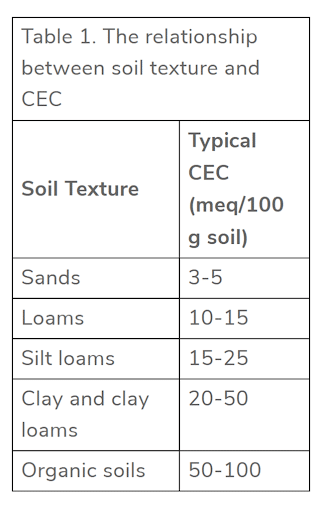
Anion Exchange Capacity (AEC) also increases. AEC is not talked about as much as CEC, but it is a critical function in the soil. The soil has a natural negative charge that repels negatively charged nutrients, such as nitrate (NO3–), sulfate (SO42-), phosphate (PO43-), and boron (B(OH)4−), which means these nutrients are constantly at risk of leaching out of the soil if they are not taken up by living organisms or magnetically connected to positively charged sites on organic matter. Therefore, organic matter saves producers money by ensuring valuable nitrogen, sulfur, phosphorus, and boron are slowed down before they end up in the nearest river.
Organic matter doesn’t just hoard these nutrients, either. It took .38 Special’s advice and holds on loosely to these nutrients. This allows roots and living organisms to easily remove these nutrients and consume them when they need to. The reason that organic matter has such a high CEC in the first place is that the decomposition of organic matter leaves compounds in smaller, fragmented bits, meaning there is a lot more surface area and a lot more exposed, charged molecules that can attract polar (positively or negatively charged) molecules. This is also why organic matter dramatically increases a soil’s ability to hold water. Water is extremely polar, with positively charged and negatively charged regions. Some compounds, such as fats and lignin, have no charge. This is why water and oil don’t mix! However, fats, oils, and lignin in the soil will begin to have charges exposed on their exterior as they are broken down and decomposed.
So, organic matter is chock full of nutrients because its individual components were once living biology or compounds produced by living biology and because of its high surface area and electrical charge. To a soil inhabitant, this makes organic matter the ultimate buffet (more like the ultimate bed and breakfast if you consider organic matter’s ability to promote good soil structure at the same time).
Release of nutrients from organic matter
Nutrients from organic matter become available to living organisms over time as microbes and other soil organisms nibble away at exposed surfaces. Assuming adequate biological activity, organic matter should be viewed as a slow-release fertilizer that can provide significant quantities of nutrients to plants over the growing season. One source cites research that claims a soil with 5% organic matter and good biological activity is expected to supply around 100-150 lb of nitrogen per acre per year. This is enough nitrogen to fulfill the nitrogen needs of the grain from 200 bushel of corn, which requires 134 lb of nitrogen per acre at that yield level.50 Twenty to thirty-five pounds of phosphorus and ten to fifteen pounds of sulfur would also be supplied for free by biology, as long as it is active. While they are in smaller quantities, the availability of calcium, manganese, zinc and a whole host of other essential nutrients are also affected by organic matter decomposition.
Organic matter trends
Global decrease
Thanks to the modernizing of agriculture, machinery, and chemical inputs have sped up the decomposition of organic matter, which has had the positive effect of releasing nutrients at lightning speed for crop and forage production. This is one factor that allowed agriculture to feed the growing world population while avoiding mass starvation across the planet. While avoiding famine is something to be applauded, soil organic matter levels cannot be exhausted forever. Most agricultural soils exhibit organic matter levels that are lower today than they contained 200 years ago.51 Many, if not most, of the problems facing production agriculture are direct consequences of lower soil organic matter levels and, consequently, less efficient natural nutrient cycling.
Tillage
One practice particularly good at catalyzing the depletion of organic matter levels over time is tillage. There are two main reasons why this is the case. First, the practice of tillage infuses oxygen into the soil. Aerobic (oxygen-dependent) microbes are the most efficient decomposers of organic matter, so adding oxygen to the soil is like adding fuel to an already burning fire. Second, the physical obliteration of soil aggregates exposes once-hidden organic matter to the hungry masses. These two factors lead to a feeding frenzy of organic matter for its energy and nutrients. Most of the carbon inside organic matter leaves the soil as CO2 gas when microbes consume it, while other nutrients immobilize and mineralize unnaturally fast as well. Crops in this situation are able to absorb these nutrients fairly well, which is why crops in tilled virgin ground grow better than surrounding areas for a few years.
External Nutrients
However, all good things must come to an end. Fields and pastures become less and less productive as carbon continues to float away and other nutrients leave the field via the crop, animal, air, or water faster than they are replaced. External nutrients (a.k.a. fertilizers) become necessary at this point if producers wish to sustain yields. Whether or not these fertilizers decrease organic matter over time is still being debated. Some research shows that increased plant production more than offsets the negative effects of fertilizers52, while others claim they do decrease organic matter levels.53
Next time
The next installment in this series will begin to describe how all of the information in this series can be turned into applicable knowledge on the farm or ranch. To do so, we will begin by discussing soil tests: why conventional soil tests do not tell the whole story, why they lead producers to purchase more fertilizer than they need, and how to accurately test soil for nutrient levels and nutrient cycling ability.

References
47https://www.agric.wa.gov.au/measuring-and-assessing-soils/what-soil-organic-carbon
48https://www.sciencedirect.com/science/article/abs/pii/S0038071720300390
49https://www.sciencedirect.com/science/article/abs/pii/S0167198711002030
50https://agphd.com/resources/nutrient-removal-charts/corn-grain-and-stover-nutrient-removal-charts/
51https://www.sciencedirect.com/science/article/abs/pii/S0065211321001048
52https://uknowledge.uky.edu/cgi/viewcontent.cgi?article=1139&context=pss_facpub
53https://link.springer.com/chapter/10.1007/978-3-030-61010-4_1

The post 4 Ecosystem Processes: Nutrient Cycle Part 6 appeared first on Understanding Ag.


