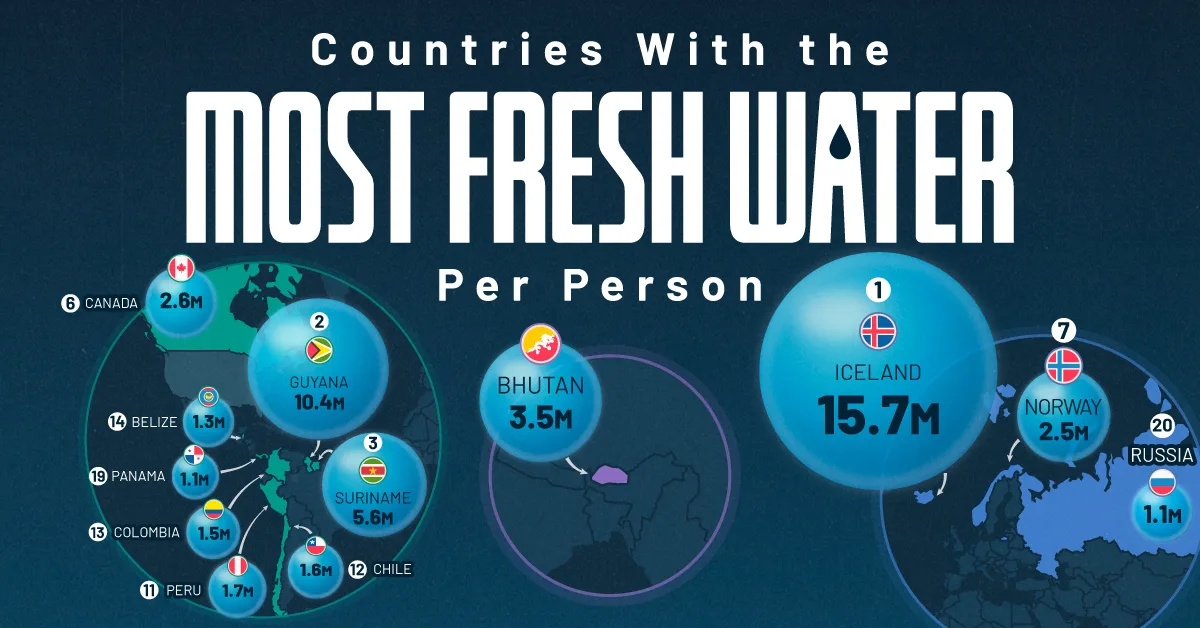
Mapped: Countries With the Most Freshwater Per Person
Key Takeaways
- Iceland has the world’s highest renewable freshwater availability, with 15.7 million cubic feet per person each year.
- Small, sparsely populated countries dominate the rankings, while populous nations generally have far less freshwater available per resident.
- The U.S. ranks 54th globally, showing that abundant total water resources do not necessarily translate into high freshwater availability per resident.
Some of the world’s largest freshwater supplies are found in countries that most people wouldn’t expect. Once population is factored in, the rankings look very different from total water resources alone.
Using data from the World Bank via Our World in Data, this map ranks countries by renewable freshwater available per person, highlighting where freshwater is most abundant relative to population.
Iceland Leads the Ranking
Iceland ranks first by a wide margin, with 15.7 million cubic feet of renewable freshwater available per person each year. Its glaciers, abundant rainfall, and population of roughly 400,000 make it one of the world’s most water-rich countries on a per-capita basis.
Guyana and Suriname follow for similar reasons. Both receive heavy tropical rainfall and have extensive river systems shared among relatively small populations.
| Rank | Country | Cubic feet per person |
|---|---|---|
| 1 |  Iceland Iceland |
15,715,042 |
| 2 |  Guyana Guyana |
10,357,802 |
| 3 |  Suriname Suriname |
5,611,506 |
| 4 |  Bhutan Bhutan |
3,527,939 |
| 5 |  Papua New Guinea Papua New Guinea |
2,772,204 |
| 6 |  Canada Canada |
2,585,036 |
| 7 |  Norway Norway |
2,472,029 |
| 8 |  Gabon Gabon |
2,383,742 |
| 9 |  New Zealand New Zealand |
2,270,735 |
| 10 |  Solomon Islands Solomon Islands |
2,020,001 |
| 11 |  Peru Peru |
1,730,420 |
| 12 |  Chile Chile |
1,599,756 |
| 13 |  Colombia Colombia |
1,465,560 |
| 14 |  Belize Belize |
1,338,427 |
| 15 |  Liberia Liberia |
1,313,707 |
| 16 |  Congo Congo |
1,299,581 |
| 17 |  Vanuatu Vanuatu |
1,126,539 |
| 18 |  Fiji Fiji |
1,098,287 |
| 19 |  Panama Panama |
1,094,756 |
| 20 |  Russia Russia |
1,055,910 |
| — |  World average World average |
190,450 |
Canada has one of the world’s largest supplies of water, yet much of it lies far from major population and agricultural centers. This highlights an important distinction: total freshwater resources and freshwater available per person are not the same.
Large countries such as Canada, Russia, and Brazil have abundant renewable water supplies, but they rank lower on a per-capita basis because those resources are spread across much larger populations. Geographic distribution can also create local shortages, even in countries with abundant overall supplies.
Where the U.S. Stands
The U.S. has one of the world’s largest renewable freshwater supplies in absolute terms, but it also has one of the largest populations. As a result, it ranks 54th globally on a per-capita basis, with about 297,000 cubic feet available per person each year.
Regional differences complicate the national picture. Water is plentiful across much of the Pacific Northwest and Great Lakes region, while many fast-growing areas in the Southwest face chronic water stress and mounting pressure on rivers, reservoirs, and groundwater supplies.
As climate change intensifies droughts and shifts precipitation patterns, managing freshwater resources is expected to become an increasingly important challenge across the U.S.
Learn More on the Voronoi App 
To learn more about this topic, check out this graphic on the world’s deepest lakes.