

An international research group has developed a novel strategy to improve self-assembled monolayers (SAMs) used as hole-transport layers in inverted perovskite solar cells. The method, called symmetry-breaking co-assembly (SBC), combines symmetric and asymmetric molecules to suppress aggregation and improve surface coverage.
“Rather than synthesizing complex and costly asymmetric molecules, we achieve the benefits of molecular asymmetry by co-assembling a widely used symmetric SAM (MeO-2PACz) with a simple asymmetric conjugated molecule (DTCA),” corresponding author Tom Wu told pv magazine. “This approach suppresses molecular self-aggregation, substantially increases surface coverage, and improves buried-interface quality.”
Wu said his team also developed a quantitative atomic force microscopy-infrared spectroscopy (AFM-IR) method to directly measure SAM coverage at the nanoscale.
“Together, these advances enabled certified efficiencies above 25.6% and excellent operational stability, providing a practical new framework for interface engineering in perovskite photovoltaics,” he added.
The researchers selected MeO-2PACz as the host molecule and compared it with two symmetry-breaking co-assemblies incorporating either 2-thiophenecarboxylic acid (TCA) or dibenzo[b,d]thiophene-4-carboxylic acid (DTCA). They deposited the MeO-2PACz, MeO-TCA and MeO-DTCA formulations from 0.7 mg/mL isopropanol solutions onto plasma-treated indium tin oxide (ITO) substrates by spin coating at 3,000 rpm for 30 seconds. They then annealed the samples at 100 C for 10 minutes.
Molecular dynamics simulations indicated that DTCA rapidly anchored to the ITO substrate and suppressed MeO-2PACz aggregation. AFM-IR measurements showed surface coverage of 60.6% for MeO-2PACz alone, 62.2% for MeO-TCA and 82.4% for MeO-DTCA.
The team also compared MeO-DTCA molar ratios of 3:1, 4:1 and 5:1 and tested DTCA alone. It identified the 4:1 mixture as the optimal formulation.
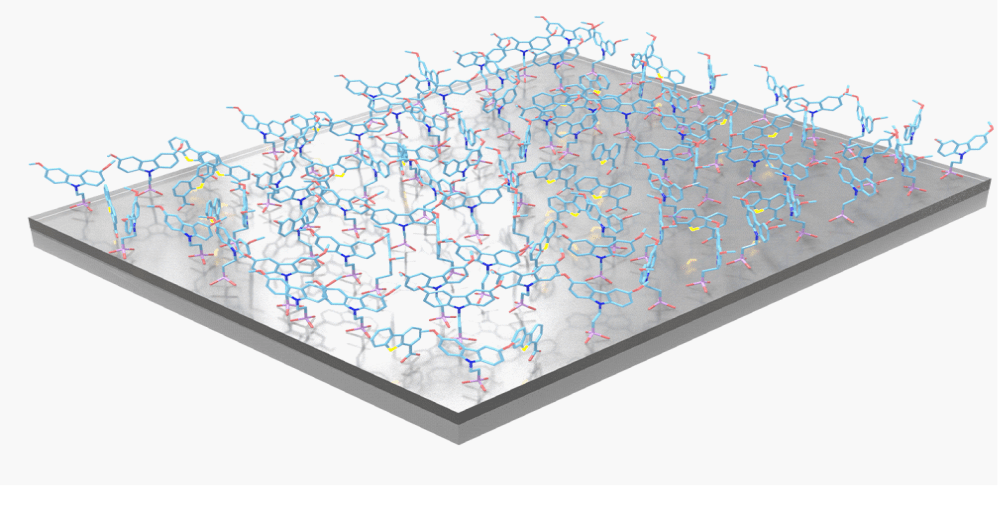
“By mixing the industry-standard symmetric SAM MeO-2PACz with a small asymmetric molecule (DTCA), we increased SAM surface coverage by more than 30%, as directly quantified using a newly developed AFM-IR analysis method,” Wu said. “We were amazed to find that strategically breaking molecular symmetry could unlock so many benefits for solar cells, leading to improvements in interface quality, energy conversion efficiency, and operational stability.”
The scientists built the cell with an inverted configuration. It was based on an indium tin oxide (ITO) substrate, a MeO-DTCA co-assembled SAM as the hole-selective layer (HTL), a perovskite absorber, a phenyl-C61-butyric acid methyl ester (PCBM) electron-transport layer (ETL), a bathocuproine (BCP) buffer layer and a silver (Ag) electrode.
They explained that, when the surface coverage of co-SAM layers is maximized, the interfacial chemical reaction under electrical stress and the non-radiative recombination loss were effectively suppressed, resulting in power conversion efficiencies of 26.32% and 25.34% for areas of 0.08 cm2 and 1 cm2, respectively. The encapsulated device retained 93% of its initial efficiency after operating at the maximum power point (MPP) for 1,150 hours.
“This study opens several exciting directions for future research,” concluded Wu. “The novel strategy is likely applicable to many other molecular systems, and we are interested in developing a broader library of symmetry-breaking molecular combinations and establishing design rules that link molecular symmetry, dipole moment, and surface coverage. Second, we aim to translate these molecular design principles to large-area modules and tandem solar cells. Finally, our quantitative AFM-IR methodology provides a new way to study ultrathin molecular layers in a quantitative approach, which could benefit not only photovoltaics but also other devices involving such molecular layers.”
The research, “Symmetry-Breaking Co-Assembly of Conjugated Molecules Boosts Perovskite Photovoltaics,” was published in Nature Communications. Scientists from China’s Hong Kong Polytechnic University, Shenzhen University of Advanced Technology, Chinese Academy of Sciences, Northwestern Polytechnical University, and Great Bay University, Australia’s University of New South Wales, the United Kingdom’s University of Surrey, South Korea’s Korea University, and Germany’s Karlsruhe Institute of Technology (KIT) participated in the study.
The post Symmetry-breaking molecular strategy pushes inverted perovskite solar cell efficiency to 26.32% appeared first on pv magazine Global.


