Happy Monday!
SPACs are back, and nuclear is leading the charge. We look back at how the last class did and what that means for this one.
In deals, $167m for advanced silicon battery materials in Washington; $22m for modular biomethanol plants in Massachusetts; and $18m for fermentation-derived chemicals in North Carolina.
In other news, Big Oil cashes in on record refining margins, Democrats set conditions for the permitting vote, and the EPA loosens methane rules.
Thanks for reading!
Not a subscriber yet?
📩 Submit deals and announcements for the newsletter at hello@ctvc.co.
💼 Find or share roles on our job board here.
CTVC is powered by Currence, market intelligence to power the AI era.
2026 SPAC attack
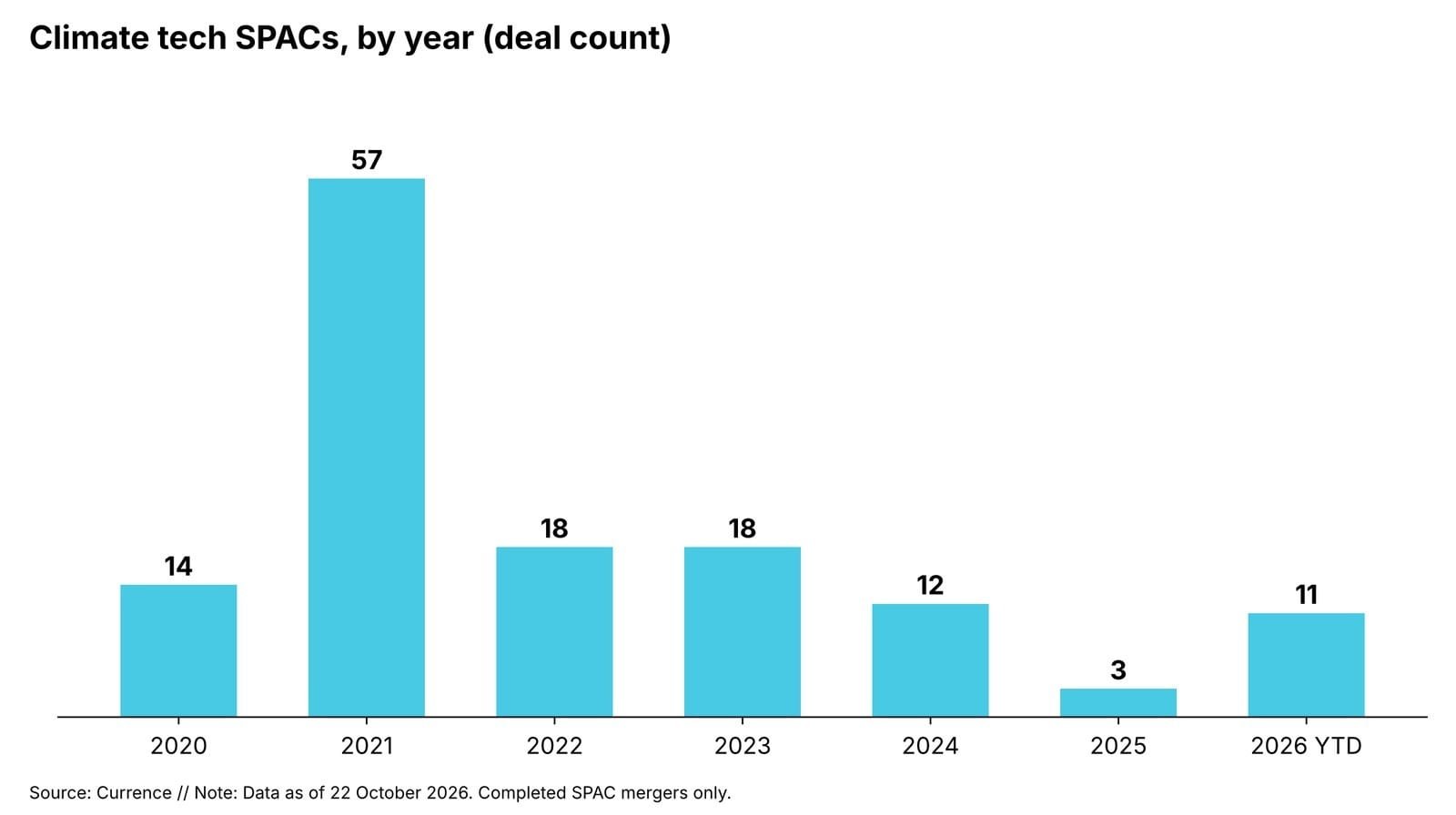
SPACs are having their biggest year since 2021, and climate tech is along for the ride. Eleven climate companies have listed through a SPAC so far in 2026, more than triple last year’s total, and 16 more have signed deals that haven’t closed. Before grading this year’s class, we went back and checked how the last one turned out.
Currence clients can get the full report and data pack on the platform here, or read on below for the takeaways.
What happened
- Eleven climate tech SPACs closed in 2026, and 16 more are pending. Nuclear leads the closed deals. The pending pipeline is six critical minerals companies, five battery makers, three renewables developers, and two nuclear developers.
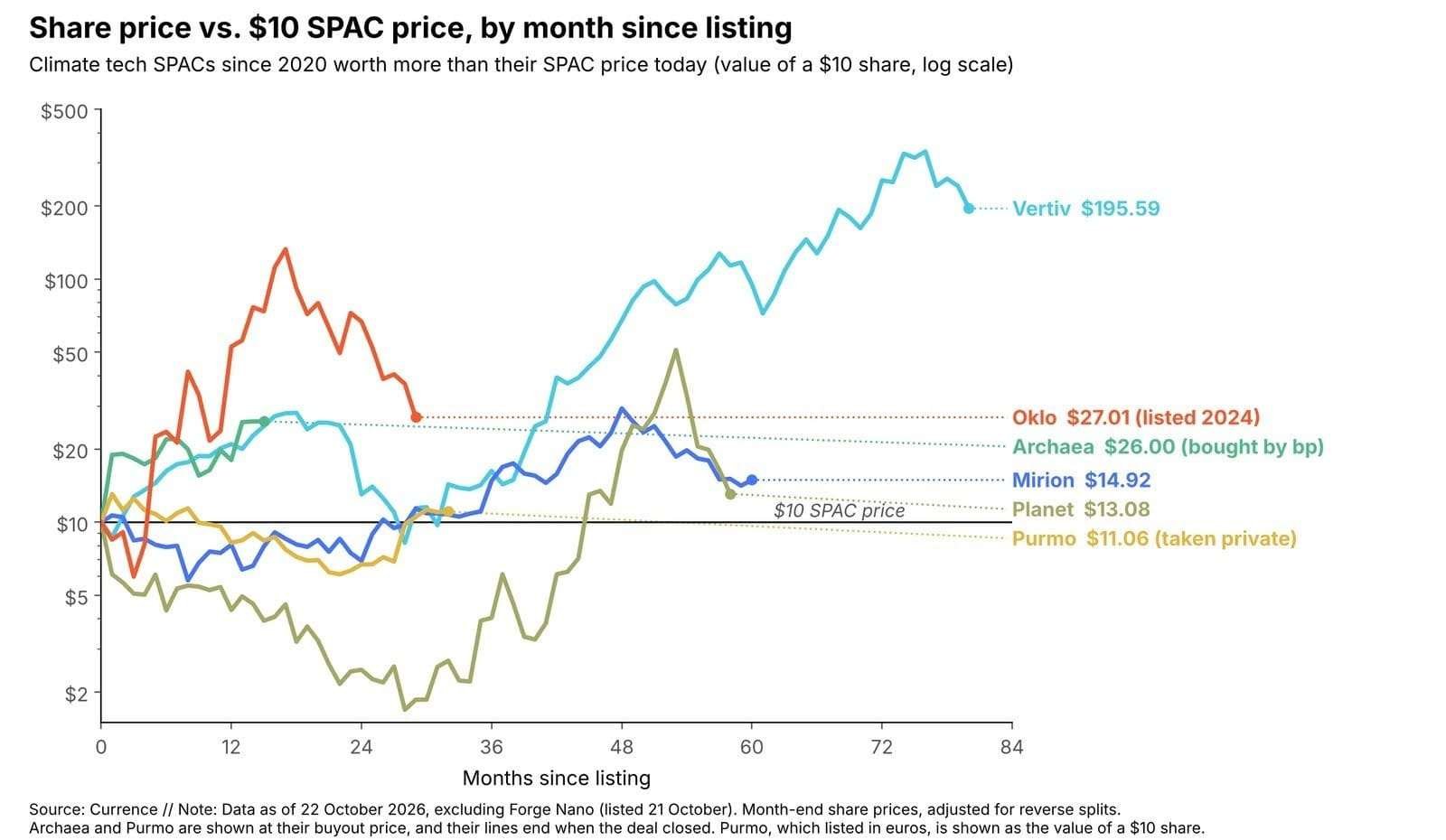
- The 2020-22 cohort mostly didn’t make it. Of the 89 climate companies that listed via SPAC, ive were worth more than their SPAC price at last trade or buyout, 22 have gone bankrupt, and 57 have lost more than 90% of their value.
- This year’s listings are already slipping. All five nuclear SPACs trade below $10, and Hadron has fallen under Nasdaq’s $1 minimum.
Why it matters
The early 2020s SPAC boom peaked in 2021, when it was the hottest way to list. With rates near zero, investors were happy to pay today for earnings years away. A SPAC let hardware companies raise the hundreds of millions they needed for first-of-a-kind plants, gave founders and venture investors an early exit, and let pre-revenue companies sell investors on projections stretching years out.
And for a while, it worked. Hype pushed most 2020 listings above their $10 SPAC price, so no shareholders cashed out before the merger, and companies kept all the money in their trusts.
But the class soon started to struggle, as plans fell short and some claims turned out to be misleading. A QuantumScape share hit $130 within a month of its 2020 debut on promises of solid-state batteries for Volkswagen, but it still has no revenue, its first commercial line isn’t due until 2028, and it trades around $4. Lordstown listed on 100,000+ truck preorders, most of which, the SEC later found, came from companies that didn’t run fleets. It went out of business within three years. Nikola’s founder was convicted of fraud in 2022. With little revenue, companies like these kept issuing new stock to stay afloat, and many needed a reverse split just to stay listed.
The ultimate blow came in 2022, when interest rates jumped from near zero to over 4% in 12 months. Investors stopped funding companies whose earnings were years out. The median 2020-21 climate SPAC lost 73% that year, more than double the Nasdaq’s 33% drop. Even the buyouts came cheap: Shell bought Volta for under $1 a share, and TPG took Altus Power private at half its SPAC price. And rates are moving that way again, as the 10-year Treasury yield hit its highest level since 2002 in October.
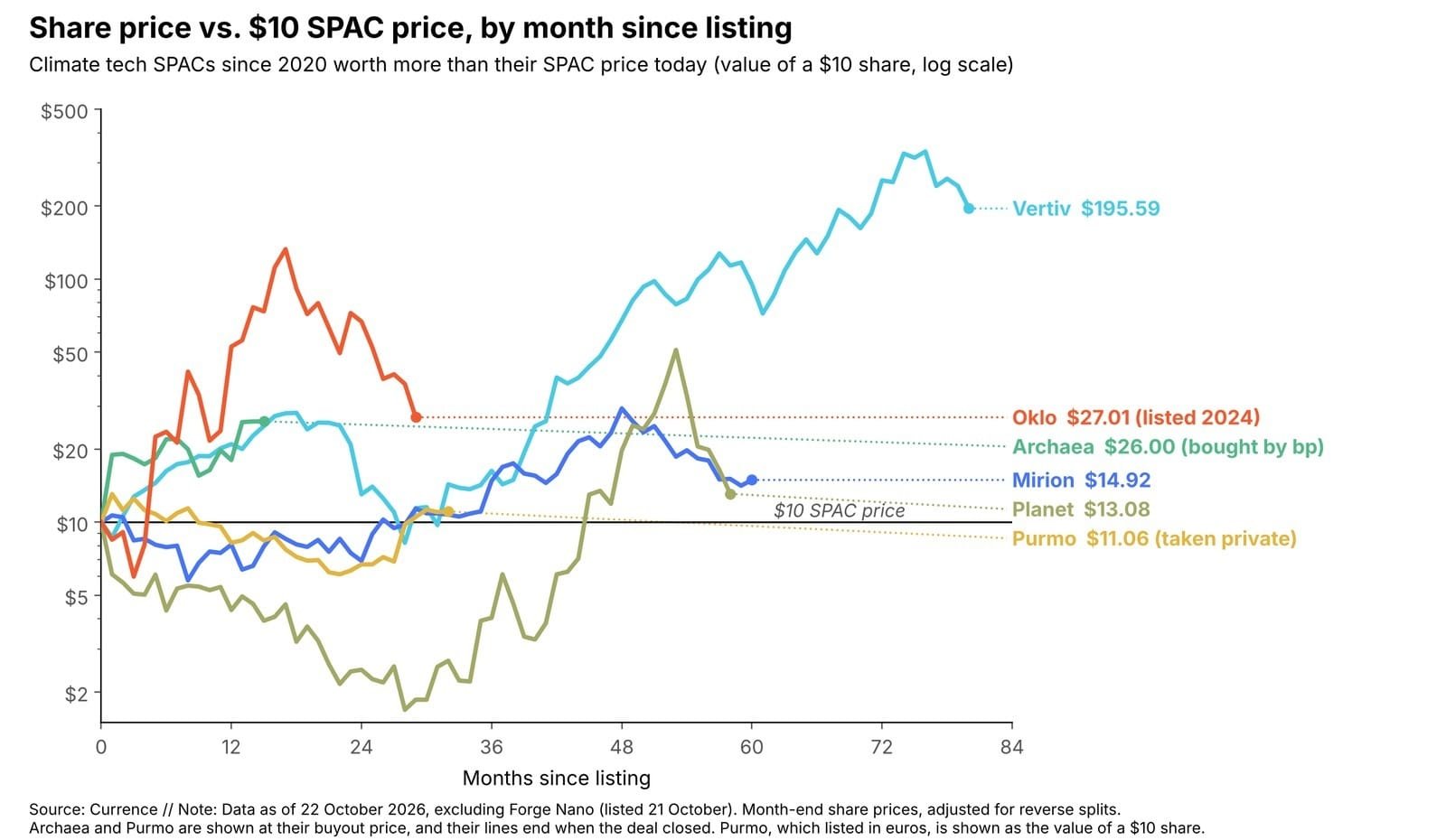
The five survivors all had one thing in common: revenue. Vertiv was selling billions a year in data center cooling and power gear when it listed and now trades at about 20x its SPAC price. Mirion, Planet, Archaea, and Purmo all had years of sales behind them, too.
So why the comeback? The IPO market has gotten picky and rewards only companies already making a profit. A SPAC lets companies years from profit agree on a valuation privately and list without winning over the wider market. The rules have also settled since 2024, and sponsors from the last boom are back. Spring Valley took NuScale public in 2022 and listed Eagle Nuclear and General Fusion this year. Kensington, the sponsor behind QuantumScape, is now merging with Nth Cycle.
The difference is the cash. Since 2022, most SPAC shareholders take their $10 back before the merger closes, so a climate SPAC keeps only about $10 of every $100 in its trust. That leaves the private money raised alongside the deal to do the work. It often decides whether a deal can close at all, since many mergers require a minimum amount of cash on closing day, and it’s what funds the business afterward.
Key takeaways
- Nuclear is this cycle’s EV. It’s a big bet on future demand, with little revenue and years of spending ahead. Most of this year’s nuclear listings won’t produce power until the 2030s, and rising rates matter for nuclear project economics.
- Policy gives minerals a floor. DOE selected Nth Cycle to negotiate a grant of up to $100m, and Controlled Thermal Resources is on the federal fast-track permitting list. But six of the pending 11 minerals and battery companies report no revenue, the same bet the 2021 class made.
- Private investors now pick who lists. The 2021 cohort ran out of cash after it listed. None of the 16 pending deals has all three of revenue, committed private money, and an intact trust. The ones that line up enough private money before the shareholder vote will close, and most of the rest will be repriced, delayed, or dropped.
Deals of the Week (10/26 – 11/1)
VC / Growth
🔋 Group14 Technologies, a Woodinville, WA-based advanced silicon battery materials manufacturer, raised $167m in Series D funding from undisclosed investors.
⚡ Emvolon, a Woburn, MA-based developer of modular waste-gas-to-fuel (biomethanol) plants, raised $22m in Series A funding from MassVentures, VX Ventures, and Wagner Carbon.
🧪 DMC Biotechnologies, a Morrisville, NC-based fermentation-derived chemicals producer, raised $18m in Series B funding from Sofinnova Partners, Inceptional Partners, Capricorn Partners, Cibus Fund, and First Bight Ventures.
🥩 Volare, a Helsinki, Finland-based insect-based protein and oil producer, raised $8m in Series A funding from Maki.vc and Springvest.
🧱 Concretene, a Manchester, England-based sustainable concrete technology developer, raised $6m in Series A funding from LocalGlobe, Molten Ventures, and PXN Ventures.
⚒️ Symx.ai, a Sudbury, Canada-based AI platform for mobile mining equipment fleets, raised $6m in Series A funding from Ascent Capital Partners.
🌱 BioLumic, a Palmerston North, New Zealand-based UV light-activated seed trait technology developer, raised $3m in funding from AgriZeroNZ.
🔋 illumion, a Cambridge, England-based charge photometry battery imaging developer, raised $2m in Seed funding from Cambridge Angels Group, Cambridge Enterprise Ventures, Foresight Group, Parkwalk Advisors, Your VC, and ZEISS Ventures.
🌾 Plasma2X, a Daresbury, England-based developer of plasma reactors making nitric acid from air, raised $1m in Pre-seed funding from TSP Ventures, DITEVEN, LYVA Labs, and University of Liverpool.
♻️ Zerow, a Scandicci, Italy-based circular deadstock fashion marketplace, raised $1m in Pre-seed funding from Invitalia.
🔋 NoorNation, a Giza, Egypt-based developer of decentralized solar energy and water systems for farms and off-grid users, raised $1m in Seed funding from Catalyst Fund, KBW Ventures, and Linah Farms.
🥩 Integriculture, a Tokyo, Japan-based cell-based cosmetics and cultivated meat producer, raised $1m in Series A funding from Niigata Venture Capital.
Project Finance / Debt
⚡ Scatec, an Oslo, Norway-based renewable energy solutions provider, raised $325m in PF Debt funding from African Development Bank, European Bank for Reconstruction and Development (EBRD), and European Investment Bank (EIB).
🔋 GIGA Storage, an Amsterdam, Netherlands-based operator of large-scale energy storage projects, raised $292m in PF Debt funding from ABN AMRO, Hamburg Commercial Bank, ING Group, Rabobank, Siemens Financial Services, and other investors.
💨 Terradot, a San Francisco, CA-based enhanced rock weathering carbon removal platform, raised $34m in Debt funding from Hannon Armstrong Sustainable Infrastructure Capital (HASI).
⚡ Fourth Partner Energy, a Hyderabad, India-based renewable energy solutions provider, raised $26m in PF Debt funding from Tata Capital.
⚡ Okra Solar, a Sydney, Australia-based provider of mesh-grid technology for off-grid solar, raised $7m in Debt funding from British International Investment (BII).
🔋 EnerSmart Storage, a Solana Beach, CA-based developer, owner, and operator of advanced battery energy storage systems, raised an undisclosed amount in PF Debt facilitated by Crux.
⚡ OnPath Energy, a Hamilton, Scotland-based renewables developer, raised an undisclosed amount in PF Debt funding from NatWest.
Exits
🏠 Quantum Building Solutions, a Dallas-Fort Worth, TX-based building automation and HVAC controls contractor, was acquired by Albireo Energy.
⚡ Meadow Energy, a New York, NY-based community solar aggregator, was acquired by Neighborhood Sun.
🥩 5YES!, a Moscow, Russia-based plant-based drinks producer, was acquired by Milk Logic (Logika Moloka).
Funds
🛢️ Ara Partners, a Houston, TX-based decarbonization-focused private equity firm, closed $2.5bn for Ara Energy Fund I, to acquire existing North American power, biofuels, and energy distribution assets and cut their emissions
🔋 Sosteneo, a Milan, Italy-based clean energy infrastructure investor, raised $504m for its second Clean Energy Infrastructure Fund, to invest in construction-ready clean energy infrastructure across Europe.
This is a sample of deals available for Currence clients. Can’t get enough deals?
Reading List
🛢 Oil majors posted their biggest quarters since 2022 on war-driven refining margins. Shell earned $10.8bn and TotalEnergies $9.1bn, both roughly double last year, while BP’s profit nearly quadrupled to $8.5bn. Refining margins nearly quadrupled year over year. [Link]
The windfall came from margins, as the majors whose capacity Hormuz didn’t hit are collecting on the squeeze. Total also booked impairments tied partly to offshore wind in the same quarter it made record money on refining. Shell’s chemicals business, which it’s reportedly shopping to Exxon, turned a profit too.
🏛 The Senate’s bipartisan permitting bill heads for a lame-duck vote on November 9, but Democrats want conditions. Four Democratic senators said they want DOE to restore the clean energy grants it canceled in October 2025, which DOE admitted in court were selected based on states’ politics. Their concern also follows DOJ’s move to revoke permits for offshore wind projects. [Link]
The deal hinged on a promise that wind and solar would get fair treatment, and the administration is testing that. Permitting reform only helps clean energy if the permits stick once granted.
🏭 The EPA is loosening methane rules for oil and gas wells, mostly easing requirements for the low-producing marginal wells that make up about 80% of US wells. It would also scrap the Super Emitter Program, which let third parties flag major leaks. [Link]
The majors largely didn’t mind the rules, since capturing flared gas pays for itself at their scale. But less reporting is a blow to the MRV companies that sold into compliance demand. This happened the same month the EU delayed its own methane rules by a year.
🏗 Meta agreed to buy environmental attributes for 200,000 tons of Fortera’s low-carbon cement. [Link]
Cement is roughly 8% of global CO2. This deal’s EAC structure is the same one Isometric and Verra moved into earlier this year, letting buyers pay for the attribute when they can’t physically source the product.
✈️ Singapore Airlines is buying waste-carbon SAF from Aether Fuels, up to 4,800 tonnes over three years with deliveries from 2028. The fuel comes from Project Beacon, Aether’s planned plant converting biomethane and industrial waste gases into SAF. [Link]
Small volume, but it’s an Asian carrier buying Asian-produced SAF, which barely existed as a category a year ago. And biomethane hasn’t taken off as a power feedstock, but it’s showing up in SAF. Infinium also announced biogas-fed projects in recent weeks.
🔋 Latitude published granular data on how 50 operating battery projects actually perform against what warranties guarantee and lenders assume. [Link]
As stationary storage grows up, it comes down to execution. Projects perform when they have the right suppliers, integration, and O&M, and more operational data is exposing the gaps and pushing the market toward consistent quality.
⚡ Heron Power and NiSource announced data center and BESS deals with Vantage and Microsoft, including a Vantage capacity reservation for Heron’s solid-state transformers. [Link]
No medium-voltage solid-state transformers have been deployed outside China yet, so this is the category’s first real test.
☢️ DOE offered Constellation up to $5bn to add about 1.1GW across three nuclear plant sites, continuing the trend of more uprates for cheap new nuclear capacity. [Link]
🚚 Ford’s new Fathom electric pickup brings bi-directional charging to the masses. [Link]
Opportunities & Events
📅 DERVOS 2026: Join the DER Task Force for the fifth annual DERVOS in Brooklyn on November 5. With the overall theme "Everything is DERs", they’re not saying that everything is small, or even literally “distributed,” but that the center of gravity is shifting toward energy resources that are closer to load and controlled by those who need the power. Sometimes that shift is bottoms-up, sometimes it’s centrally planned, but either way, DERs aren’t the sideshow anymore. They’re the main event. Register to hear all the unfiltered hottakes. Use code CTVC for 15% off.
📅 SOSV Deep Tech Summit: From November 4-6 attend SOSV’s deep tech summit virtually. Over the three day summit they will focus on climate tech, human health, and AI for the physical world. With over 5,000 attendees, 2,000 VCs, and 75 speakers, this is a great event for anyone interested in the Deep Tech space.
📅 Energy and Climate Conference 2026: Join a student run conference at HBS on November 8 for a thoughtful and dynamic day of programming exploring the future of energy resilience and climate action. This conference brings together leading voices from industry, policy, academia, and venture capital to examine how innovation and action intersect to build a more resilient future.
💡 SET Award 2027: Apply for equity free €10,000 prizes per category for energy and climate startups. Finalists pitch in Berlin at the SET Tech Festival in March 2027. Apply by November 30
💡 Hello Tomorrow Challenge: Global deeptech competition with a €200K grand prize and prizes for track winners. Includes climate/energy-relevant tracks. Apply by November 30.
Jobs
Grid Enhancing Technologies Engineer @Georgia Power
Account Executive @Currence
Data Product Manager @Currence
Founding Customer Success Manager @Currence
Senior Backend Engineer (AI) @Currence
Director of Growth & Giving @Elemental Impact
📩 Feel free to send us deals, announcements, or anything else at hello@ctvc.co. Have a great week ahead!