

Fire safety, a key topic for BIPV
Few topics have reshaped European construction over the past decade as sharply as the fire performance of building façades. High-profile fires such as Grenfell Tower in London and, more recently, the Campanar tower in Valencia have pushed the reaction to fire of external wall materials (and the certificates that vouch for them) to the centre of the conversation. For high-rise buildings in particular, the direct consequences have been clear: careful selection of envelope materials and system design, more demanding classifications, and an ongoing revision of standards and testing methods in Europe.
Building-integrated photovoltaics (BIPV) arrives directly into this tightening environment. BIPV manufacturers are increasingly aiming for the highest reaction-to-fire classes. Recently, controversy has emerged as certain products (in several cases reaching the European market from other regions) are marketed with a “Class A” fire reaction classification, the “non-combustible” grade many countries now demand on high-rise façades. In the European context, referring to “Class A” without stating the reference standard used to achieve it creates confusion, because “non-combustible” performance under the European reaction-to-fire classification EN 13501-1 is genuinely challenging for a BIPV system, and there are well-founded doubts about its feasibility given the polymer content every module contains.
What “reaction to fire” actually measures
In Europe, the reaction to fire of construction products is classified under EN 13501-1, which sorts products into Euroclasses from A1 (no contribution to fire) through intermediate grades down to F (no performance determined, or easily ignited). The classification draws on a family of tests, and the relevant route to the “Class A” demands the non-combustibility test (EN ISO 1182), the determination of gross calorific value in a bomb calorimeter (EN ISO 1716), and the single burning item test (EN 13823, universally known as the SBI test). Lower classes rely on a different test route, the small-flame ignitability test (EN ISO 11925-2), which is not part of the A2 route and is set aside here. In essence, each test measures a different aspect of how a product responds to heat and flame.
Confusion often begins when classifications from different standardisation frameworks are mixed. China’s GB 8624 classification uses closely related methods and even reports an “A (A2)” grade, while North American practice relies on entirely different references such as ASTM E84 or the UL series, also referring to Class A for top performers. A rating earned under one system does not automatically translate into another, and a certificate that quotes several frameworks side by side can give an impression of consensus that the underlying tests do not support. Indeed, a Class A under ASTM E84 does not directly translate into a A2-s1,d0 classification under EN 13501-1.
A quick point of scope: this discussion concerns reaction to fire on façades. The external fire performance of roofs is governed by a separate framework (EN 13501-5), which is not part of the Class A controversy and is left aside here.
In Europe, fire reaction specifications are set by national building codes in each country, which usually tie the minimum reaction-to-fire class to the building’s height and use. For low-rise buildings the requirement is often modest, but for high-rise façades many country building codes demand A2 or better. That threshold is precisely what opens or closes the door to a given product and the reason why a “Class A” label carries real commercial weight.
The A2 route and why laminated glass-glass PV modules struggle to take it
A BIPV module is a layered composite product typically composed of a front tempered glass, at least two polymer encapsulant layers embedding the solar cells, and a rear glass (replaced in certain cases by a polymer backsheet), plus a junction box and cabling that allow the system connection into strings. EN 13501-1 handles such products by looking at their components. The route to an A2 classification, simplified in the flow chart below, combines two demands that must both be satisfied.
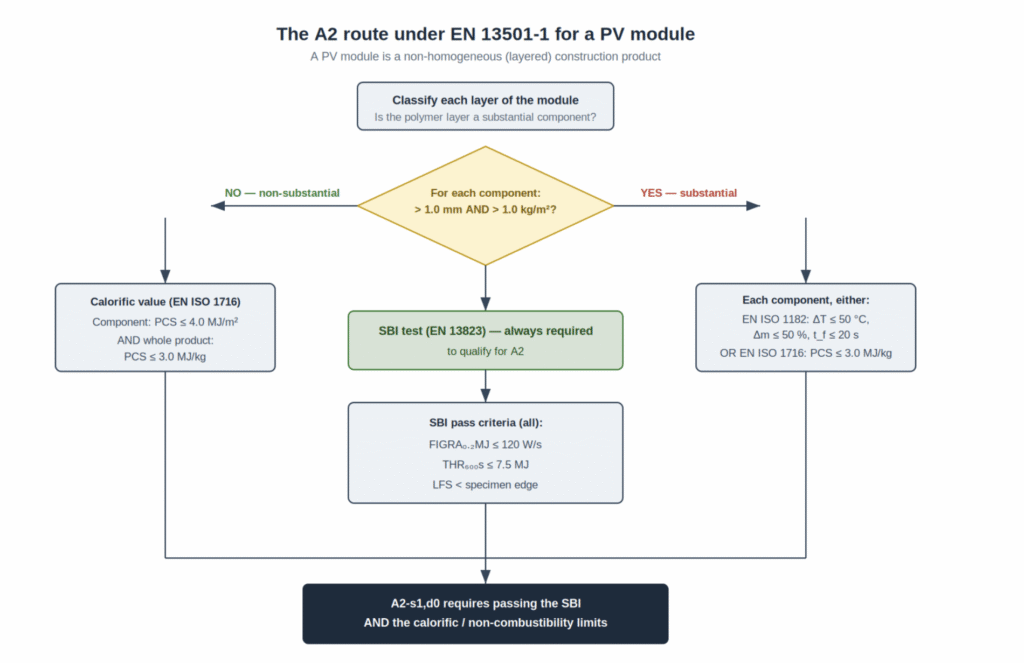
First, the module must pass the SBI test (EN 13823), which exposes the product to a burner flame and limits how fast fire can grow (FIGRA), how much heat it releases in the first ten minutes (THR), and how far flame spreads. Second, because a module is a non-homogeneous product, each of its substantial components must clear a non-combustibility hurdle, demonstrated either through the non-combustibility test (EN ISO 1182) or through the calorific-value test (EN ISO 1716) depending on whether they are substantial or non-substantial material in the tested BIPV module configuration. Either route is acceptable, but the threshold has to be met by every substantial component, and it is this second demand that BIPV modules struggles to meet.
Why an A2 claim on laminated glass BIPV systems is hard to believe
The reason is the encapsulant. Whichever way it is classified under EN 13501-1, the polymers that bond a module together (EVA, PVB or polyolefin alternatives) fail the test that applies to them. As a substantial layer, the encapsulant must pass the non-combustibility test, EN ISO 1182, where a polymer specimen ignites and sustains flaming, failing the pass criteria. As a thin, non-substantial layer (< 1 mm and < 1 kg/m²), it is judged instead on calorific value under EN ISO 1716, against a PCS limit of 4.0 MJ/m² for the encapsulant layer and 3.0 MJ/kg for the glass-glass sandwich. PV encapsulants release on the order of 40 MJ/kg, and even a single standard film carries far more energy per square metre than that limit allows: the two EVA layers of a typical module, around 0.9 mm in total, amount to roughly 34 MJ/m², some eight times the limit. That is not a marginal exceedance but an order- of-magnitude gap intrinsic to the material. The large mass of inert glass dilutes the figure when heat is averaged per kilogram of the whole product, which is why a full-product number can look deceptively low; but the calorific contribution of the polymer layer itself, measured per unit of surface, stays far above the threshold whatever the glass configuration. Either route, in other words, leads to the same place.
In principle, one could try to meet the surface limit by using less encapsulant. But the numbers make this a dead end: meeting 4.0 MJ/m² would require reducing the total polymer to roughly a tenth of a millimetre, around a tenth of what a working BIPV module carries in the best case. At that thickness the encapsulant can no longer do its job: it cannot embed the cells, absorb thermal stress, seal against moisture or electrically insulate the circuit. The only way to pass the calorific criterion would be to remove so much encapsulant that the laminate would cease to function as a safe and reliable photovoltaic module. In practice, a conventional laminated-glass module cannot reach an A2 classification without sacrificing its function as a photovoltaic device.
This is not particular to PV. Standard architectural laminated glass, bonded with PVB or EVA, is normally classified B-s1,d0, and the reason is the same: the interlayer’s calorific value always exceeds the A2 limit. The published literature on laminated glass reaches this same conclusion. A handful of laminated-glass products do carry an A2 classification, but only by replacing the ordinary interlayer with a fire-engineered one, such as gel-filled layers designed to suppress the organic contribution. The application of such materials into BIPV modules is far from being straightforward. The specifications of BIPV module’s encapsulant are more demanding than those of a passive architectural laminated glass: it must stay optically transparent, block UV, resist heat and moisture, and electrically insulate solar cells, all at once. An encapsulant that satisfies all of those requirements and also passes the A2 tests is yet to be demonstrated by the BIPV industry. A BIPV product built as laminated glass should, at best, classify like its conventional architectural equivalent because it adds combustible material the plain glass does not have: the cells, the cabling, the junction box. A claim that the BIPV module does better than that, and reaches the non-combustible band, runs against the grain of both its own bill of materials and what the glass industry already knows.
As part of our technical due-diligence work for manufacturers and specifiers, Becquerel Institute has reviewed a number of A2-s1,d0 certificates for BIPV modules and found practical reasons for caution. In one, the test object is described in one place as the complete module and elsewhere as a single layer, leaving it unclear how the test was conducted. In others, the classification was obtained under a non-European framework but presented in a way that reads as an EN 13501-1 result. And in general, the reports do not show the combustible component (i.e. the encapsulant) suggesting that it was never assessed on its own; the non-combustibility evidence they contain is consistent with a pass on the glass only. As presented, an A2 or “Class A” claim under EN 13501-1 on the finished module cannot be verified from them, however reputable the laboratory named on the letterhead.
For a façade, the real question is a system question
Reaction-to-fire classification characterises how a product responds to heat and flame, but does not capture how a complete, installed façade behaves in a fire event. In intermediate-scale tests such as the SBI, questions such as how fire spreads through the wall, and how fast or in what way it propagates through the system, remain unanswered. This matters especially for photovoltaic glass, which tends to fracture and fragment in a fire: an SBI classification cannot reveal the glass breakage and falling debris that occur in real conditions, and that can compromise evacuation and open new paths for the fire to spread.
Large-scale system tests are the best approach to demonstrate the performance of a façade system in a fire event. Methods such as BS 8414, NFPA 285, the Nordic SP FIRE 105 and France’s LEPIR2 expose a complete, installed assembly (BIPV modules, framing, cavities, fixings, barriers and joints) to a severe fire load, and characterise the system in a more representative and realistic set-up. Some BIPV glass façade systems have already passed such tests, demonstrating that a PV envelope can meet the same full-scale fire benchmarks used for leading conventional cladding. Independent research points the same way: recent large-scale evaluations, identify cavity fire spread, glass breakage, burning encapsulant and falling debris as the real hazards. All of them are system-level phenomena invisible to a material test.
The EN 13501-1 fire reaction classification and a large-scale system rating such as those from BS 8414 or NFPA 285 are not points on a single scale. They answer different questions: one about a product’s reaction to fire, the other about a complete assembly’s resistance to fire spread.
Toward harmonised rules
In recent years, the topic of fire safety of BIPV systems has gained attention within the research community. European projects BIPVBOOST, SEAMLESS-PV, MASS-IPV or INCREASE, among others, have led research activities with a focus on fire safety. These R&D projects have contributed to a better understanding of risks, the development of new testing procedures adapted to the specificities of such multifunctional construction products, and have also brought the debate to ongoing standardisation forums at IEC and ISO level.
IEA PVPS Task 15 has a dedicated activity on fire safety of BIPV systems. An international group of experts has recently reviewed fire-safety provisions for BIPV façades across a range of countries. The preliminary conclusions suggest that BIPV is today assessed largely within façade frameworks built for conventional materials. No country yet offers complete, repeatable test methods specific to BIPV.
Concerning testing methodologies, the analysis suggests that the SBI test is not well adapted to BIPV cladding, because its specimen size is smaller than a typical BIPV module and it lacks protocols for the definition of the placement of junction boxes and cables, the combustible components located in the cavity behind a façade. As of today, some countries restrict façade PV to glass-glass modules and disqualifies glass-backsheet designs, while others are turning to intermediate- or large-scale propagation tests as an alternative compliance route.
The international group of experts identifies harmonisation as a key element to bring clarity to this complex topic: aligning test methods, classification systems and performance criteria at European level and across IEA member countries. Over the medium term, that also means confronting a deeper particularity: a PV module is an electrically active element that stays energised whenever the sun shines, a reality that current passive-cladding tests do not reflect and that R&D is only beginning to address.
The hidden cost to the BIPV industry
BIPV has a central role to play in the architecture and energy systems of the coming decades, and it can be deployed safely. But as its adoption grows across many markets, that growth has to rest on fair and clear communication about safety. A reaction-to-fire class quoted without the reference standard that applies where the product will actually be installed, or stretched from a favourable specimen to the finished module, is not a harmless marketing shortcut. It can place a product on a building that the applicable code would otherwise have excluded.
The current “Class A” confusion carries several costs. It puts the reputation of the whole BIPV industry at stake: one misclassified system on a building where it does not belong, exposed by an inspection or an incident, can damage the confidence the technology has only started to earn in the construction sector. It creates a real safety risk, placing a product on a façade the applicable code would otherwise have excluded. And it distorts competition, penalising honesty: faced with two datasheets, a specifier will tend to choose an A2 rating over a B-s1,d0 one, even when the A2 is unsubstantiated and the Bs1,d0 is the true, verified ceiling.
It is in the interest of the BIPV industry, authorities and end-users alike to take a comprehensive look at the real fire performance of the products entering the market to protect fair competition and the safe deployment of a promising technology.
Becquerel Institute supports BIPV manufacturers, prescribers, building owners and investors who need an independent, expert view on BIPV technologies, performance, market development, country requirements and regulations, competitiveness or feasibility. If you are interested in knowing more about the benefits of BIPV technologies, get in touch with Jose Maria Vega de Seoane, Managing Director at Becquerel Institute Spain.
Author: Jose Maria Vega de Seoane.
Becquerel Institute is a strategic consulting company and applied research institute specialising in solar photovoltaics and energy transition. Founded in Brussels in 2014, with regional offices in France, Italy and Spain, it provides strategic advice across all segments of the PV value chain and is a recognised partner in European and international research programmes.
The post The controversy over fire classification of BIPV systems appeared first on pv magazine Global.


