
India’s ambitions to become a global leader in green hydrogen are moving from long-term policy goals towards commercial reality.
Investment is increasing across renewable power, manufacturing, industrial decarbonisation and export infrastructure, while both domestic and international demand are beginning to shape the market.
Those themes were explored during a recent webinar hosted by Frost & Sullivan India, which brought together experts from across the hydrogen value chain to discuss one central question: What will it take to build a winning green hydrogen ecosystem?
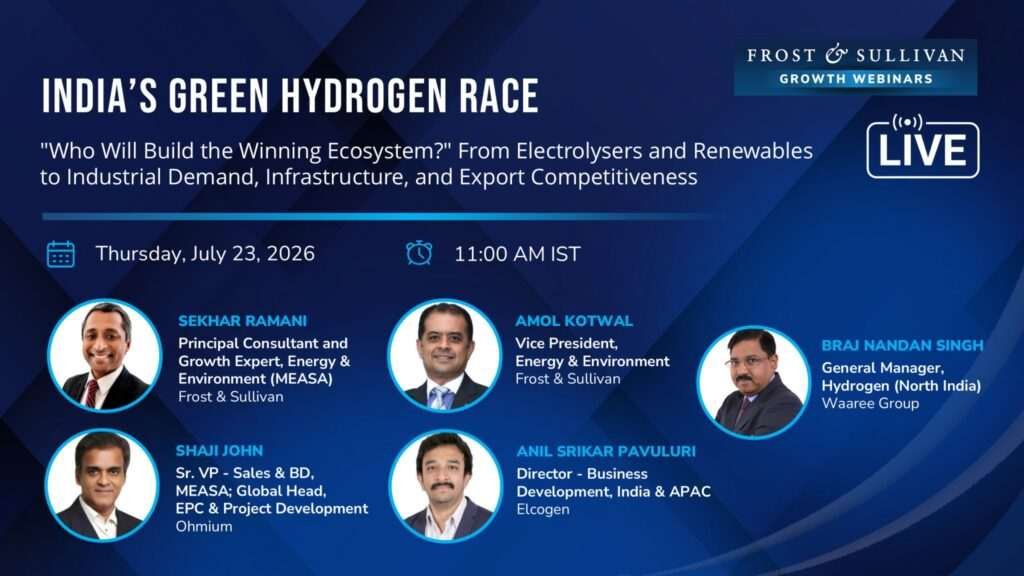
The panel featured Anil Skikar Pavuluri, Business Development Director for India and APAC at Elcogen, alongside Shaji John, Vice President of Sales and Business Development at Ohmium, and Braj Nandan Singh, General Manager, Hydrogen, at Waaree Group.
The discussion highlighted that success will depend on far more than low-cost renewable electricity. Creating a competitive market will require coordinated progress across technology, manufacturing, infrastructure, regulation, finance and demand. Each part of the value chain will need to develop at a similar pace if India is to achieve its ambitions.
India has already established one of the world’s most ambitious green hydrogen programmes, targeting 5 million tonnes of annual production by 2030. However, the conversation has now moved beyond ambition. The central question facing industry is no longer whether India wants to build a hydrogen economy, but how quickly it can move from announcements and memorandums of understanding to commissioned projects, long-term contracts and commercially viable businesses.
For businesses operating across the hydrogen sector, the opportunity is significant. India combines rapidly growing energy demand, world-class renewable resources and strong government support, creating the conditions for one of the world’s largest emerging green hydrogen markets. The challenge now is turning that potential into commercially viable projects at scale.
As one panelist summarised, the winners of India’s hydrogen race will not necessarily be the companies with the biggest announcements, but those with committed customers, bankable projects and the ability to execute.
Here are the key themes that emerged from the discussion:
India’s green hydrogen market is moving from ambition towards execution
India’s green hydrogen ambitions are backed by significant policy support. The National Green Hydrogen Mission targets 5 million tonnes per year of production by 2030, supported by incentives for both hydrogen production and electrolyser manufacturing.
However, the industry remains at an early stage.
According to Frost & Sullivan’s assessment shared during the webinar, India currently has around 8,000 tonnes of green hydrogen production capacity on the ground. That represents less than 1% of the 2030 ambition. While this highlights the scale of the challenge, the pipeline is becoming increasingly credible, with projects moving from announcements towards contracts and construction.
Under the Strategic Interventions for Green Hydrogen Transition (SIGHT) programme, 19 companies have received allocations linked to approximately 860,000 tonnes of hydrogen production capacity, while incentives have also been awarded for 3 GW of electrolyser manufacturing capacity.
The gap between ambition and execution is therefore the key issue facing the market.
The industry’s focus has shifted from asking “can India produce green hydrogen?” to asking “who will buy it, who will finance it, and who can build it?”
Customers will determine the pace of growth
A recurring theme throughout the discussion was that demand (not supply) will ultimately determine how quickly India’s hydrogen economy develops.
Today, global hydrogen demand is approaching approximately 100 million tonnes per year (IEA’s Global Hydrogen Review 2025), almost all of which is produced using fossil fuels. Green hydrogen remains significantly more expensive, with a current cost gap of around two to three times compared with grey hydrogen.
The long-term cost frontier for green hydrogen is widely considered to be around USD 1–2/kg. Reaching this level will be critical for replacing grey hydrogen at scale, but achieving it will require progress across the entire value chain: lower-cost renewable electricity, larger-scale electrolysis manufacturing, improved efficiency, reliable operation and access to finance.
The first wave of demand is expected to come from industries that already consume hydrogen today.
Refineries and fertiliser producers are expected to lead adoption because they already have established hydrogen requirements. India’s fertiliser sector is particularly important, with government-backed initiatives beginning to aggregate demand for green ammonia.
Beyond domestic industrial demand, exports are expected to become a major driver. Shipping is emerging as one of the most promising future markets, with international regulations and incentives under development through organisations such as the International Maritime Organization (IMO). Green ammonia and e-methanol could become important fuels for maritime decarbonisation, particularly for countries that lack sufficient renewable resources of their own.
Other sectors are expected to follow.
Green steel and glass production are likely to become important applications as industrial companies seek lower-carbon production routes. Road transportation is also developing, although adoption is expected to occur later as infrastructure, economics and hydrogen vehicle deployment continue to mature.
The message from the webinar was pretty clear: projects need customers before they need equipment.
A key lesson from the global hydrogen market correction is that “build first and find buyers later” is no longer a viable approach. The projects progressing today are those with confirmed offtake agreements, government support or captive demand.
Making green hydrogen projects bankable remains the biggest challenge
Moving from announcement to execution requires more than technology. Large-scale green hydrogen projects combine renewable generation, electrolysis, hydrogen handling and, in many cases, downstream products such as ammonia, methanol or sustainable aviation fuel.
These are not single projects. They are multiple complex projects connected together. Developers must manage renewable power assets, hydrogen production systems and downstream conversion facilities, each with different technical and commercial requirements.
Three factors were highlighted as critical:
- Offtake certainty
- Access to finance
- Execution capability
Large-scale projects require significant capital investment, and investors need confidence that products will have buyers over long periods. The strongest business models emerging globally are those where the customer is secured before investment decisions are made.
Four project models are likely to drive the next phase of growth:
- Export projects backed by international buyers
- Domestic supply agreements with refineries and fertiliser producers
- Captive projects where producers and users are part of the same organisation
- Manufacturing opportunities across hydrogen technologies and components
Electrolysers become the machines behind the molecule
While renewable electricity often receives the most attention in discussions about green hydrogen, electrolysis technology will play a central role in determining project economics.
Customers are becoming increasingly sophisticated in evaluating electrolyser technologies. Conversations have moved beyond upfront equipment costs towards efficiency, degradation rates, operating lifetime, renewable integration capability, water consumption and total cost of ownership.
India is also aiming to build a domestic electrolyser manufacturing ecosystem.
One panelist highlighted that India’s previous experience in renewable energy, where domestic manufacturers struggled to compete against China’s rapidly scaled manufacturing base, has created a strong incentive to avoid repeating the same outcome in hydrogen technologies.
China’s early investment in electrolyser manufacturing has given it a strong position. India is now attempting to accelerate its own manufacturing capabilities through incentives, localisation and supply-chain development.
The opportunity is significant. According to the discussion, many electrolyser components could eventually be manufactured domestically, with localisation levels of 80–90% considered achievable across several technologies.
Different technologies will likely serve different applications:
- Alkaline electrolysers offer maturity and scale and available for immediate use in large scale plants.
- PEM technology provides flexibility and responsiveness with specific use cases on Mobility, direct Renewable integrated projects.
- Solid oxide electrolysis offers efficiency advantages, particularly when integrated with industrial processes and available heat sources. SOEC offers massive scale down on costs within next 2 years and with added advantage of high efficiencies, matching grey hydrogen costs becomes quite realistic.
The key challenge will be scaling manufacturing while maintaining quality, reliability and competitive costs.
Infrastructure and collaboration will determine success
All the panelists highlighted the importance of collaboration between policymakers, developers, technology providers, financiers, manufacturers and end users.
Infrastructure remains a critical piece of the puzzle.
India’s planned hydrogen hubs are expected to develop around major ports, creating integrated ecosystems connecting renewable energy, hydrogen production, storage, transport and export infrastructure. These hubs will be particularly important for international markets such as Japan, Korea and Europe.
However, challenges remain around:
- Renewable power access
- Grid connectivity
- Land availability
- Water supply
- Storage and transport infrastructure
- International certification standards
The panel highlighted that India has many of the ingredients required for success (abundant renewable resources, manufacturing capability and strong industrial demand) but coordination between these elements will determine how quickly projects can scale.
What businesses should watch next
India’s green hydrogen market is entering a decisive period.
The next few years will reveal which projects can successfully transition from announcements into operating assets.
Key developments to watch include:
- Large-scale hydrogen and ammonia projects reaching construction
- Growth of domestic electrolyser manufacturing
- Long-term export agreements
- Development of hydrogen hubs
- Progress on demand creation mechanisms
- Evolution of international certification frameworks
By 2030, success may not be measured solely by whether India reaches its full 5 million tonne target. A more important milestone will be whether the country has created a functioning commercial ecosystem. That is to say… projects operating at scale, customers purchasing green hydrogen, domestic manufacturers competing globally and supply chains supporting continued growth.
India’s green hydrogen industry is entering a decisive phase. Many of the building blocks are already in place, but the next stage will depend on how effectively they are brought together into a functioning commercial ecosystem.
The discussion reinforced that no single technology, policy or company will determine success. Progress across manufacturing, infrastructure, finance, regulation and industrial demand must happen together.
India has an opportunity to become more than a producer of green hydrogen. It has the potential to become a global centre for hydrogen technologies and manufacturing… but only if it can successfully bridge the transition between ambition and execution.
Find out more
To discuss how Elcogen’s solid oxide technology can support future hydrogen projects, please contact Anil (anil.pavuluri@elcogen.com) or the Elcogen team via sales@elcogen.com
Text: Laura Quinton
The post India’s green hydrogen race enters the execution phase appeared first on Elcogen.


