Ranked: America’s Most AI-Resistant Jobs
This was originally posted on our Voronoi app. Download the app for free on iOS or Android and discover incredible data-driven charts from a variety of trusted sources.
Key Takeaways:
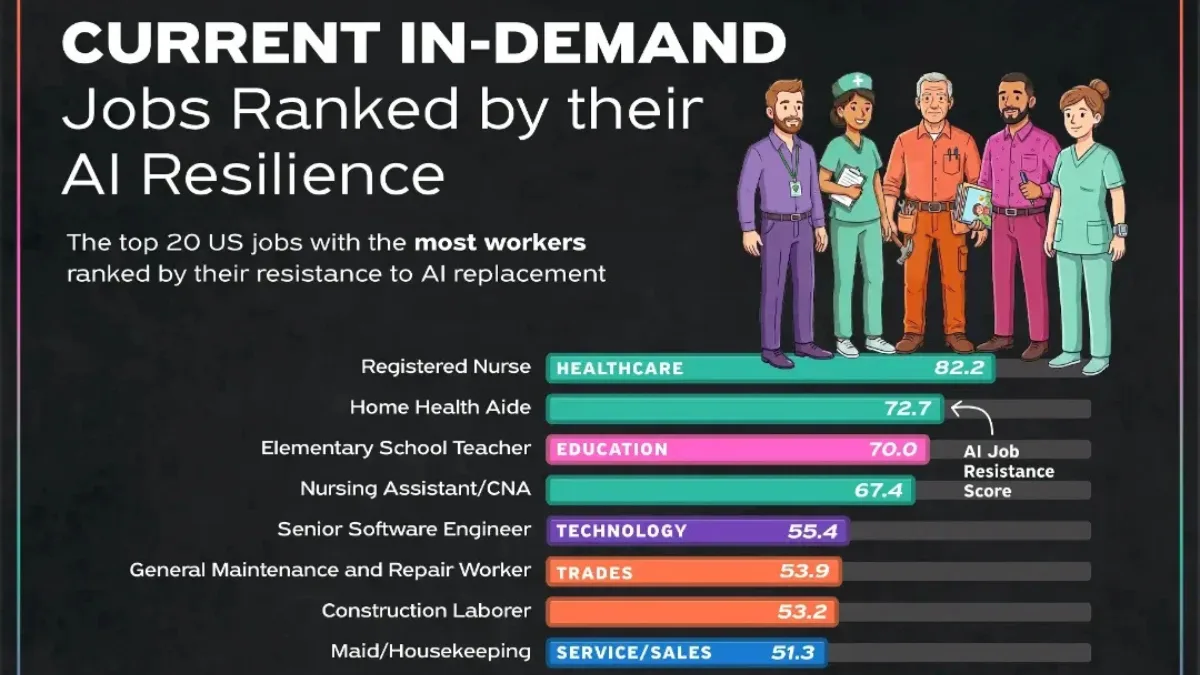
- Registered nurses rank first with an AI resilience score of 82.2, followed by home health aides (72.7) and elementary school teachers (70.0).
- Healthcare, education, and skilled-trade occupations generally rank higher than management, logistics, and sales roles.
- Only four of the 20 occupations score above 60, showing how rare strong AI resilience is among today’s largest in-demand jobs.
As artificial intelligence transforms the workplace, one question is becoming increasingly important: which jobs are the hardest to automate?
Occupations that depend on human interaction, physical adaptability, and real-world judgment tend to be more resilient than those centered on routine information processing.
This visualization, created by Julie R. Peasley, ranks 20 of America’s largest in-demand occupations by their AI resilience using data from JobZone Risk alongside employment outlook information from the U.S. Bureau of Labor Statistics.
Which In-Demand U.S. Jobs Are Most Resistant to AI?
The ranking combines labor demand with AI resilience to highlight occupations that may be better positioned as AI capabilities continue to improve.
Explore the complete ranking below.
| Rank | In-Demand Jobs | AI Risk Score |
|---|---|---|
| 1 | Registered Nurse | 82.2 |
| 2 | Home Health Aide | 72.7 |
| 3 | Elementary School Teacher | 70.0 |
| 4 | Nursing Assistant/CNA | 67.4 |
| 5 | Senior Software Engineer | 55.4 |
| 6 | General Maintenance and Repair Worker | 53.9 |
| 7 | Construction Laborer | 53.2 |
| 8 | Maid/Housekeeping | 51.3 |
| 9 | Teaching Assistant | 51.2 |
| 10 | Accountant | 47.3 |
| 11 | Waiter/Waitress | 46.3 |
| 12 | Restaurant Line Cook | 45.2 |
| 13 | Janitor/Cleaner | 44.2 |
| 14 | Security Guard | 43.6 |
| 15 | General and Operations Manager | 37.5 |
| 16 | Long-Haul Truck Driver | 36.0 |
| 17 | Supervisor of Retail Sales Workers | 34.7 |
| 18 | Other Manager | 30.2 |
| 19 | Laborer and Freight, Stock, and Material Mover | 29.9 |
| 20 | Wholesale and Manufacturing Sales Representative | 26.1 |
The results show a clear divide. Healthcare occupations dominate the top of the ranking, while several management, transportation, logistics, and sales roles score much lower.
Healthcare Leads the Rankings
Registered nurses earn the highest AI resilience score at 82.2, followed by home health aides at 72.7 and nursing assistants/CNAs at 67.4. These occupations depend on hands-on patient care, emotional intelligence, clinical judgment, and adaptability, all of which remain difficult for AI systems to replicate consistently.
The BLS projects continued strong demand for many healthcare occupations as the U.S. population ages and healthcare needs grow. At the same time, AI is increasingly being used to support clinicians by automating administrative tasks rather than replacing patient-facing care.
Teaching and Skilled Trades Also Score Well
Education also performs well, with elementary school teachers scoring 70.0 and teaching assistants scoring 51.2. Effective teaching extends far beyond delivering information and includes classroom management, mentoring, creativity, and responding to students’ individual needs.
Skilled trades also remain relatively resilient because physical work in unpredictable environments is difficult to automate. General maintenance and repair workers score 53.9, while construction laborers follow closely at 53.2.
Research on AI resilience increasingly emphasizes diversity of skills and adaptability as important characteristics for organizations and workers navigating rapid technological change.
Demand Doesn’t Always Mean AI Resistance
Some occupations that employ millions of Americans receive much lower resilience scores. General and operations managers score 37.5, long-haul truck drivers score 36.0, laborers and freight movers score 29.9, and wholesale and manufacturing sales representatives rank last at 26.1.
Many of these jobs include information-processing tasks that generative AI can increasingly support. However, few occupations are expected to disappear entirely. AI is more likely to automate specific tasks and reshape how people work.
For workers, resilience increasingly comes from combining technical expertise with human skills that remain difficult to automate, including empathy, leadership, creativity, and problem-solving.
Learn More on the Voronoi App 
Want to see how AI disruption compares with compensation across occupations? Check out Ranked: The 30 Highest-Paying Jobs in America on the Voronoi app for another data-driven look at today’s labor market.