
For climate companies, policy can determine whether projects are deployed, delayed, or derailed. In 2025, that landscape changed dramatically. Federal grants were paused or canceled. Tariffs disrupted supply chains. Regulations and incentives became harder to predict.
For many entrepreneurs, policy uncertainty is business uncertainty. We surveyed founders across the Elemental portfolio about the policy changes affecting their businesses, where they see the greatest risks, and what could help them continue on their path to scale.
Five clear themes emerged.
1. Policy is a critical growth accelerant.
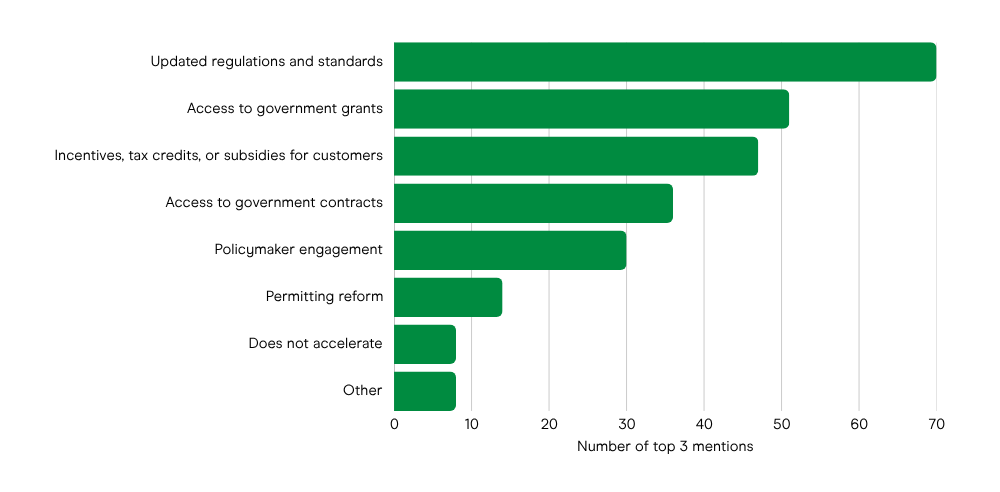
Despite a shifting landscape of federal regulations, tariffs, and incentives, companies still see policy as a way to move faster. 97% of survey respondents identified at least one way that policy could accelerate their business over the next three years.
Financial incentives—like access to government grants, tax credits, and subsidies—ranked as critical opportunities for unlocking innovation, but the top opportunity for impact was updating regulations and standards. A common frustration we hear from companies is that regulations are often written for incumbent technologies, like wind and solar, leaving next-generation solutions excluded from the market or forcing them to fit into rules that were designed for a different era. This can include a range of issues like:
- Connecting more quickly to the grid—a critical process for many energy companies that varies widely across jurisdictions.
- Creating or expanding customer-side incentives to drive community uptake of emerging solutions such as commercial and home energy efficiency technologies.
- Phasing in new trade requirements, like domestic sourcing and manufacturing minimums, more predictably.
Alignment at the federal and local level can help customers buy, investors underwrite, and agencies evaluate new technologies with more confidence.
Rank the top three ways you see public policy most accelerating your business in the next 3 years.
2. When public commitments falter, private capital hesitates.
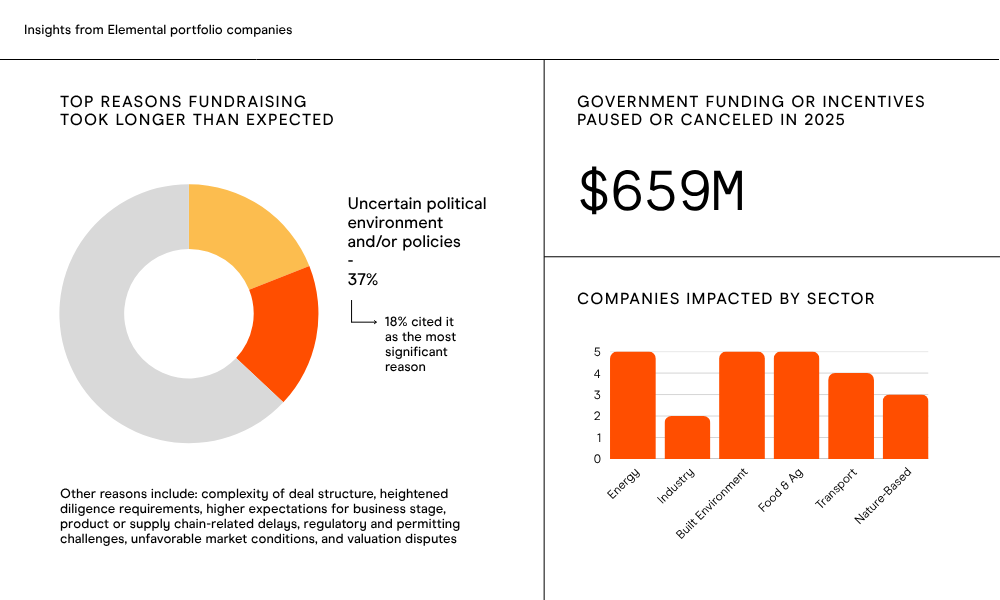
Roughly 90% of companies reported altering expansion plans, fundraising plans, or operations in response to the evolving federal landscape. Translated to dollars, companies reported approximately $659 million in government grants, financing, or incentives rescinded, canceled, or paused in 2025.
Policy volatility has cascading effects. When public commitments become unreliable, companies lose the confidence signal that helps bring private capital to the table. Among companies whose fundraising rounds took longer than anticipated, 37% cited political or policy uncertainty as one of the primary reasons for the delay, and 18% cited it as the most significant reason.
While some broader industry surveys report even greater impacts, Elemental’s portfolio is not concentrated in industries like wind and solar that experienced significant disruption. Regardless, canceled awards eliminated a critical source of commercialization funding and created existential pressure across our portfolio companies.
3. Momentum is shifting toward state and local pathways.
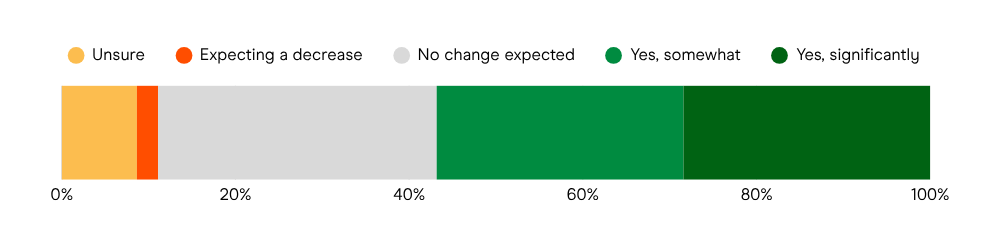
Federal policy may set the broader conditions, but projects ultimately get built in local communities. As federal programs become less predictable, companies are placing greater emphasis on opportunities closer to home. More than half of Elemental portfolio companies expect to increase engagement with state and local governments over the next three years.
Do you anticipate increasing your company’s engagement with U.S. state and local governments on policy-related matters over the next ~3 years?
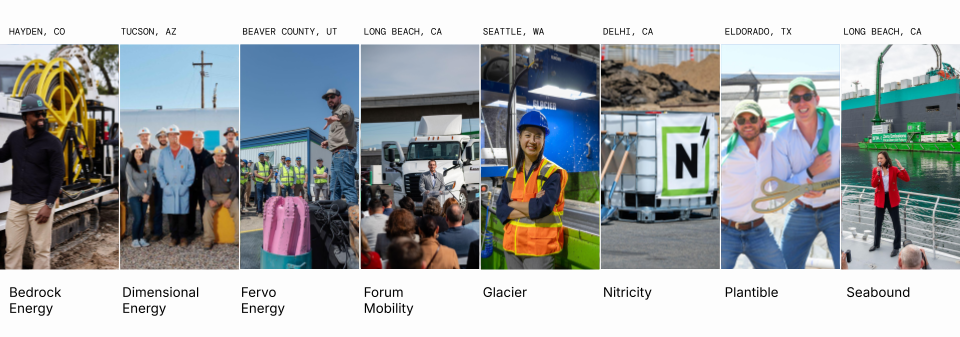
This aligns with the general renewed focus on community-based momentum that we saw in 2025. One standout example is Plantible. Last year, we worked closely with their team to prepare for a local hearing with the Texas Parks and Wildlife Department aimed at removing a highly-productive duckweed strain from Texas’s banned exotic species list so they could cultivate it at scale. Their local relationships and community enrichment efforts became central to their success in convincing a highly skeptical panel to see the value, not only of the plant, but of the role that Plantible plays in the Schleicher County, Texas community, which has seen a 60% increase in the median income since their arrival.
4. U.S trade policy is reshaping costs and supply chains.
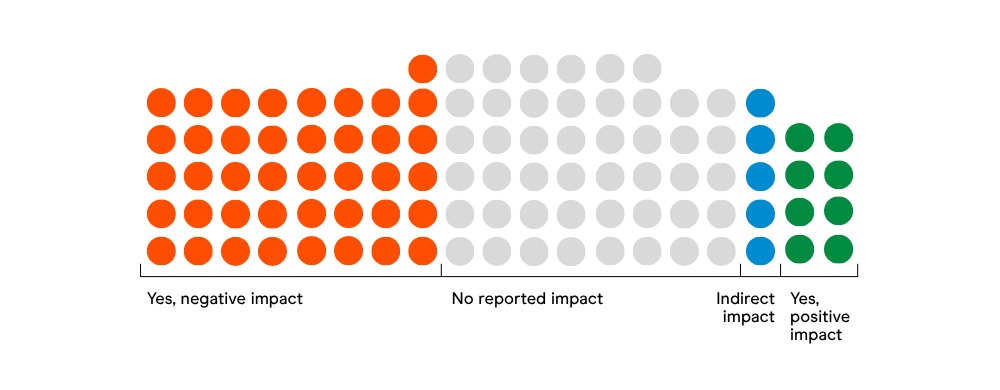
42% of respondents said trade changes had a negative effect on their business due to higher costs, supply-chain adjustments, delayed customer decisions, or reduced competitiveness. Many of these companies are working quickly to shore up new domestic manufacturing for everything from EV charging hardware, to critical production equipment, electronics, and other key operational inputs. But domestic manufacturing is not an overnight solution—companies need clear timelines, realistic transition rules, and support to make them a reality.
At the same time, the effects were not uniformly negative. A small number of companies reported new opportunities driven by the increased focus on local manufacturing and production—particularly companies working to produce essential materials, such as critical minerals, domestically.
Have recent tariffs or changes in trade policy affected your operations, costs, pricing, or growth plans over the past year? If so, how?
5. Permitting is not a universal challenge—but it can be a decisive one.
While only 16% of respondents ranked broad permitting reform among their top three policy priorities, more than twice as many said regulatory or permitting assistance would help them reach their next commercial milestone. Comprehensive permitting reform remains essential if the U.S. is going to build infrastructure at the pace and scale required. For the companies in our portfolio, however, the more immediate need is often hands-on support navigating existing requirements so individual projects can keep moving while broader reforms take shape.
For climate tech companies, siting and permitting can be the deciding factor for whether a project happens or not. For example, Ebb Carbon’s Project Macoma became the first marine carbon removal project to secure a Clean Water Act permit under the National Pollutant Discharge Elimination System (NPDES). The company spent years working with local Tribes, regulators, and the community to earn approval, demonstrating that early engagement and clear permitting pathways can unlock first-of-a-kind projects while maintaining rigorous environmental protections.
Across each of these themes, one thing remained true. Entrepreneurs are pushing through policy uncertainty by doing what they do best: adapting their strategies, strengthening local partnerships, and finding new pathways to market.
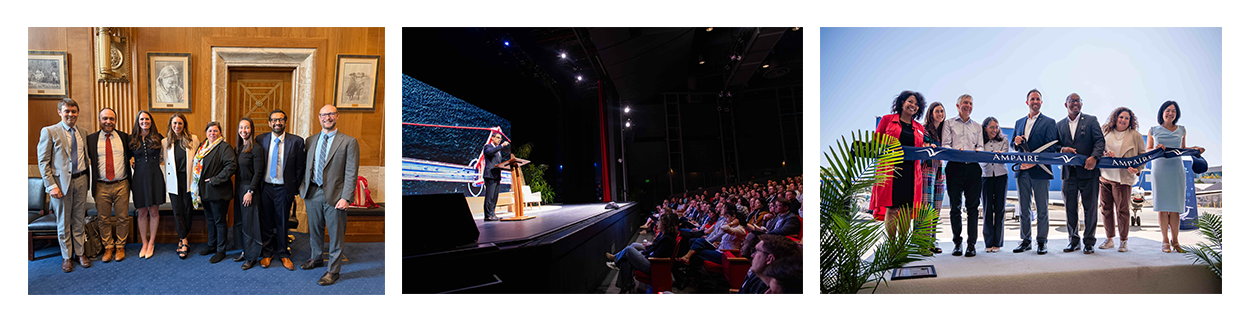
At Elemental, this has been a critical moment to lean in. We’ve been working alongside our portfolio companies to bring their real-world experiences into policy conversations on Capitol Hill, as well as with state and local governments in places like Texas, Utah, and Washington State. What has emerged is a genuine bipartisan interest to understand what it takes to deploy critical technologies into communities, and deliver the new jobs, higher wages, lower energy costs, and greater resilience that can come with them.
We are also providing founders and teams with the tailored support they need to do the work: preparing for meetings with policymakers, partnering on events that build buy-in with local decision makers, enabling partnerships for local workforce development, and more.
“Elemental’s helped us turn a complicated regulatory hurdle into a practical engagement plan, with clear priorities, stronger messaging, and the right stakeholders at the table. Their support was instrumental in helping us achieve a policy win that removed a meaningful barrier to deployment.” – Tony Martens, Co-Founder & CEO, Plantible Foods
Together, we are working hard to build the conditions for these game-changing climate technologies to keep moving forward, even amid regulatory uncertainty.
___
About the data: These findings draw from Elemental’s 2025 annual portfolio survey, which included responses from 97 companies. Response totals vary by question based on relevance, survey logic, and nonresponse.
The post How Policy Uncertainty Is Shaping Climate Innovation appeared first on Elemental Impact.


