

Solar and wind’s share of Latin America’s energy generation mix continues to grow, with renewables comprising roughly 80% of newly installed power generation capacity in 2025. Increasingly frequent droughts, rising demand for grid stability, and the continued decline of solar generation costs have driven countries in the region to embrace clean power. However, as more solar and wind is deployed, the requirements for frequency regulation, operating reserves, and grid stability have increased.
Brazil remains the largest solar market in Latin America, while Chile stands out as the region’s most mature market for energy storage. At the same time, Mexico, Colombia, and Argentina continue to drive renewable energy market growth through government policy and the advancement of utility-scale projects.
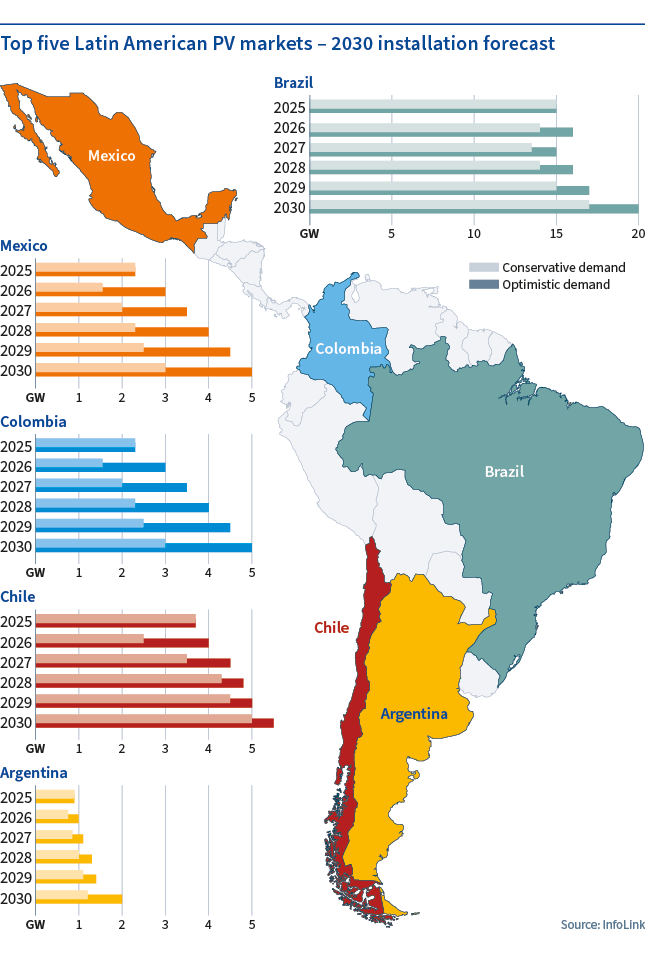
PV demand in Latin America reached approximately 30 GW in 2025, up around 9% year on year. For the near future, demand is forecast to decline to 27 GW in 2026 due to grid capacity and feeder constraints in several countries. Despite this short-term slowdown, annual regional PV demand is still expected to reach 42 GW to 54 GW by 2030, supported by energy transition policies, growing electricity demand, and increasing corporate renewable electricity procurement.
Brazil
Brazil is Latin America’s largest PV market, with the region’s most mature distributed-generation (DG) segment. As of the end of June 2026, DG accounted for approximately 68% of the country’s cumulative installed PV capacity.
An update to Brazil’s distribution and generation regulations in 2022 (Law No. 14,300/2022) led to a revision of the country’s rooftop PV net metering, requiring users to pay a growing share of distribution network charges. Projects that submitted applications earlier remain eligible for more favorable terms, which triggered a significant installation rush during 2022 to 2023.
As distribution charges have been rising year by year, growth in distributed PV demand has gradually slowed. Brazil’s PV demand reached approximately 15 GW in 2025 and is projected to decline slightly to 14 GW in 2026, while still accounting for more than 50% of total Latin American demand.
To reduce the fiscal burden, the Brazilian government proposed some regulatory restructuring (Provisional Measure No. 1,304/2025) as part of its energy market reform. The measure plans to impose a spending cap on the Energy Development Account (Conta de Desenvolvimento Energético, CDE) and introduce the Supplementary Resources Charge (Encargo de Complemento de Recursos, ECR), gradually shifting part of the energy transition costs to subsidized consumers.
Growth in the heavily subsidy-dependent distributed PV market is projected to slow further from the second half of 2026 through 2027. Even so, thanks to corporate power purchase agreements (CPPAs) supported by the gradual development of utility-scale ground-mounted PV projects and the energy storage market, Brazil’s long-term renewable energy growth outlook remains unchanged, with PV demand still expected to reach 17 GW to 20 GW by 2030.
Mexico
Mexico was recently considered one of Latin America’s most promising PV markets, but the country’s PV demand has fluctuated notably in recent years due to energy policy shifts and changes in administration. Supported by strong solar resources and its proximity to US supply chains, Mexico continues to see growth in commercial and industrial (C&I) electricity demand, driven by industrial regions in the north and along the US-Mexico border. Corporate renewable power procurement also provides long-term support for the PV market.
In contrast, after the previous administration led by President Andrés Manuel López Obrador strengthened the dominant role of the state-owned utility Comisión Federal de Electricidad (CFE), investment in some private renewable energy projects and grid development slowed, constraining the advancement of utility-scale PV projects and limiting energy storage market growth. Mexico also still lacks a comprehensive energy storage market mechanism and regulatory framework. Current applications are mainly concentrated in C&I backup power, small-scale solar-plus-storage systems, and demonstration projects, with large-scale grid-level deployment yet to begin.
To improve the investment environment, President Claudia Sheinbaum introduced the revised Electricity Sector Law (Ley del Sector Eléctrico) and related energy reforms in January 2025. While maintaining CFE’s dominant role, the reforms reopened selected private and mixed-investment models and expanded participation opportunities for renewable energy projects. Increased industrial electricity demand and growing corporate renewable electricity procurement continue to support a positive market outlook.
On June 5, 2026, Mexico’s CFE announced the results of the first tender under the mixed development schemes (Esquemas Mixtos), covering roughly 7.4 GW (AC) of capacity. Solar accounted for around 6.7 GW (AC), or nearly 90% of the total, indicating the continued push to advance utility-scale PV development. Mexico’s PV demand reached approximately 2.4 GW in 2025 and is projected to increase to 3.5 GW to 5 GW by 2030.
Chile
Chile is among Latin America’s most mature PV markets. Supported by the exceptional solar resources of the Atacama Desert in northern Chile, utility-scale ground-mounted PV has expanded rapidly. PV demand reached approximately 3.7 GW in 2025 and is projected to increase to 5 GW to 5.5 GW annually by 2030. Given the country’s highly liberalized electricity market and substantial mining-sector power demand, CPPAs and utility-scale power plants have become the primary sources of demand.
Chile was an early mover on the policy front, having enacted clean power legislation in 2008 (Law 20.257) to establish a quota system for non-conventional renewable energy (NCRE). In 2013, Chile passed legislation to raise the NCRE (renewables excluding big hydro) generation target to 20% by 2025 (Law 20.698).
Since then, the government has continued to advance the phaseout of coal-fired power plants and the country’s 2050 carbon neutrality target, which has driven sustained growth in renewable energy investment. In recent years, an increasing number of utility-scale PV projects have incorporated energy storage systems to mitigate solar curtailment and improve peak–off-peak balancing. Although some regions continue to face transmission congestion and power curtailment, Chile remains one of Latin America’s most advanced PV and energy storage markets, supported by its well-established market mechanisms and energy policies.
Colombia
Compared with Brazil and Chile, Colombia’s PV market got off to a later start but has more recently seen an uptick in growth. Given the country’s long-standing reliance on hydropower, the government has actively promoted energy diversification in response to a changing climate and frequent water shortages, making solar a key pillar of its energy transition. The market is currently dominated by utility-scale ground-mounted projects, while markets for rooftop PV and energy-communities remain in the early stages of development, offering substantial long-term growth potential.
On the policy front, Colombia has continued to attract private investment through renewable energy auctions, tax incentives, and transmission and distribution reforms. The government has proposed restrictions on new oil and gas exploration and accelerated the energy transition, targeting a 50% share of NCRE by 2030 and carbon neutrality by 2050. Colombia’s PV demand reached approximately 2.3 GW in 2025 and is projected to increase to 3 GW to 5 GW by 2030, making it one of Latin America’s faster-growing emerging markets.
Notably, compared with more mature markets such as Brazil and Chile, Colombia’s renewable energy penetration remains relatively limited, while grid infrastructure, transmission and distribution capacity, and market mechanisms still require improvement. Energy storage deployment is therefore concentrated in demonstration projects, small-scale grid-support applications, and remote-area microgrids, with a large-scale market yet to take shape.
Next phase
Together, these four markets account for nearly 80% of total PV demand in Latin America and serve as the primary drivers of regional market development, while other countries continue to advance PV deployment. Notably, Latin American PV demand growth is expected to slow in 2026 due to insufficient grid capacity, delays in transmission and distribution development, and grid connection constraints in several countries, indicating that market expansion has gradually outpaced grid infrastructure development.
As renewable energy penetration continues to rise, Latin America’s renewable energy market is transitioning from a phase centered primarily on capacity additions to one focused on grid integration and system optimization. Future growth will increasingly depend on energy storage deployment, upgrades to transmission and distribution infrastructure, and stronger grid dispatch capabilities to support higher levels of renewable energy integration.
Over the medium to long term, the region’s fundamental growth drivers – including energy transition policies, corporate renewable electricity procurement, and rising electricity demand – remain intact. As countries continue to strengthen grid infrastructure and refine market mechanisms, Latin America’s renewable energy market is expected to retain solid growth potential and remain a key growth region for global renewable energy investment.
About the author

Jenny Lin, an associate analyst in InfoLink Consulting’s solar department, focuses on global solar supply chain research with an emphasis on the wafer segment. Her responsibilities include tracking strategic shifts, pricing trends, and utilization rates among manufacturers to deliver market intelligence that supports corporate decision-making. Lin closely monitors emerging solar markets in the Middle East, Latin America, and Africa, conducting research on regional policies, tender progress, and project development.
The post PV Progress across Latin America appeared first on pv magazine Global.


