
When highly pathogenic H5N1 avian influenza spread into U.S. dairy cattle, it raised the pressing question for farmers and regulators: what happens when virus‑contaminated dairy manure is spread on fields?
That’s the focus of new research led by Dr. Tucker Burch of the USDA Agricultural Research Service.
Why it matters
Poultry farms have tested positive shortly after nearby dairies spread manure. Nobody has proven a link, and proving one requires knowing whether viruses actually travel in the aerosol when a tanker is running.
Why the lagoon became the question
Burch spoke at an international conference about avian influenza, held in partnership with the University of Guelph. He outlined how viral and fecal bioaerosols are spread during dairy manure application.
“The background here is the spillover of H5N1 into U.S. dairy cattle. This is a very novel challenge for the dairy industry. The virus was shed during this outbreak at very high titer in the milk. A lot of that actually ends up in the manure lagoons,” said Burch.
In a study by Emory University, the avian influenza virus was found at multiple California dairy farms in several locations, including manure lagoons. That raised questions about manure management.
“Because it’s in the lagoon, there were lots of questions that came up,” said Burch. “What do we do with this waste? It needs to get land applied. Do we need to hold onto it for a certain amount of time (or) can it get applied right away? And then, during application, are there any concerns with aerosols drifting away from the application site?”
There was added urgency to these questions after anecdotal reports of poultry farms that tested positive shortly after nearby dairy farms had spread manure. That suggested aerosols could be involved, even if the link hadn’t been proven.
A decade of practice at catching things in the air
Burch works in a joint USDA–USGS laboratory in central Wisconsin that operates closely with the University of Wisconsin Marshfield Agricultural Research Station, which has a dairy farm that milks about 120 cows and raises 400 to 500 heifers. He describes the farm as an ideal research partner.
The research team has relevant experience. Nearly a decade ago, when Wisconsin dairies explored irrigation-based manure spreading using centre pivots and traveling guns, nearby residents worried those systems might spray zoonotic pathogens into the air. Burch’s group sampled the air for micro-organisms to assess risk.
“If you’re collecting air samples to look at micro-organisms, there’s essentially three types of technology. You can impact the organisms on a solid media, you can impinge them in a liquid media, or you can filter them out,” he said.
The process involved cumbersome gear including pumps, generators and extension cords.
“To collect air samples for one hour, we usually spent two hours just moving equipment around.”
In early 2024, as the dairy H5N1 outbreak unfolded, Burch encountered a battery‑operated air sampler made by NovaPrep (the cub sampler) that runs at very high flow rates, which means high concentration of material on a filter.
What turned up inside the barns
His team obtained several units and quickly put them to work at the research farm. Samples were taken in the milking parlour, dairy barn, heifer barn and transition barn for new arrivals, as well as at outdoor locations.
Burch said he quickly learned how easily outdoor controls can be contaminated if placed too close to barns.
Samples were analyzed for a suite of indigenous enteric viruses and for ruminant bacteroides, a bacterial marker in cattle feces. Patterns matched animal age groups.
“We detected a variety of viruses on the farm and found some interesting and sensible correlations with probably the age of the livestock we were sampling,” said Burch.
Bovine polyomavirus was found more often in the milking parlor, and both adenovirus and enterovirus were associated with younger animals.
He said ruminant bacteroides appeared in every indoor air sample, although concentrations varied.
Six metres from the tanker
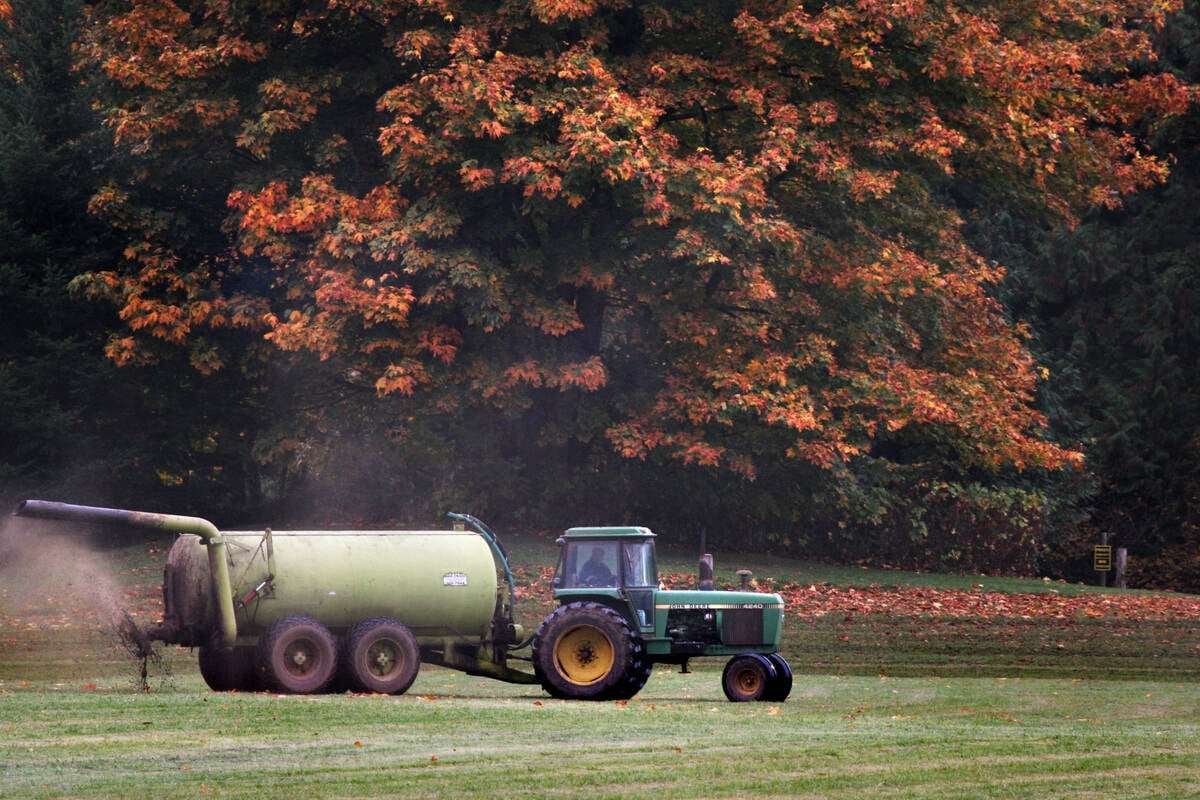
Burch’s team wanted to test air during tanker-based manure application, so it ran a trial in 2025 in an approximately 400‑metre field.
Samplers were set as close as six metres from the spread area. Manure samples from the tankers showed high levels of ruminant bacteroides, bovine adenovirus, coronavirus and enterovirus. In the downwind air, only the bacterial marker (ruminant bacteroidetes) appeared.
Making sure tests are correct
Although tests are more sensitive than they were in the past, there is still concern about adequate virus detection.
Naturally occurring viruses in manure are too sparse and variable to serve as reliable tracers so the team is adding high concentrations E. coli into the tankers and tracking them downwind.
The team is now planning to use coliphage (a type of bacteriophage) as a spiked viral marker in manure tankers.
By adding large quantities of coliphage (approximately 100 quadrillion plaque-forming units of coliphage), they hope to create a detectable signal in downwind air samples, allowing for more powerful assessment of viral aerosolization and transport.
Sampling the lagoon itself
During his presentation, Burch credited Dr. Joseph Heffron, also from the USDA, for this plan B approach. Heffron also spoke at the conference about sampling methods for surveillance of livestock viruses in a dairy manure lagoon, with a particular focus on avian influenza and other enteric viruses.
Heffron’s study, also at a University of Wisconsin Marshfield agricultural research station, used a two-stage lagoon system where the primary five-million-litre lagoon overflows into a secondary four-million-litre lagoon.
Sampling strategies included perimeter sampling, centre-of-lagoon sampling using specialized lake samplers, and large-volume filtered samples from the secondary lagoon.
He said lagoons are not only a potential source of environmental contamination when manure is land-applied, but also serve as important monitoring points for assessing herd health.
“This is really the motivation of coming to, and this is the question that I want to answer, is how do we get from something that is tens of millions of litres down to six microlitres of template that we put into our PCR (polymerase chain reaction),” he said.
While the recent study remains ongoing, key data findings so far include:
What the lagoon sampling shows so far
- Sample the interior, not the edge. Virus concentrations are consistently higher in the lagoon interior than at the perimeter, so perimeter sampling alone is not sufficient.
- Do not agitate first. Agitating the lagoon increases fecal bacteria signals but marginally reduces virus detection, so agitation is not helpful when the goal is finding viruses.
- Replicate at every step. Multiple locations, multiple samples and multiple extractions are all important for reliable detection.
Source: Joseph Heffron, USDA Agricultural Research Service
The post Researchers can’t yet tell if viruses drift from manure tankers appeared first on Farmtario.


