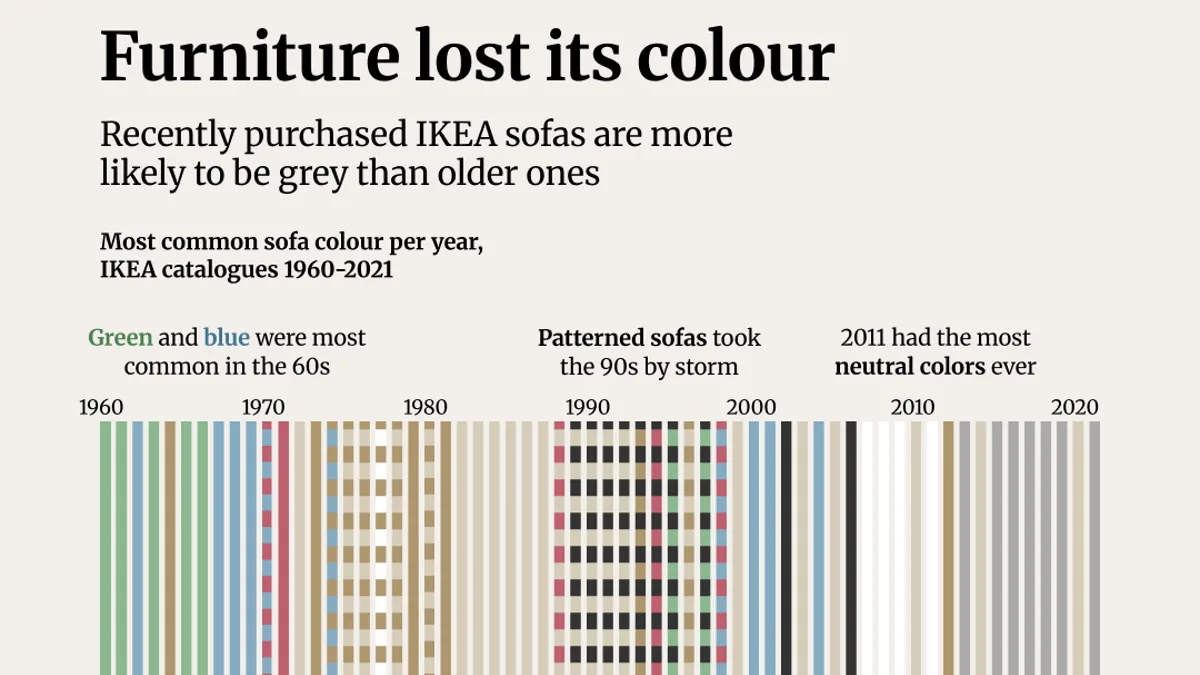
The Color of IKEA Sofas Over Time (1960–2021)
Key Takeaways:
- IKEA catalogs show a shift from colorful sofas in the 1960s toward gray, beige, and white by the 2020s.
- The 1990s stand out for bold patterned upholstery before neutral colors became increasingly common.
- In 2011, IKEA’s catalog featured the most neutral sofa palette in the entire dataset.
IKEA’s catalogs offer a remarkable visual history of changing interior tastes. Created by The European Correspondent using data manually collected from IKEA Catalogues, this visualization tracks the most prominent sofa colors featured each year between 1960 and 2021.
First published in 1951, the IKEA catalog went on to become one of the world’s most widely distributed publications. Its decades-long archive provides an unusually rich record of how mainstream furniture styles changed across generations.
From Vibrant Living Rooms to Neutral Spaces
The table below summarizes the dominant sofa colors featured in IKEA catalogs over the past six decades.
| Decade | Colours |
|---|---|
| 1960s |  Green; Green;  Blue; Blue;  Red Red |
| 1970s | Blue; Red;  Beige; Beige;  Brown; Brown;  White White |
| 1980s | Beige; Cream; Tan; Brown; White |
| 1990s |  Black; White; Red; Green; Blue; Beige Black; White; Red; Green; Blue; Beige |
| 2000s | Blue; Black; Beige; White;  Grey Grey |
| 2010s | White; Beige; Grey; Black |
| 2020s | Grey; Beige; White |
Greens and blues were common throughout much of the 1960s before beige, brown, and other warmer tones became more prominent in the 1970s and 1980s. The 1990s brought a burst of plaid and patterned upholstery, while the 2000s marked a shift toward gray, white, black, and beige.
By 2011, the catalog had reached the most neutral point in the dataset. That year sits within a broader shift toward muted sofa colors during the 2000s and 2010s, when white, beige, gray, and black became increasingly prominent.
Over the same period, IKEA expanded from its Scandinavian roots into hundreds of locations worldwide, giving its design language a global audience.
Why Is the World Losing Color?
IKEA furniture is not the only place where neutral colors have become more visible. Similar shifts toward whites, grays, and blacks have appeared in areas ranging from automobiles to architecture and consumer products, suggesting that the sofa trend may be part of a wider change in modern aesthetics.
The popularity of minimalism and Scandinavian design may help explain part of this shift. Both favor simple forms and restrained palettes, while neutral colors are also versatile and easy to combine with different interiors. Related changes in color preferences have also been documented across other areas of design and consumer culture, as explored by The Guardian.
Could Color Make a Comeback?
Design trends rarely move in only one direction. IKEA’s catalog archive includes periods when bold greens, blues, floral prints, and geometric patterns were fashionable, showing how dramatically tastes can change over time.
For now, however, neutral aesthetics remain prominent across furniture, vehicles, architecture, and consumer products. Muted palettes have become a defining feature of contemporary design, including many European design traditions.
Learn More on the Voronoi App
If you enjoyed this visualization, check out 79% Of Cars in the U.S. Are White, Black, Grey, or Silver on the Voronoi app to see how the shift toward neutral colors extends far beyond our living rooms.