
Spider mite infestations are starting to pop up in some soybean and dry bean fields, especially in regions that have missed the recent rains and those fields with a known history of mite infestations.
Where to start scouting
Scouting soybeans and dry beans frequently for mites this time of year is important, as infestations tend to be noticed too late from the road when management was required much earlier.
Mite infestations typically start on the field’s edge, especially close to freshly cut ditch banks and roadsides or next to recently harvested wheat fields. Focus first on field edges and known sandy areas, especially knolls inside the fields. Look for plants that are yellowing or look drought-stressed or sandblasted. Signs of stippling (white or yellow dots) on the upper leaf surface indicate mite feeding.
Turn the leaves over and look for webbing and tiny dots moving around. Using a hand lens helps you to see the actual mites on the undersides of the leaves. Plan to scout fields that you suspect have mites last in your route, so you don’t carry mites into the next field you enter.
When you have hit the threshold
Four or more mites per leaflet or one severely damaged leaf per plant prior to pod fill indicates that control is necessary. The economic threshold is reached if the stippling on the plants looks like Level 3 in the picture below.
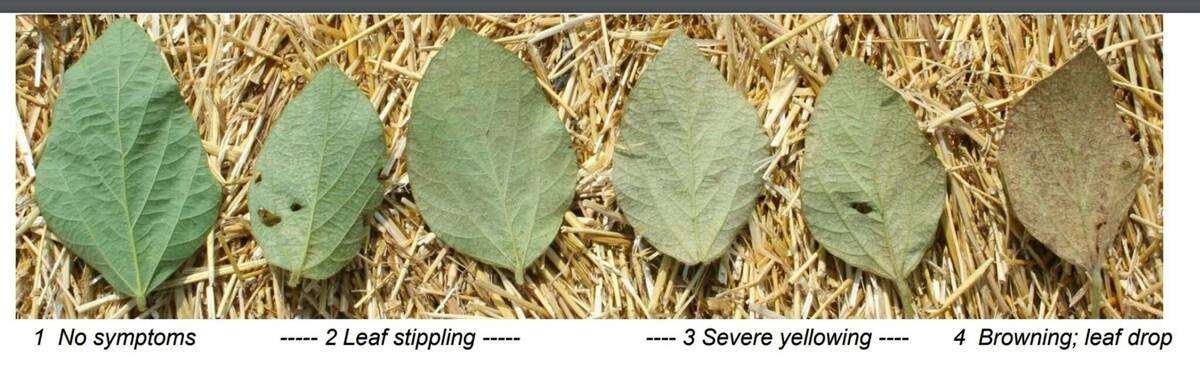
Stippling found on leaves within mid-canopy or above is a sign that mite infestations are reaching threshold. Spot treatments can be effective prior to wind events if mites are only found at the fields’ edge or in a limited number of pockets in the field.
What still works
As for control, dimethoate might work in some fields, but our research with Western University and Agriculture and Agri-Food Canada in London shows many fields have populations that are resistant to Cygon and Lagon.
Through this study, partially funded by Grain Farmers of Ontario and the Ontario Bean Growers, bioassays with mites collected in soybean and dry bean fields across Ontario show the prevalence of dimethoate (Cygon or Lagon) resistance in some regions. Some populations are almost completely resistant, while some are only partially, with only a small percentage of the population surviving when sprayed with dimethoate.
For dry bean fields, Oberon miticide (spiromesifen) is a better choice to use as it is registered on that crop for mite control and only a few populations are starting to become tolerant to that product. Unfortunately, Oberon is not registered for use on soybeans.
New species turning up
As part of the same study at Western, several new spider mite species have been found in fields, with or without two-spotted spider mites (TSSM). Some of these newly detected species were not known to be in Ontario, or at least, were not known to feed on soybeans and dry beans. Four-spotted spider mites (T. turkestani, FSSM) in particular have us concerned.
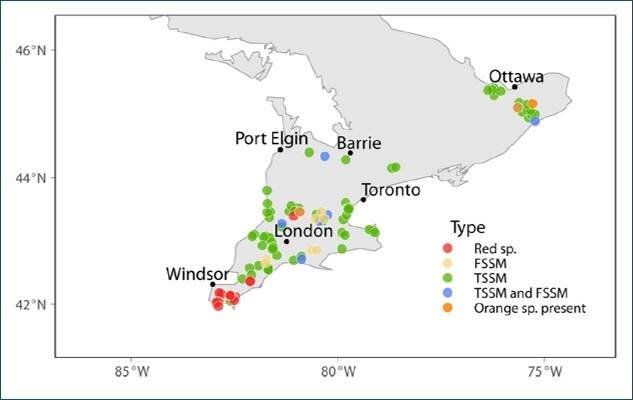
They look very similar to TSSM, but as their name suggests, they have four spots instead of two but seem to cause more severe injury to leaves than TSSM do. A red spider mite has also been found, though we are still waiting to confirm what species they are. The more we learn about mite species dynamics across Ontario, the better we can understand what impact they can have and how to manage them.
As always, more information on products registered for mites is available on the Crop Protection Hub.
This first appeared on fieldcropnews.com.
Tracey Baute is OMAFA’s field crop entomologist.
The post Scout now for spider mites, and don’t count on dimethoate appeared first on Farmtario.


