Ranked: Countries That Hold the Most Reserves in Gold
Key Takeaways
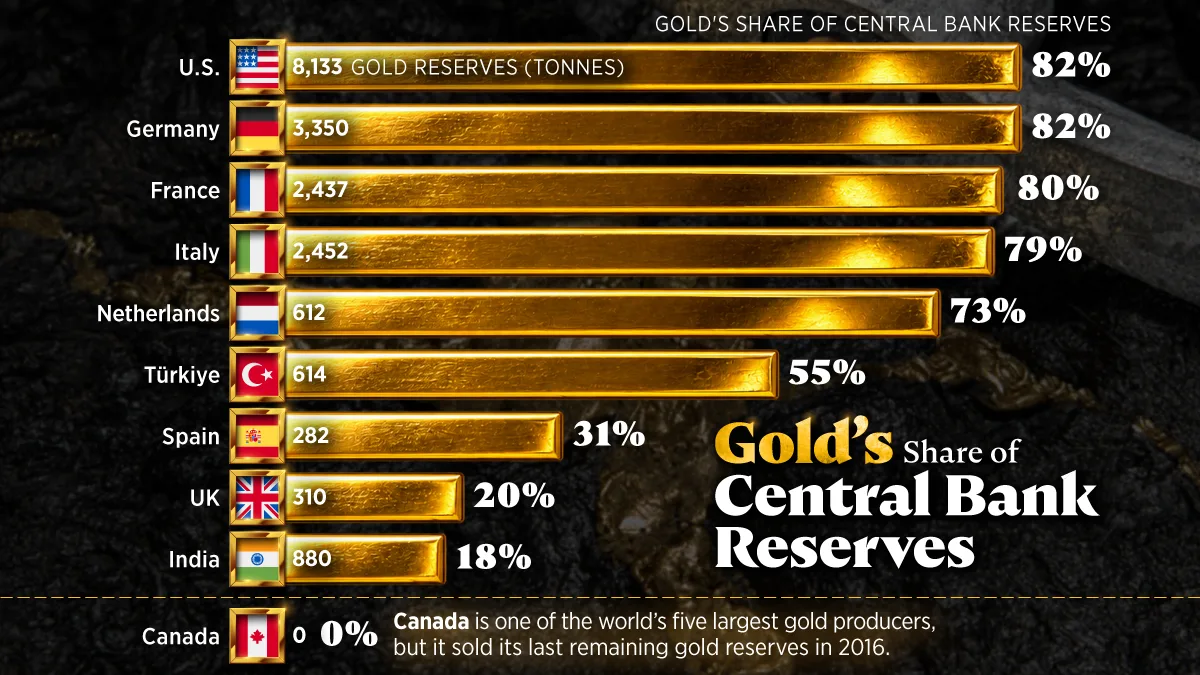
- The U.S. and Germany have the highest gold shares among the selected economies, at 82% of central bank reserves.
- China holds 2,306 tonnes of gold, the fourth-largest amount in this dataset, but gold represents less than 9% of reserves.
- Canada is one of the world’s largest gold producers, yet its central bank holds no gold reserves.
Gold remains a major reserve asset for many of the world’s largest economies, but its weight in national reserves ranges from 0% to over 80%.
This graphic ranks selected economies by the share of their central bank reserves held in gold in 2025. The data for this visualization comes from the World Gold Council, based on December 2025 figures.
Gold Dominates Reserves in the U.S. and Europe
Western economies dominate the top of the ranking.
Four countries have roughly four-fifths of their central bank reserves allocated to gold, while the Netherlands rounds out the top five at 72.9%.
| Economy | Gold Reserves (tonnes) | Share of Reserves (%) |
|---|---|---|
 U.S. U.S. |
8,133 | 82.4 |
 Germany Germany |
3,350 | 82.2 |
 France France |
2,437 | 79.9 |
 Italy Italy |
2,452 | 79.3 |
 Netherlands Netherlands |
612 | 72.9 |
 Turkey Turkey |
614 | 54.6 |
 Spain Spain |
282 | 30.8 |
 UK UK |
310 | 20.3 |
 India India |
880 | 17.7 |
 Australia Australia |
80 | 15.3 |
 Switzerland Switzerland |
1,040 | 13.6 |
 Saudi Arabia Saudi Arabia |
323 | 9.0 |
 Japan Japan |
846 | 8.7 |
 China China |
2,306 | 8.6 |
 Indonesia Indonesia |
86 | 7.7 |
 Brazil Brazil |
172 | 6.8 |
 Mexico Mexico |
120 | 6.6 |
 South Korea South Korea |
104 | 3.4 |
 Canada Canada |
0 | 0.0 |
China Has More Gold, But a Much Smaller Share
China shows why the size of a country’s gold stockpile tells only part of the story. Gold’s share of reserves also depends on the scale and composition of its other reserve assets.
China holds 2,306 tonnes of gold, the fourth-largest amount in this dataset, but gold represents just 8.6% of its reserves.
Japan has a similar share at 8.7%, despite holding 846 tonnes. India stands somewhat higher at 17.7%, with 880 tonnes in official holdings.
Canada Stands Out With Zero Gold Reserves
Canada sits at the bottom of the ranking with no official gold holdings, despite being a major global gold producer.
The country sold its last remaining gold reserves in 2016, leaving gold at 0% of its central bank reserves.
Canada’s decision to eliminate its gold holdings was decades in the making. After the collapse of the Bretton Woods system in the early 1970s, gold no longer played the same role in backing currencies.
Canada gradually shifted its reserves toward foreign government bonds and other financial assets, selling more than 90% of its gold holdings between 1970 and 1980. The federal government formally decided in the early 1980s to continue divesting its gold holdings.
According to Canada’s Department of Finance, high-quality fixed-income securities were considered better suited to the country’s reserve-management objectives because they were more liquid, generated interest income, and reduced volatility compared with gold.
Learn More on the Voronoi App 
If you enjoyed today’s post, check out Ranked: World Currencies vs. the U.S. Dollar in 2026 on Voronoi.