
At Elemental, we’re obsessed with helping founders bridge the Scale Gap. This survey offers a pulse check at what companies are experiencing right now, and what it will take to help them clear the next hurdle. Our biggest takeaway: there is no one-size-fits-all path to scale. Each company faces a different gap based on its technology, sector, stage, and route to market.
This reinforces the need for a broader mix of capital and deployment partners, and reflects the model we’ve built at Elemental: pairing catalytic capital with project expertise and connections to customers, local partners, and investors. This is especially timely as founders look to the data center buildout as a new path to market and need the right partners to turn that demand into real projects.
Repost of: 2026 Founder Survey by CTVC and Elemental Impact
TL;DR
-
- Founders need equity—but equity alone isn’t the right fit. While 70% say equity would most accelerate growth, 73% say traditional VC structures aren’t a good fit, highlighting the importance of a broader mix of capital.
- Technology alone isn’t enough. 26% of founders say technology scale-up is their biggest commercialization challenge (that number jumps to 77% if you’re focusing on pre-commercial companies), while 20% cite customer acquisition, underscoring the need for deployment partners in addition to capital.
- Smaller projects can be the bridge to scale. Half of respondents are financing smaller-scale projects, suggesting that catalytic capital can help technologies prove their solutions through early deployments and unlock larger pools of commercial finance.
Financing Structure
Founders selecting which capital structure would most accelerate their growth
Percent of founders who selected each type of capital structure to most accelerate growth in their top three
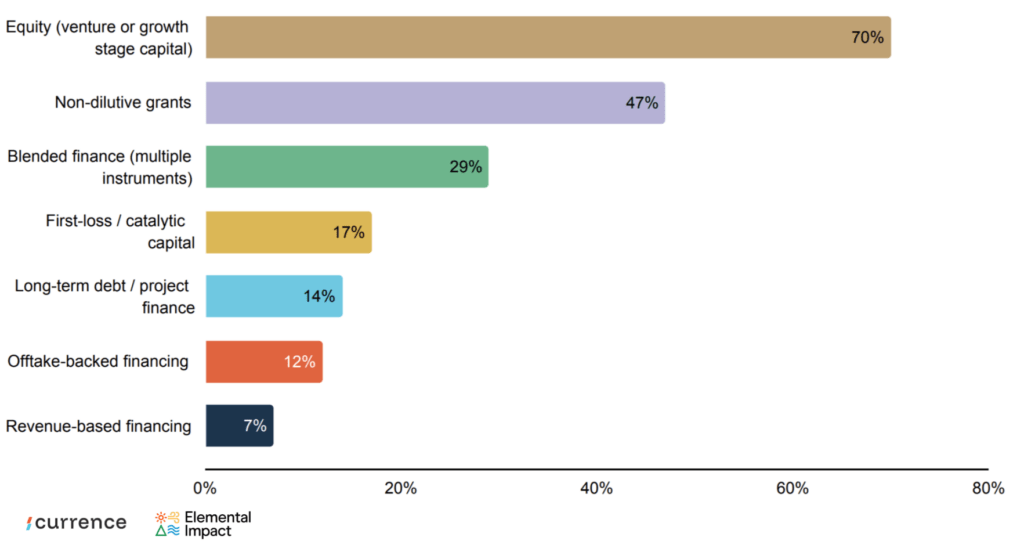
This was a multi-select question (up to 2). Equity is the top answer by a wide margin (70% of founders selected it), but non-dilutive grants (47%) and blended finance (29%) show strong appetite for structures beyond traditional venture.
Founders selecting their top financing challenges
Percent of founders who ranked each challenge in their top three
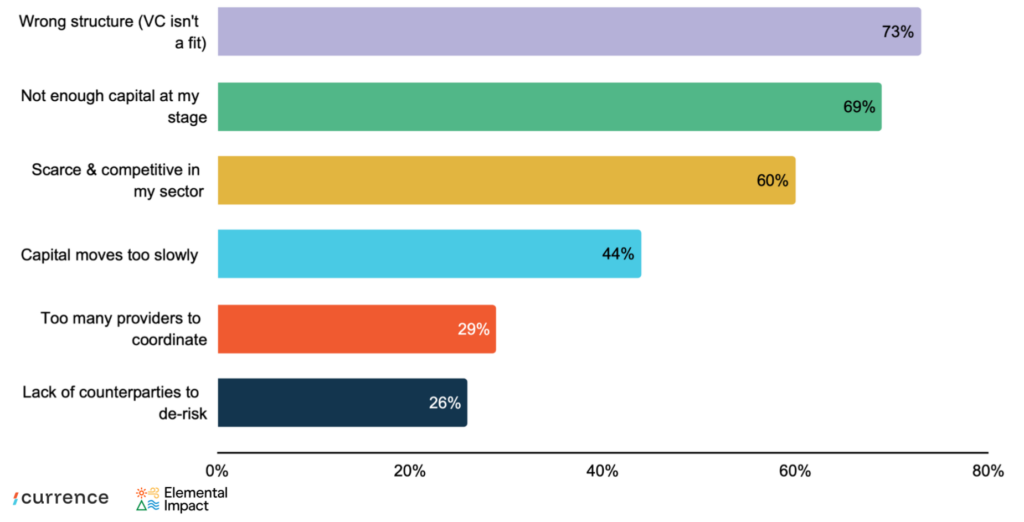
Even though founders will take equity, they consider it the wrong structure. 73% flag capital structure as a top financing challenge, the highest of any barrier, even as 70% say equity is what would most accelerate their growth. VC wasn’t necessarily built for capital-intensive, long-horizon projects.
Different challenges hit as companies scale. “Not enough capital” peaks early; 42% of pre-commercial and 38% of pilot-stage founders name it their #1 challenge, then tapers as companies mature. “Wrong structure” peaks later, at early commercial expansion (35%), and is far less common at pre-commercial (16%) and FOAK (18%).
Climate tech founders’ target raise sizes split by sector
Bubble size by number of founders targeting each raise size, by sector
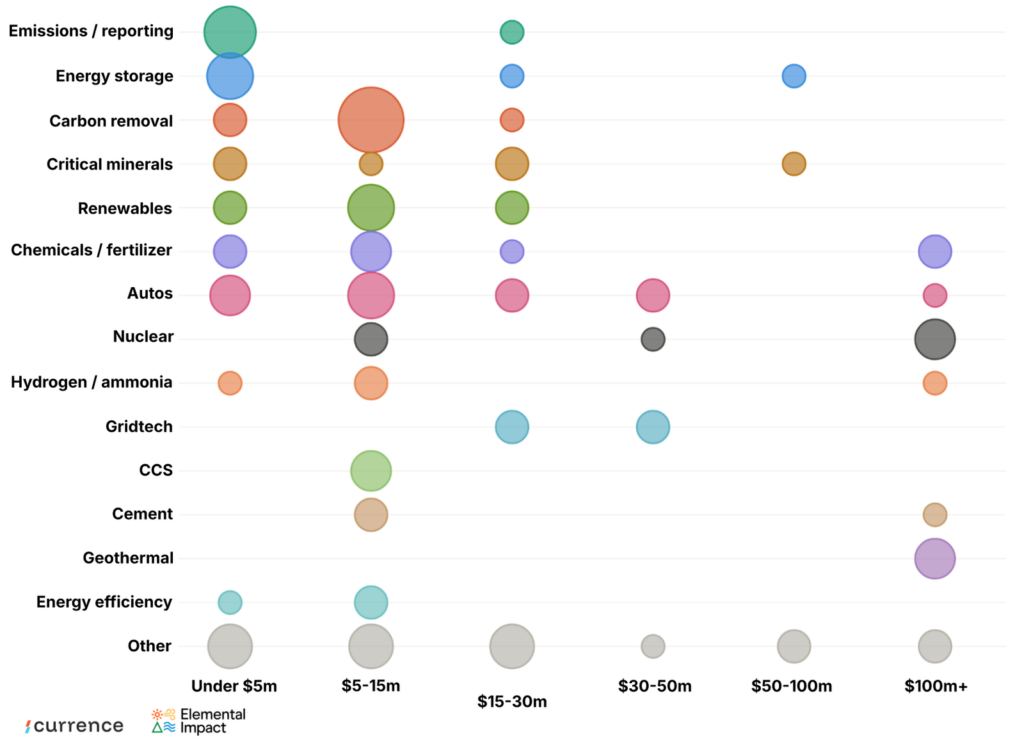
Founders’ fundraising targets reflect where capital is concentrating across the broader market. Nuclear and geothermal companies are more likely to be pursuing $100 million+ raises, consistent with the rise of large investments in energy and other asset-heavy sectors. Meanwhile, emissions and reporting companies cluster toward smaller rounds, reflecting the lower upfront capital needs of more asset-light business models. Together, the responses show how widely financing needs vary across climate tech, and why the sector requires more than one type of capital.
Barriers to Scale
Founders selecting their biggest deployment barrier
Percentage of mentions across non-capital barriers to deployment
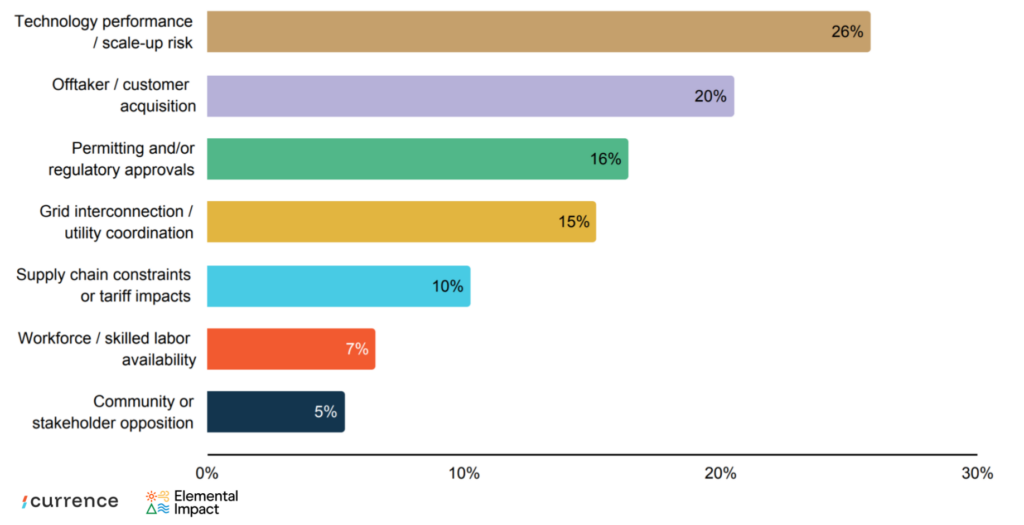
Technology performance / scale-up risk leads at 26% of mentions, followed by offtaker/customer acquisition (20%) and permitting (16%). We’re seeing that execution risk is the main barrier to founders beyond capital. But structural issues like permitting and grid interconnection combined rival it.
The named risk differs by stage, unsurprisingly. Tech/scale-up risk is an even bigger proportion of biggest risk at pre-commercial stage (77%), but falls as companies scale. Customer/offtaker signing as a risk peaks at 52% at the early commercial stage.
Catalytic Capital
Founders want catalytic capital to de-risk the first deployment
Percent of founders selecting each as the most valuable role for philanthropic or catalytic capital
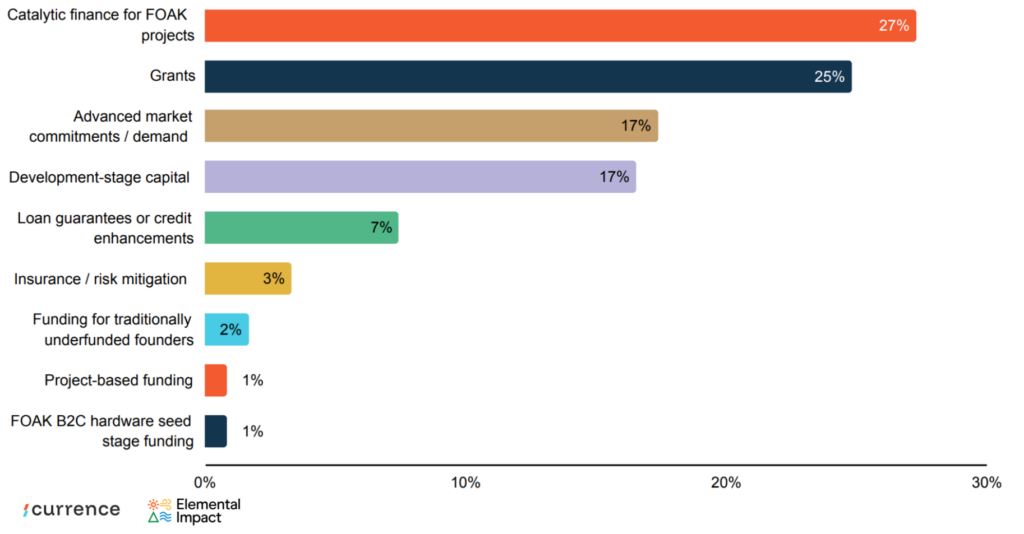
Catalytic finance for FOAK projects (27%) and grants (25%) top the list, with advanced market commitments and pre-FID development capital tied for third (17% each). Founders most want catalytic capital to de-risk real-world deployment.
Founder Sentiment
More founders say project capital access has worsened than improved
Percent of founders rating access to project capital today vs. 12 months ago
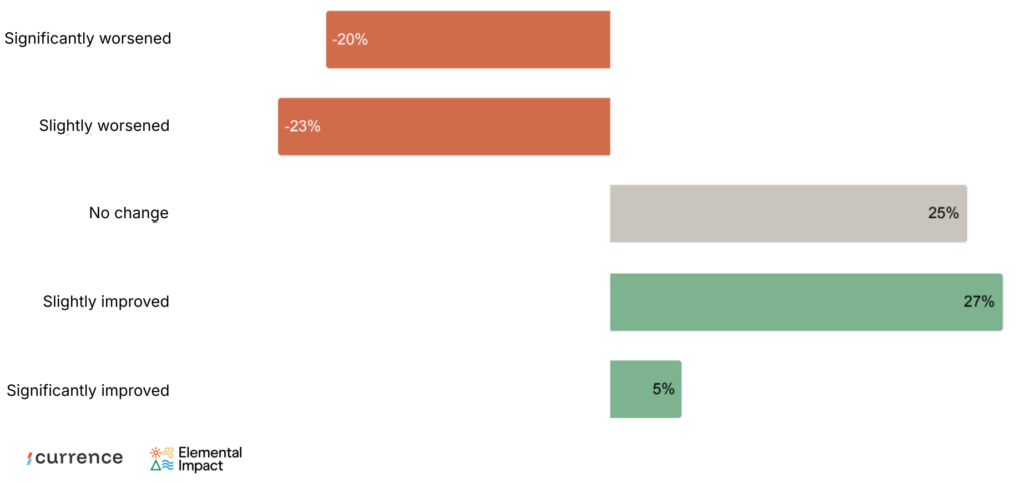
43% of founders say project capital access has worsened over the past year (23% slightly, 20% significantly), versus 32% who say it’s improved. A quarter reports no change.
Net sentiment is negative, but there’s a sharp sector split. Breaking it down further: in nuclear, 83% report improved; In carbon removal, 64% say worsened.
Challenging, volatile, uncertain: founders describe 2026 in one word
One-word answers describing today’s environment
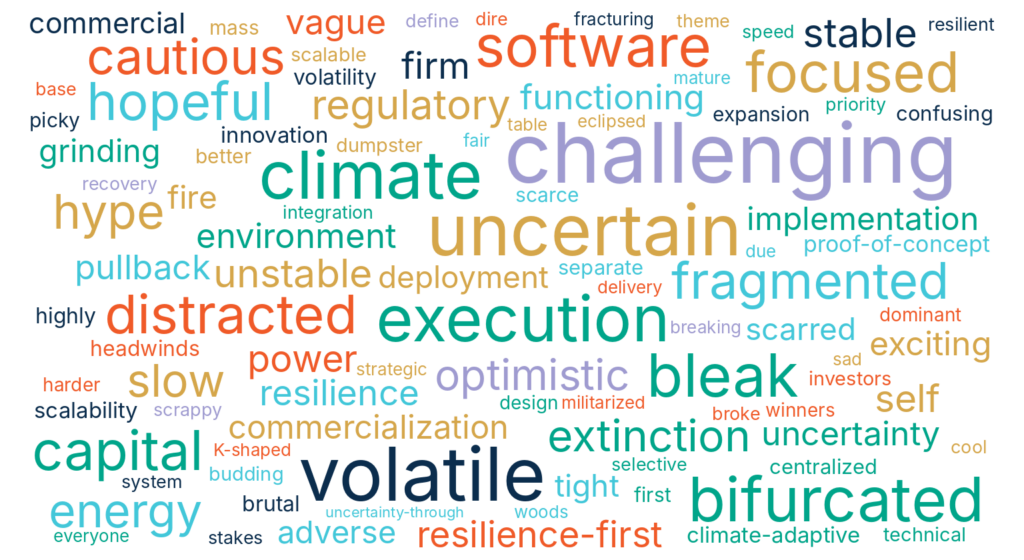
“Challenging” was the single most common response, followed by “volatile,” “uncertain,” and “bleak.”
There were also some positives, including “hopeful” and “execution” to reflect founders’ ability to dig in and pivot where needed despite challenges.
Policy
Carbon pricing and tax credit stability top the policy wish list
Percent of founders selecting each policy development as most likely to accelerate their business
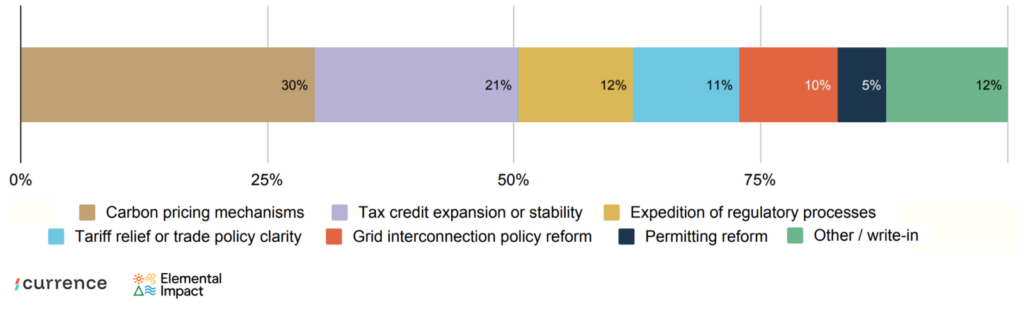
The barriers holding up projects today aren’t necessarily the same issues founders want policymakers to address. Permitting and grid interconnection are among the biggest obstacles founders face on the ground, challenges that are growing as AI and data centers increase demand for power and infrastructure. But founders ranked carbon pricing (30%) and stable tax credits (21%) as their top policy priorities, suggesting that clearer, more predictable market conditions would do more to help projects move forward in this current market.
Read more about how policy uncertainty is shaping climate innovation.
Methodology: All figures are drawn from n=121 respondents to the Currence + Elemental 2026 Founder Survey, data as of 21 July 2026. Percentages for multi-select questions (Q1, Q8, Q11, Q15a) reflect share of total mentions, not share of respondents, and sum to 100% within each question. Every number has been independently verified against the raw response file.
The post 2026 Founder Survey appeared first on Elemental Impact.


